

288
11 Spintronics
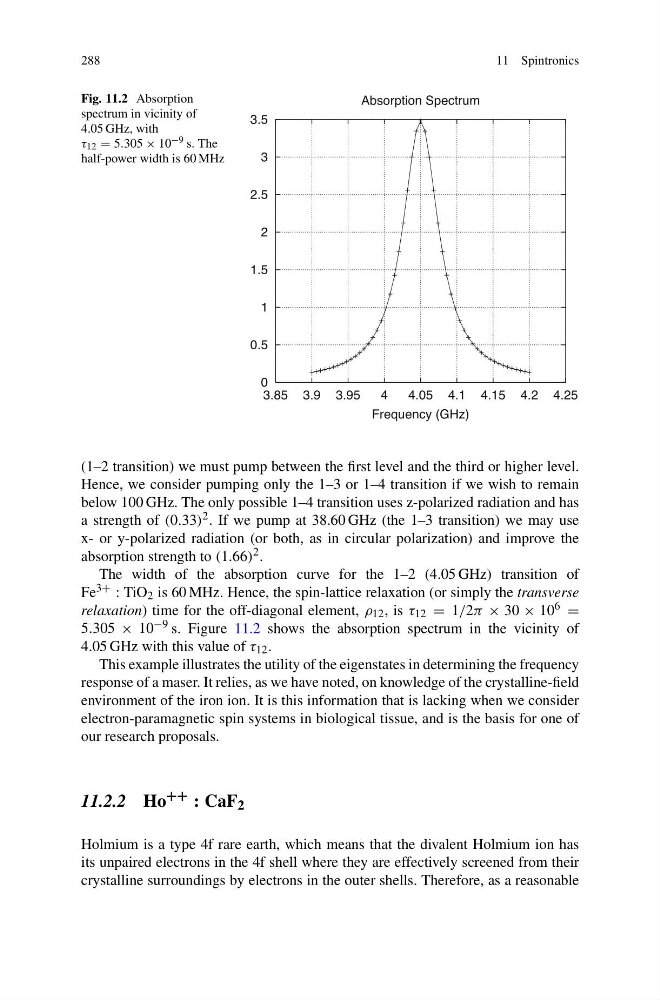
Fig. 11.2 Absorption
spectrum in vicinity of
4.05 GHz, with
τ 12 = 5.305 × 10 −9 s. The
half-power width is 60 MHz
0
0.5
1
1.5
2
2.5
3
3.5
3.85 3.9 3.95
4
4.05 4.1 4.15 4.2 4.25
Frequency (GHz)
Absorption Spectrum
(1–2 transition) we must pump between the first level and the third or higher level.
Hence, we consider pumping only the 1–3 or 1–4 transition if we wish to remain
below 100 GHz. The only possible 1–4 transition uses z-polarized radiation and has
a strength of (0.33) 2 . If we pump at 38.60 GHz (the 1–3 transition) we may use
x- or y-polarized radiation (or both, as in circular polarization) and improve the
absorption strength to (1.66) 2 .
The width of the absorption curve for the 1–2 (4.05 GHz) transition of
Fe 3+ : TiO 2 is 60 MHz. Hence, the spin-lattice relaxation (or simply the transverse
relaxation) time for the off-diagonal element, ρ 12 , is τ 12 = 1/2π × 30 × 10 6 =
5.305 × 10 −9 s. Figure 11.2 shows the absorption spectrum in the vicinity of
4.05 GHz with this value of τ 12 .
This example illustrates the utility of the eigenstates in determining the frequency
response of a maser. It relies, as we have noted, on knowledge of the crystalline-field
environment of the iron ion. It is this information that is lacking when we consider
electron-paramagnetic spin systems in biological tissue, and is the basis for one of
our research proposals.
11.2.2 Ho
++
: CaF 2
Holmium is a type 4f rare earth, which means that the divalent Holmium ion has
its unpaired electrons in the 4f shell where they are effectively screened from their
crystalline surroundings by electrons in the outer shells. Therefore, as a reasonable
11 Spintronics
Fig. 11.2 Absorption
spectrum in vicinity of
4.05 GHz, with
τ 12 = 5.305 × 10 −9 s. The
half-power width is 60 MHz
0
0.5
1
1.5
2
2.5
3
3.5
3.85 3.9 3.95
4
4.05 4.1 4.15 4.2 4.25
Frequency (GHz)
Absorption Spectrum
(1–2 transition) we must pump between the first level and the third or higher level.
Hence, we consider pumping only the 1–3 or 1–4 transition if we wish to remain
below 100 GHz. The only possible 1–4 transition uses z-polarized radiation and has
a strength of (0.33) 2 . If we pump at 38.60 GHz (the 1–3 transition) we may use
x- or y-polarized radiation (or both, as in circular polarization) and improve the
absorption strength to (1.66) 2 .
The width of the absorption curve for the 1–2 (4.05 GHz) transition of
Fe 3+ : TiO 2 is 60 MHz. Hence, the spin-lattice relaxation (or simply the transverse
relaxation) time for the off-diagonal element, ρ 12 , is τ 12 = 1/2π × 30 × 10 6 =
5.305 × 10 −9 s. Figure 11.2 shows the absorption spectrum in the vicinity of
4.05 GHz with this value of τ 12 .
This example illustrates the utility of the eigenstates in determining the frequency
response of a maser. It relies, as we have noted, on knowledge of the crystalline-field
environment of the iron ion. It is this information that is lacking when we consider
electron-paramagnetic spin systems in biological tissue, and is the basis for one of
our research proposals.
11.2.2 Ho
++
: CaF 2
Holmium is a type 4f rare earth, which means that the divalent Holmium ion has
its unpaired electrons in the 4f shell where they are effectively screened from their
crystalline surroundings by electrons in the outer shells. Therefore, as a reasonable