

11.2 Paramagnetic Spin Dynamics and the Spin Hamiltonian
287
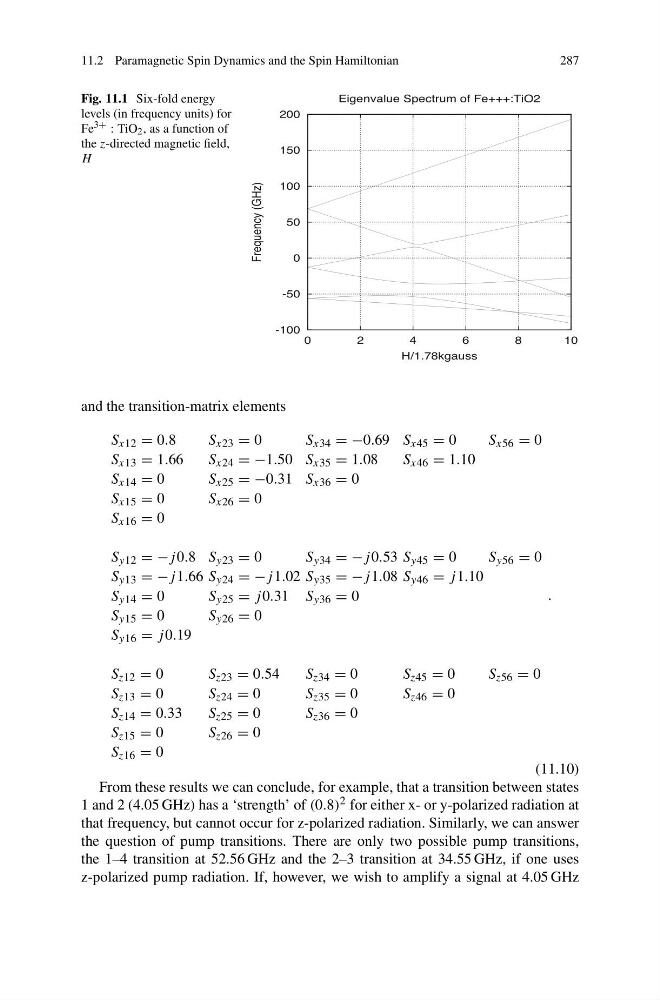
Fig. 11.1 Six-fold energy
levels (in frequency units) for
Fe
3+ : TiO 2 , as a function of
the z-directed magnetic field,
H
-100
-50
0
50
100
150
200
0
2
4
6
8
10
Frequency (GHz)
H/1.78kgauss
Eigenvalue Spectrum of Fe+++:TiO2
and the transition-matrix elements
S x12 = 0.8
S x23 = 0
S x34 = −0.69 S x45 = 0
S x56 = 0
S x13 = 1.66
S x24 = −1.50 S x35 = 1.08
S x46 = 1.10
S x14 = 0
S x25 = −0.31 S x36 = 0
S x15 = 0
S x26 = 0
S x16 = 0
S y12 = −j 0.8 S y23 = 0
S y34 = −j 0.53 S y45 = 0
S y56 = 0
S y13 = −j 1.66 S y24 = −j 1.02 S y35 = −j 1.08 S y46 = j 1.10
S y14 = 0
S y25 = j 0.31 S y36 = 0
S y15 = 0
S y26 = 0
S y16 = j 0.19
S z12 = 0
S z23 = 0.54
S z34 = 0
S z45 = 0
S z56 = 0
S z13 = 0
S z24 = 0
S z35 = 0
S z46 = 0
S z14 = 0.33
S z25 = 0
S z36 = 0
S z15 = 0
S z26 = 0
S z16 = 0
.
(11.10)
From these results we can conclude, for example, that a transition between states
1 and 2 (4.05 GHz) has a ‘strength’ of (0.8) 2 for either x- or y-polarized radiation at
that frequency, but cannot occur for z-polarized radiation. Similarly, we can answer
the question of pump transitions. There are only two possible pump transitions,
the 1–4 transition at 52.56 GHz and the 2–3 transition at 34.55 GHz, if one uses
z-polarized pump radiation. If, however, we wish to amplify a signal at 4.05 GHz
287
Fig. 11.1 Six-fold energy
levels (in frequency units) for
Fe
3+ : TiO 2 , as a function of
the z-directed magnetic field,
H
-100
-50
0
50
100
150
200
0
2
4
6
8
10
Frequency (GHz)
H/1.78kgauss
Eigenvalue Spectrum of Fe+++:TiO2
and the transition-matrix elements
S x12 = 0.8
S x23 = 0
S x34 = −0.69 S x45 = 0
S x56 = 0
S x13 = 1.66
S x24 = −1.50 S x35 = 1.08
S x46 = 1.10
S x14 = 0
S x25 = −0.31 S x36 = 0
S x15 = 0
S x26 = 0
S x16 = 0
S y12 = −j 0.8 S y23 = 0
S y34 = −j 0.53 S y45 = 0
S y56 = 0
S y13 = −j 1.66 S y24 = −j 1.02 S y35 = −j 1.08 S y46 = j 1.10
S y14 = 0
S y25 = j 0.31 S y36 = 0
S y15 = 0
S y26 = 0
S y16 = j 0.19
S z12 = 0
S z23 = 0.54
S z34 = 0
S z45 = 0
S z56 = 0
S z13 = 0
S z24 = 0
S z35 = 0
S z46 = 0
S z14 = 0.33
S z25 = 0
S z36 = 0
S z15 = 0
S z26 = 0
S z16 = 0
.
(11.10)
From these results we can conclude, for example, that a transition between states
1 and 2 (4.05 GHz) has a ‘strength’ of (0.8) 2 for either x- or y-polarized radiation at
that frequency, but cannot occur for z-polarized radiation. Similarly, we can answer
the question of pump transitions. There are only two possible pump transitions,
the 1–4 transition at 52.56 GHz and the 2–3 transition at 34.55 GHz, if one uses
z-polarized pump radiation. If, however, we wish to amplify a signal at 4.05 GHz