

10.3 The Eight-Layer Inversion Algorithm
253
0.05
0.055
0.06
0.065
0.07
0.075
0.08
0.085
0.09
9.5 9.55 9.6 9.65 9.7 9.75 9.8 9.85 9.9 9.95 10
Resistance (Ohms)
Frequency (E10)
Frequency Response of Probe in Freespace
’freespace_SF.dat’ using 1:2
107
108
109
110
111
112
113
114
9.5 9.55 9.6 9.65 9.7 9.75 9.8 9.85 9.9 9.95 10
Reactance (Ohms)
Frequency (E10)
Frequency Response of Probe in Freespace
’freespace_SF.dat’ using 1:3
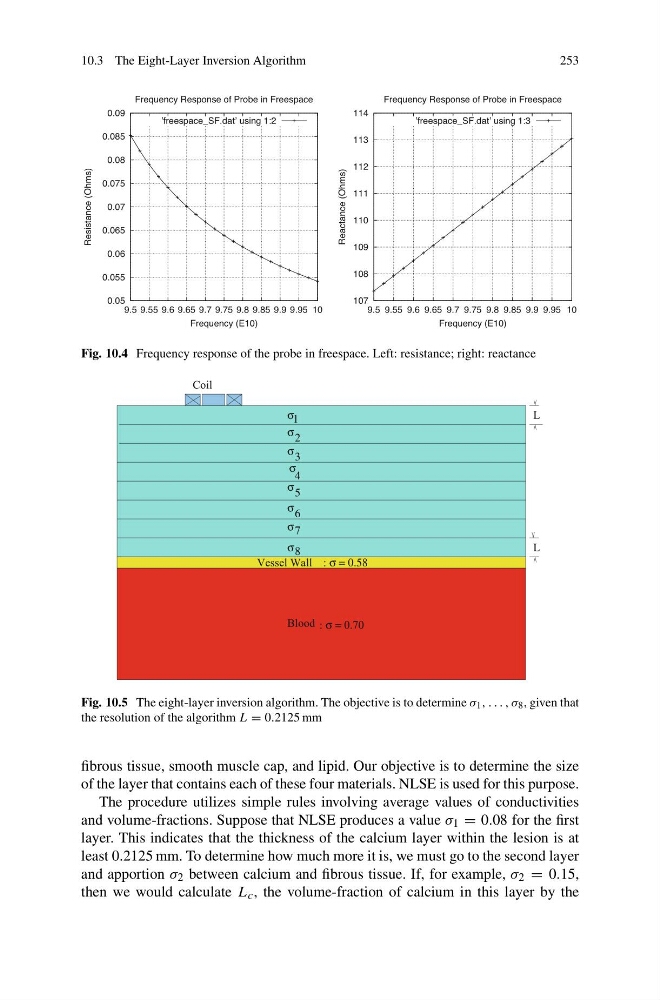
Fig. 10.4 Frequency response of the probe in freespace. Left: resistance; right: reactance
Vessel Wall
Coil
L
σ 1
σ
σ
σ
σ
σ
σ
σ
7
8
L
2
3
4
5
6
Blood : σ = 0.70
: σ = 0.58
Fig. 10.5 The eight-layer inversion algorithm. The objective is to determine σ 1 , . . . , σ 8 , given that
the resolution of the algorithm L = 0.2125 mm
fibrous tissue, smooth muscle cap, and lipid. Our objective is to determine the size
of the layer that contains each of these four materials. NLSE is used for this purpose.
The procedure utilizes simple rules involving average values of conductivities
and volume-fractions. Suppose that NLSE produces a value σ 1 = 0.08 for the first
layer. This indicates that the thickness of the calcium layer within the lesion is at
least 0.2125 mm. To determine how much more it is, we must go to the second layer
and apportion σ 2 between calcium and fibrous tissue. If, for example, σ 2 = 0.15,
then we would calculate L c , the volume-fraction of calcium in this layer by the
253
0.05
0.055
0.06
0.065
0.07
0.075
0.08
0.085
0.09
9.5 9.55 9.6 9.65 9.7 9.75 9.8 9.85 9.9 9.95 10
Resistance (Ohms)
Frequency (E10)
Frequency Response of Probe in Freespace
’freespace_SF.dat’ using 1:2
107
108
109
110
111
112
113
114
9.5 9.55 9.6 9.65 9.7 9.75 9.8 9.85 9.9 9.95 10
Reactance (Ohms)
Frequency (E10)
Frequency Response of Probe in Freespace
’freespace_SF.dat’ using 1:3
Fig. 10.4 Frequency response of the probe in freespace. Left: resistance; right: reactance
Vessel Wall
Coil
L
σ 1
σ
σ
σ
σ
σ
σ
σ
7
8
L
2
3
4
5
6
Blood : σ = 0.70
: σ = 0.58
Fig. 10.5 The eight-layer inversion algorithm. The objective is to determine σ 1 , . . . , σ 8 , given that
the resolution of the algorithm L = 0.2125 mm
fibrous tissue, smooth muscle cap, and lipid. Our objective is to determine the size
of the layer that contains each of these four materials. NLSE is used for this purpose.
The procedure utilizes simple rules involving average values of conductivities
and volume-fractions. Suppose that NLSE produces a value σ 1 = 0.08 for the first
layer. This indicates that the thickness of the calcium layer within the lesion is at
least 0.2125 mm. To determine how much more it is, we must go to the second layer
and apportion σ 2 between calcium and fibrous tissue. If, for example, σ 2 = 0.15,
then we would calculate L c , the volume-fraction of calcium in this layer by the