

8
1 A Bilinear Conjugate-Gradient Inversion Algorithm
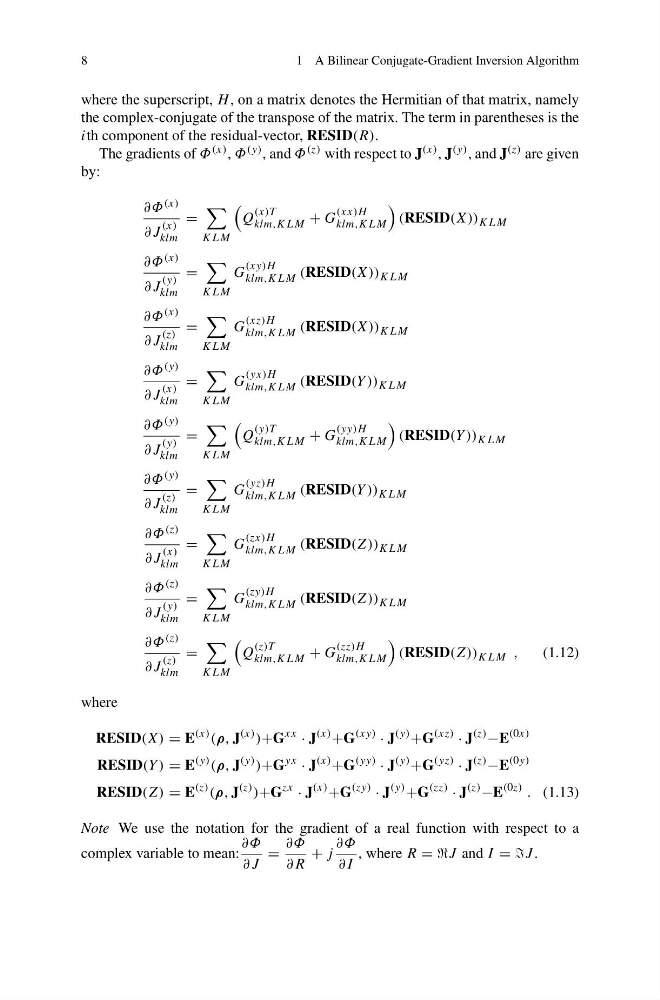
where the superscript, H , on a matrix denotes the Hermitian of that matrix, namely
the complex-conjugate of the transpose of the matrix. The term in parentheses is the
ith component of the residual-vector, RESID(R).
The gradients of Φ (x) , Φ (y) , and Φ (z) with respect to J (x) , J (y) , and J (z) are given
by:
∂Φ (x)
∂J
(x)
klm
=
KLM
Q
(x)T
klm,KLM + G
(xx)H
klm,KLM
(RESID(X)) KLM
∂Φ (x)
∂J
(y)
klm
=
KLM
G
(xy)H
klm,KLM (RESID(X)) KLM
∂Φ (x)
∂J
(z)
klm
=
KLM
G
(xz)H
klm,KLM (RESID(X)) KLM
∂Φ (y)
∂J
(x)
klm
=
KLM
G
(yx)H
klm,KLM (RESID(Y )) KLM
∂Φ (y)
∂J
(y)
klm
=
KLM
Q
(y)T
klm,KLM + G
(yy)H
klm,KLM
(RESID(Y )) KLM
∂Φ (y)
∂J
(z)
klm
=
KLM
G
(yz)H
klm,KLM (RESID(Y )) KLM
∂Φ (z)
∂J
(x)
klm
=
KLM
G
(zx)H
klm,KLM (RESID(Z)) KLM
∂Φ (z)
∂J
(y)
klm
=
KLM
G
(zy)H
klm,KLM (RESID(Z)) KLM
∂Φ (z)
∂J
(z)
klm
=
KLM
Q
(z)T
klm,KLM + G
(zz)H
klm,KLM
(RESID(Z)) KLM ,
(1.12)
where
RESID(X) = E
(x) (ρ, J
(x) )+G
xx
· J
(x)
+G
(xy)
· J
(y)
+G
(xz)
· J
(z)
−E
(0x)
RESID(Y ) = E
(y) (ρ, J
(y) )+G
yx
· J
(x)
+G
(yy)
· J
(y)
+G
(yz)
· J
(z)
−E
(0y)
RESID(Z) = E
(z) (ρ, J
(z) )+G
zx
· J
(x)
+G
(zy)
· J
(y)
+G
(zz)
· J
(z)
−E
(0z) . (1.13)
Note We use the notation for the gradient of a real function with respect to a
complex variable to mean:
∂Φ
∂J
=
∂Φ
∂R
+ j
∂Φ
∂I
, where R = =J and I = =J .
1 A Bilinear Conjugate-Gradient Inversion Algorithm
where the superscript, H , on a matrix denotes the Hermitian of that matrix, namely
the complex-conjugate of the transpose of the matrix. The term in parentheses is the
ith component of the residual-vector, RESID(R).
The gradients of Φ (x) , Φ (y) , and Φ (z) with respect to J (x) , J (y) , and J (z) are given
by:
∂Φ (x)
∂J
(x)
klm
=
KLM
Q
(x)T
klm,KLM + G
(xx)H
klm,KLM
(RESID(X)) KLM
∂Φ (x)
∂J
(y)
klm
=
KLM
G
(xy)H
klm,KLM (RESID(X)) KLM
∂Φ (x)
∂J
(z)
klm
=
KLM
G
(xz)H
klm,KLM (RESID(X)) KLM
∂Φ (y)
∂J
(x)
klm
=
KLM
G
(yx)H
klm,KLM (RESID(Y )) KLM
∂Φ (y)
∂J
(y)
klm
=
KLM
Q
(y)T
klm,KLM + G
(yy)H
klm,KLM
(RESID(Y )) KLM
∂Φ (y)
∂J
(z)
klm
=
KLM
G
(yz)H
klm,KLM (RESID(Y )) KLM
∂Φ (z)
∂J
(x)
klm
=
KLM
G
(zx)H
klm,KLM (RESID(Z)) KLM
∂Φ (z)
∂J
(y)
klm
=
KLM
G
(zy)H
klm,KLM (RESID(Z)) KLM
∂Φ (z)
∂J
(z)
klm
=
KLM
Q
(z)T
klm,KLM + G
(zz)H
klm,KLM
(RESID(Z)) KLM ,
(1.12)
where
RESID(X) = E
(x) (ρ, J
(x) )+G
xx
· J
(x)
+G
(xy)
· J
(y)
+G
(xz)
· J
(z)
−E
(0x)
RESID(Y ) = E
(y) (ρ, J
(y) )+G
yx
· J
(x)
+G
(yy)
· J
(y)
+G
(yz)
· J
(z)
−E
(0y)
RESID(Z) = E
(z) (ρ, J
(z) )+G
zx
· J
(x)
+G
(zy)
· J
(y)
+G
(zz)
· J
(z)
−E
(0z) . (1.13)
Note We use the notation for the gradient of a real function with respect to a
complex variable to mean:
∂Φ
∂J
=
∂Φ
∂R
+ j
∂Φ
∂I
, where R = =J and I = =J .