

180
7 Integration of Functionals, PCM and Stochastic IntegralEquations
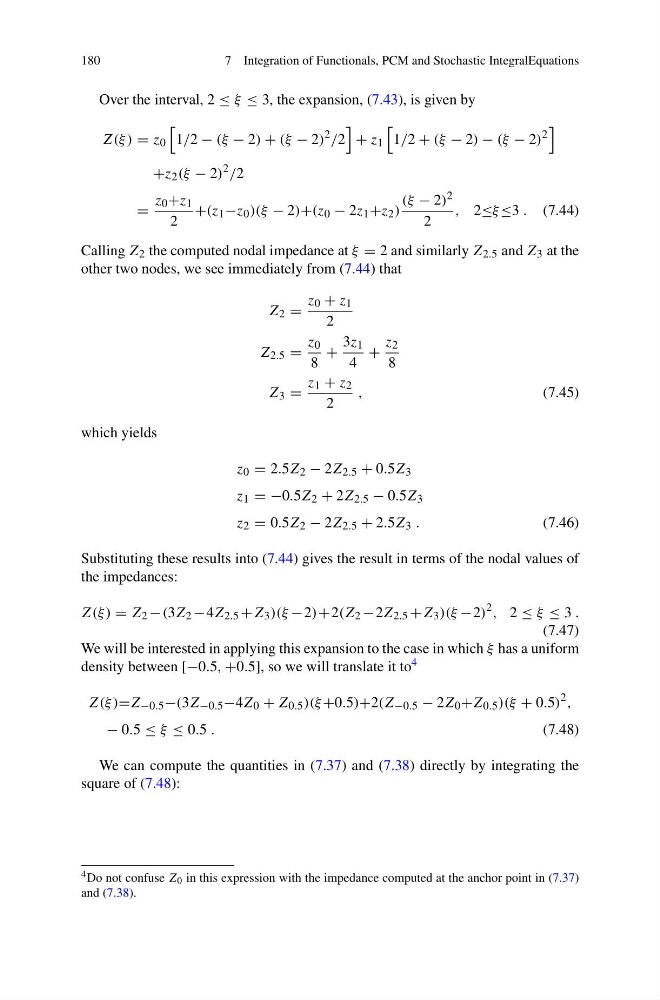
Over the interval, 2 ≤ ξ ≤ 3, the expansion, (7.43), is given by
Z(ξ ) = z 0
1/2 − (ξ − 2) + (ξ − 2)
2 /2
+ z 1
1/2 + (ξ − 2) − (ξ − 2)
2
+z 2 (ξ − 2)
2 /2
=
z 0 +z 1
2
+(z 1 −z 0 )(ξ − 2)+(z 0 − 2z 1 +z 2 )
(ξ − 2) 2
2
, 2≤ξ ≤3 . (7.44)
Calling Z 2 the computed nodal impedance at ξ = 2 and similarly Z 2.5 and Z 3 at the
other two nodes, we see immediately from (7.44) that
Z 2 =
z 0 + z 1
2
Z 2.5 =
z 0
8
+
3z 1
4
+
z 2
8
Z 3 =
z 1 + z 2
2
,
(7.45)
which yields
z 0 = 2.5Z 2 − 2Z 2.5 + 0.5Z 3
z 1 = −0.5Z 2 + 2Z 2.5 − 0.5Z 3
z 2 = 0.5Z 2 − 2Z 2.5 + 2.5Z 3 .
(7.46)
Substituting these results into (7.44) gives the result in terms of the nodal values of
the impedances:
Z(ξ ) = Z 2 −(3Z 2 −4Z 2.5 +Z 3 )(ξ −2)+2(Z 2 −2Z 2.5 +Z 3 )(ξ −2)
2 , 2 ≤ ξ ≤ 3 .
(7.47)
We will be interested in applying this expansion to the case in which ξ has a uniform
density between [−0.5, +0.5], so we will translate it to 4
Z(ξ )=Z −0.5 −(3Z −0.5 −4Z 0 + Z 0.5 )(ξ +0.5)+2(Z −0.5 − 2Z 0 +Z 0.5 )(ξ + 0.5)
2 ,
− 0.5 ≤ ξ ≤ 0.5 .
(7.48)
We can compute the quantities in (7.37) and (7.38) directly by integrating the
square of (7.48):
4 Do not confuse Z 0 in this expression with the impedance computed at the anchor point in (7.37)
and (7.38).
7 Integration of Functionals, PCM and Stochastic IntegralEquations
Over the interval, 2 ≤ ξ ≤ 3, the expansion, (7.43), is given by
Z(ξ ) = z 0
1/2 − (ξ − 2) + (ξ − 2)
2 /2
+ z 1
1/2 + (ξ − 2) − (ξ − 2)
2
+z 2 (ξ − 2)
2 /2
=
z 0 +z 1
2
+(z 1 −z 0 )(ξ − 2)+(z 0 − 2z 1 +z 2 )
(ξ − 2) 2
2
, 2≤ξ ≤3 . (7.44)
Calling Z 2 the computed nodal impedance at ξ = 2 and similarly Z 2.5 and Z 3 at the
other two nodes, we see immediately from (7.44) that
Z 2 =
z 0 + z 1
2
Z 2.5 =
z 0
8
+
3z 1
4
+
z 2
8
Z 3 =
z 1 + z 2
2
,
(7.45)
which yields
z 0 = 2.5Z 2 − 2Z 2.5 + 0.5Z 3
z 1 = −0.5Z 2 + 2Z 2.5 − 0.5Z 3
z 2 = 0.5Z 2 − 2Z 2.5 + 2.5Z 3 .
(7.46)
Substituting these results into (7.44) gives the result in terms of the nodal values of
the impedances:
Z(ξ ) = Z 2 −(3Z 2 −4Z 2.5 +Z 3 )(ξ −2)+2(Z 2 −2Z 2.5 +Z 3 )(ξ −2)
2 , 2 ≤ ξ ≤ 3 .
(7.47)
We will be interested in applying this expansion to the case in which ξ has a uniform
density between [−0.5, +0.5], so we will translate it to 4
Z(ξ )=Z −0.5 −(3Z −0.5 −4Z 0 + Z 0.5 )(ξ +0.5)+2(Z −0.5 − 2Z 0 +Z 0.5 )(ξ + 0.5)
2 ,
− 0.5 ≤ ξ ≤ 0.5 .
(7.48)
We can compute the quantities in (7.37) and (7.38) directly by integrating the
square of (7.48):
4 Do not confuse Z 0 in this expression with the impedance computed at the anchor point in (7.37)
and (7.38).