

146
6 Stochastic Inverse Problems: Models and Metrics
r(x
∗
+ σ v) − −r(x
∗ ) ≈ σ v · ∇∇r(x
∗ ) +
σ 2
2
i,j
∂ 2 r(x)
∂x j ∂x i
| x ∗ v i v j ,
(6.7)
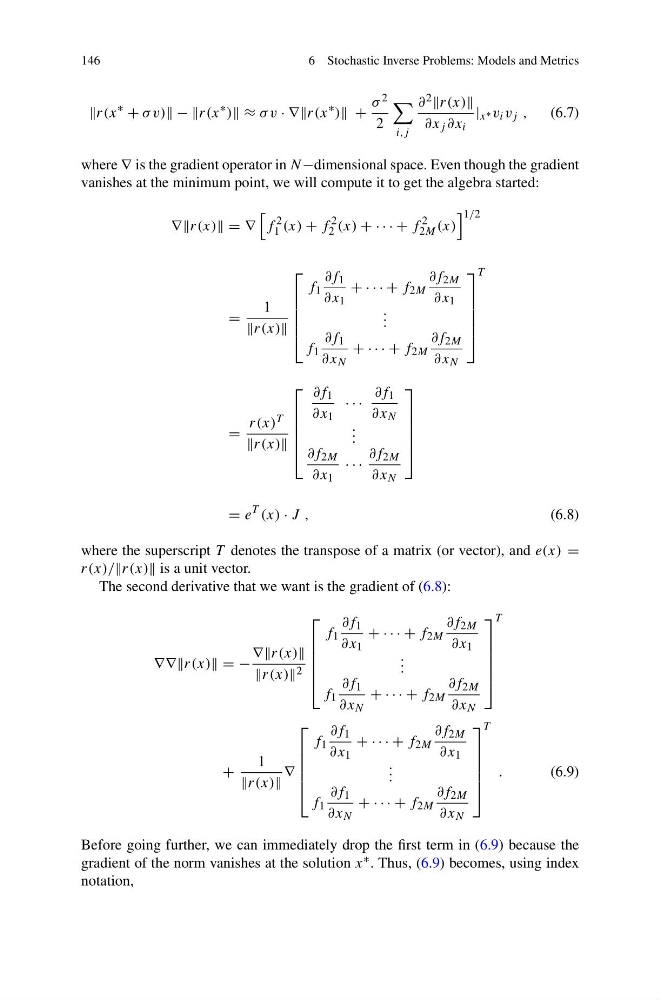
where ∇ is the gradient operator in N−dimensional space. Even though the gradient
vanishes at the minimum point, we will compute it to get the algebra started:
∇∇r(x) = ∇
f
2
1 (x) + f
2
2 (x) + · · · + f
2
2M (x)
1/2
=
1
r(x)
⎡
⎢
⎢
⎢
⎢
⎣
f 1
∂f 1
∂x 1
+ · · · + f 2M
∂f 2M
∂x 1
. . .
f 1
∂f 1
∂x N
+ · · · + f 2M
∂f 2M
∂x N
⎤
⎥
⎥
⎥
⎥
⎦
T
=
r(x) T
r(x)
⎡
⎢
⎢
⎢
⎢
⎣
∂f 1
∂x 1
· · ·
∂f 1
∂x N
. . .
∂f 2M
∂x 1
· · ·
∂f 2M
∂x N
⎤
⎥
⎥
⎥
⎥
⎦
= e
T (x) · J ,
(6.8)
where the superscript T denotes the transpose of a matrix (or vector), and e(x) =
r(x)/r(x) is a unit vector.
The second derivative that we want is the gradient of (6.8):
∇∇∇r(x) = −
∇∇r(x)
r(x) 2
⎡
⎢
⎢
⎢
⎢
⎣
f 1
∂f 1
∂x 1
+ · · · + f 2M
∂f 2M
∂x 1
. . .
f 1
∂f 1
∂x N
+ · · · + f 2M
∂f 2M
∂x N
⎤
⎥
⎥
⎥
⎥
⎦
T
+
1
r(x)
∇
⎡
⎢
⎢
⎢
⎢
⎣
f 1
∂f 1
∂x 1
+ · · · + f 2M
∂f 2M
∂x 1
. . .
f 1
∂f 1
∂x N
+ · · · + f 2M
∂f 2M
∂x N
⎤
⎥
⎥
⎥
⎥
⎦
T
.
(6.9)
Before going further, we can immediately drop the first term in (6.9) because the
gradient of the norm vanishes at the solution x ∗ . Thus, (6.9) becomes, using index
notation,
6 Stochastic Inverse Problems: Models and Metrics
r(x
∗
+ σ v) − −r(x
∗ ) ≈ σ v · ∇∇r(x
∗ ) +
σ 2
2
i,j
∂ 2 r(x)
∂x j ∂x i
| x ∗ v i v j ,
(6.7)
where ∇ is the gradient operator in N−dimensional space. Even though the gradient
vanishes at the minimum point, we will compute it to get the algebra started:
∇∇r(x) = ∇
f
2
1 (x) + f
2
2 (x) + · · · + f
2
2M (x)
1/2
=
1
r(x)
⎡
⎢
⎢
⎢
⎢
⎣
f 1
∂f 1
∂x 1
+ · · · + f 2M
∂f 2M
∂x 1
. . .
f 1
∂f 1
∂x N
+ · · · + f 2M
∂f 2M
∂x N
⎤
⎥
⎥
⎥
⎥
⎦
T
=
r(x) T
r(x)
⎡
⎢
⎢
⎢
⎢
⎣
∂f 1
∂x 1
· · ·
∂f 1
∂x N
. . .
∂f 2M
∂x 1
· · ·
∂f 2M
∂x N
⎤
⎥
⎥
⎥
⎥
⎦
= e
T (x) · J ,
(6.8)
where the superscript T denotes the transpose of a matrix (or vector), and e(x) =
r(x)/r(x) is a unit vector.
The second derivative that we want is the gradient of (6.8):
∇∇∇r(x) = −
∇∇r(x)
r(x) 2
⎡
⎢
⎢
⎢
⎢
⎣
f 1
∂f 1
∂x 1
+ · · · + f 2M
∂f 2M
∂x 1
. . .
f 1
∂f 1
∂x N
+ · · · + f 2M
∂f 2M
∂x N
⎤
⎥
⎥
⎥
⎥
⎦
T
+
1
r(x)
∇
⎡
⎢
⎢
⎢
⎢
⎣
f 1
∂f 1
∂x 1
+ · · · + f 2M
∂f 2M
∂x 1
. . .
f 1
∂f 1
∂x N
+ · · · + f 2M
∂f 2M
∂x N
⎤
⎥
⎥
⎥
⎥
⎦
T
.
(6.9)
Before going further, we can immediately drop the first term in (6.9) because the
gradient of the norm vanishes at the solution x ∗ . Thus, (6.9) becomes, using index
notation,