

128
5 An Electromagnetic Model for Anisotropic Media: Green’s Dyad for Plane-. . .
The angles (θ, φ, ψ) are the Euler angles. Their values determine the position of
the triad (i, j, k) relative to (I, J, K). The angles range over the following values:
0 ≤ θ ≤ π
0 ≤ φ < 2π
0 ≤ ψ < 2π
.
(5.22)
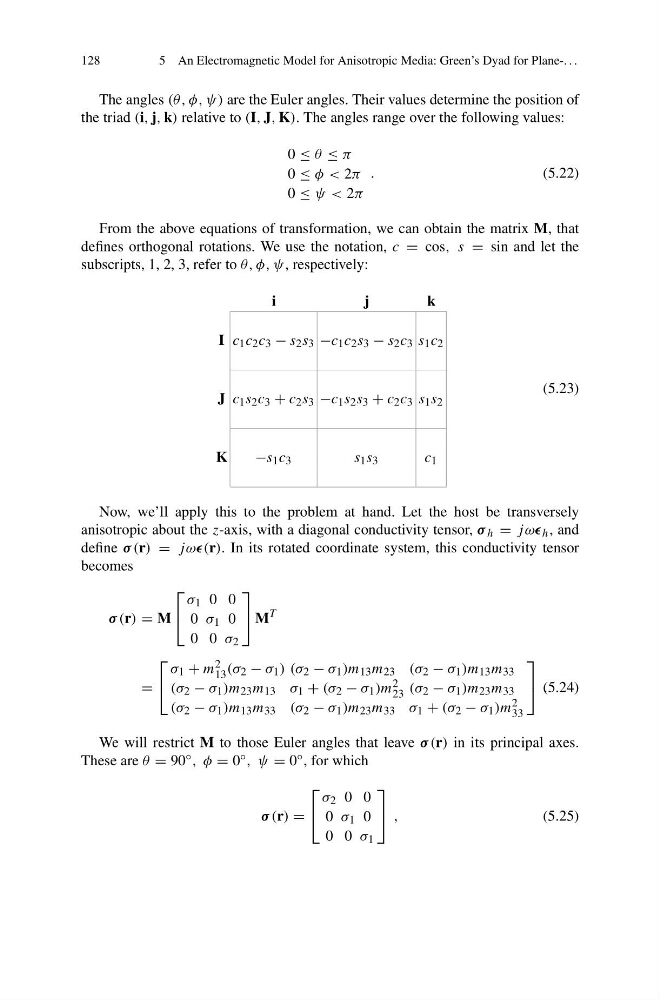
From the above equations of transformation, we can obtain the matrix M, that
defines orthogonal rotations. We use the notation, c = cos, s = sin and let the
subscripts, 1, 2, 3, refer to θ, φ, ψ, respectively:
i
j
k
I c 1 c 2 c 3 − s 2 s 3 −c 1 c 2 s 3 − s 2 c 3 s 1 c 2
J c 1 s 2 c 3 + c 2 s 3 −c 1 s 2 s 3 + c 2 c 3 s 1 s 2
K
−s 1 c 3
s 1 s 3
c 1
(5.23)
Now, we’ll apply this to the problem at hand. Let the host be transversely
anisotropic about the z-axis, with a diagonal conductivity tensor, σ h = jω h , and
define σ (r) = jω(r). In its rotated coordinate system, this conductivity tensor
becomes
σ (r) = M
⎡
⎣
σ 1 0 0
0 σ 1 0
0 0 σ 2
⎤
⎦ M
T
=
⎡
⎣
σ 1 + m 2
13 (σ 2 − σ 1 ) (σ 2 − σ 1 )m 13 m 23 (σ 2 − σ 1 )m 13 m 33
(σ 2 − σ 1 )m 23 m 13 σ 1 + (σ 2 − σ 1 )m 2
23 (σ 2 − σ 1 )m 23 m 33
(σ 2 − σ 1 )m 13 m 33 (σ 2 − σ 1 )m 23 m 33 σ 1 + (σ 2 − σ 1 )m 2
33
⎤
⎦ .
(5.24)
We will restrict M to those Euler angles that leave σ (r) in its principal axes.
These are θ = 90 ◦ , φ = 0 ◦ , ψ = 0 ◦ , for which
σ (r) =
⎡
⎣
σ 2 0 0
0 σ 1 0
0 0 σ 1
⎤
⎦ ,
(5.25)
5 An Electromagnetic Model for Anisotropic Media: Green’s Dyad for Plane-. . .
The angles (θ, φ, ψ) are the Euler angles. Their values determine the position of
the triad (i, j, k) relative to (I, J, K). The angles range over the following values:
0 ≤ θ ≤ π
0 ≤ φ < 2π
0 ≤ ψ < 2π
.
(5.22)
From the above equations of transformation, we can obtain the matrix M, that
defines orthogonal rotations. We use the notation, c = cos, s = sin and let the
subscripts, 1, 2, 3, refer to θ, φ, ψ, respectively:
i
j
k
I c 1 c 2 c 3 − s 2 s 3 −c 1 c 2 s 3 − s 2 c 3 s 1 c 2
J c 1 s 2 c 3 + c 2 s 3 −c 1 s 2 s 3 + c 2 c 3 s 1 s 2
K
−s 1 c 3
s 1 s 3
c 1
(5.23)
Now, we’ll apply this to the problem at hand. Let the host be transversely
anisotropic about the z-axis, with a diagonal conductivity tensor, σ h = jω h , and
define σ (r) = jω(r). In its rotated coordinate system, this conductivity tensor
becomes
σ (r) = M
⎡
⎣
σ 1 0 0
0 σ 1 0
0 0 σ 2
⎤
⎦ M
T
=
⎡
⎣
σ 1 + m 2
13 (σ 2 − σ 1 ) (σ 2 − σ 1 )m 13 m 23 (σ 2 − σ 1 )m 13 m 33
(σ 2 − σ 1 )m 23 m 13 σ 1 + (σ 2 − σ 1 )m 2
23 (σ 2 − σ 1 )m 23 m 33
(σ 2 − σ 1 )m 13 m 33 (σ 2 − σ 1 )m 23 m 33 σ 1 + (σ 2 − σ 1 )m 2
33
⎤
⎦ .
(5.24)
We will restrict M to those Euler angles that leave σ (r) in its principal axes.
These are θ = 90 ◦ , φ = 0 ◦ , ψ = 0 ◦ , for which
σ (r) =
⎡
⎣
σ 2 0 0
0 σ 1 0
0 0 σ 1
⎤
⎦ ,
(5.25)