

17
deliberately aligned upon sunrise or sunset on dates that happen to approximate to
the true equinox, because they were conceived as halfway … between the solstices’
(Ruggles, 1997). Apparently, Mnajdra South would contradict this statement, unless
the orientation of the axis was a mere byproduct of the general design of the temple,
as previously discussed (Fig. 3). Consequently, the day midway between the solstices perhaps had more relevance than the one we might expect, or desire.
2.2 Mediterranean Equinoxes
The first buildings which are arguably orientated close to the astronomical equinox,
whenever the eastern horizon in nearly flat, are the funerary temples and related
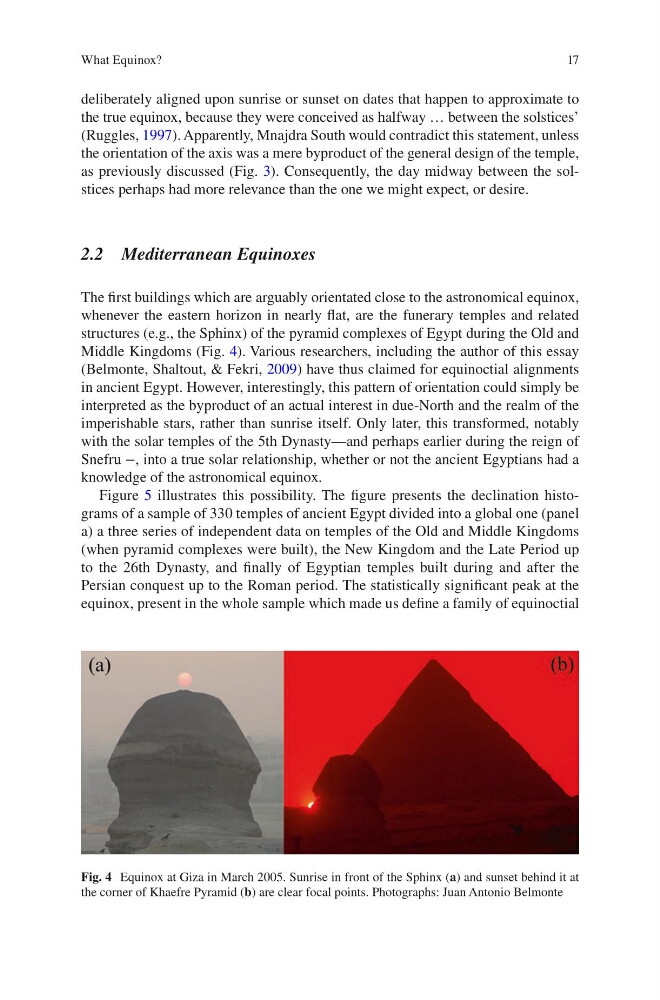
structures (e.g., the Sphinx) of the pyramid complexes of Egypt during the Old and
Middle Kingdoms (Fig. 4). Various researchers, including the author of this essay
(Belmonte, Shaltout, & Fekri, 2009) have thus claimed for equinoctial alignments
in ancient Egypt. However, interestingly, this pattern of orientation could simply be
interpreted as the byproduct of an actual interest in due-North and the realm of the
imperishable stars, rather than sunrise itself. Only later, this transformed, notably
with the solar temples of the 5th Dynasty—and perhaps earlier during the reign of
Snefru −, into a true solar relationship, whether or not the ancient Egyptians had a
knowledge of the astronomical equinox.
Figure 5 illustrates this possibility. The figure presents the declination histograms of a sample of 330 temples of ancient Egypt divided into a global one (panel
a) a three series of independent data on temples of the Old and Middle Kingdoms
(when pyramid complexes were built), the New Kingdom and the Late Period up
to the 26th Dynasty, and finally of Egyptian temples built during and after the
Persian conquest up to the Roman period. The statistically significant peak at the
equinox, present in the whole sample which made us define a family of equinoctial
Fig. 4 Equinox at Giza in March 2005. Sunrise in front of the Sphinx (a) and sunset behind it at
the corner of Khaefre Pyramid (b) are clear focal points. Photographs: Juan Antonio Belmonte
What Equinox?
deliberately aligned upon sunrise or sunset on dates that happen to approximate to
the true equinox, because they were conceived as halfway … between the solstices’
(Ruggles, 1997). Apparently, Mnajdra South would contradict this statement, unless
the orientation of the axis was a mere byproduct of the general design of the temple,
as previously discussed (Fig. 3). Consequently, the day midway between the solstices perhaps had more relevance than the one we might expect, or desire.
2.2 Mediterranean Equinoxes
The first buildings which are arguably orientated close to the astronomical equinox,
whenever the eastern horizon in nearly flat, are the funerary temples and related
structures (e.g., the Sphinx) of the pyramid complexes of Egypt during the Old and
Middle Kingdoms (Fig. 4). Various researchers, including the author of this essay
(Belmonte, Shaltout, & Fekri, 2009) have thus claimed for equinoctial alignments
in ancient Egypt. However, interestingly, this pattern of orientation could simply be
interpreted as the byproduct of an actual interest in due-North and the realm of the
imperishable stars, rather than sunrise itself. Only later, this transformed, notably
with the solar temples of the 5th Dynasty—and perhaps earlier during the reign of
Snefru −, into a true solar relationship, whether or not the ancient Egyptians had a
knowledge of the astronomical equinox.
Figure 5 illustrates this possibility. The figure presents the declination histograms of a sample of 330 temples of ancient Egypt divided into a global one (panel
a) a three series of independent data on temples of the Old and Middle Kingdoms
(when pyramid complexes were built), the New Kingdom and the Late Period up
to the 26th Dynasty, and finally of Egyptian temples built during and after the
Persian conquest up to the Roman period. The statistically significant peak at the
equinox, present in the whole sample which made us define a family of equinoctial
Fig. 4 Equinox at Giza in March 2005. Sunrise in front of the Sphinx (a) and sunset behind it at
the corner of Khaefre Pyramid (b) are clear focal points. Photographs: Juan Antonio Belmonte
What Equinox?