

18
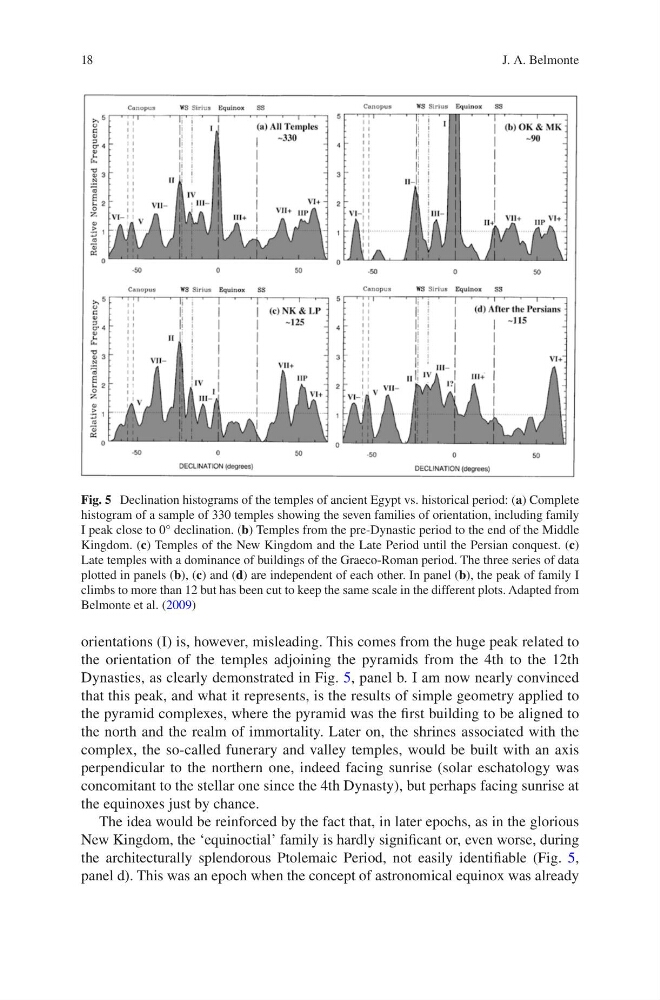
orientations (I) is, however, misleading. This comes from the huge peak related to
the orientation of the temples adjoining the pyramids from the 4th to the 12th
Dynasties, as clearly demonstrated in Fig. 5, panel b. I am now nearly convinced
that this peak, and what it represents, is the results of simple geometry applied to
the pyramid complexes, where the pyramid was the first building to be aligned to
the north and the realm of immortality. Later on, the shrines associated with the
complex, the so- called funerary and valley temples, would be built with an axis
perpendicular to the northern one, indeed facing sunrise (solar eschatology was
concomitant to the stellar one since the 4th Dynasty), but perhaps facing sunrise at
the equinoxes just by chance.
The idea would be reinforced by the fact that, in later epochs, as in the glorious
New Kingdom, the ‘equinoctial’ family is hardly significant or, even worse, during
the architecturally splendorous Ptolemaic Period, not easily identifiable (Fig. 5,
panel d). This was an epoch when the concept of astronomical equinox was already
Fig. 5 Declination histograms of the temples of ancient Egypt vs. historical period: (a) Complete
histogram of a sample of 330 temples showing the seven families of orientation, including family
I peak close to 0° declination. (b) Temples from the pre-Dynastic period to the end of the Middle
Kingdom. (c) Temples of the New Kingdom and the Late Period until the Persian conquest. (c)
Late temples with a dominance of buildings of the Graeco-Roman period. The three series of data
plotted in panels (b), (c) and (d) are independent of each other. In panel (b), the peak of family I
climbs to more than 12 but has been cut to keep the same scale in the different plots. Adapted from
Belmonte et al. (2009)
J. A. Belmonte
orientations (I) is, however, misleading. This comes from the huge peak related to
the orientation of the temples adjoining the pyramids from the 4th to the 12th
Dynasties, as clearly demonstrated in Fig. 5, panel b. I am now nearly convinced
that this peak, and what it represents, is the results of simple geometry applied to
the pyramid complexes, where the pyramid was the first building to be aligned to
the north and the realm of immortality. Later on, the shrines associated with the
complex, the so- called funerary and valley temples, would be built with an axis
perpendicular to the northern one, indeed facing sunrise (solar eschatology was
concomitant to the stellar one since the 4th Dynasty), but perhaps facing sunrise at
the equinoxes just by chance.
The idea would be reinforced by the fact that, in later epochs, as in the glorious
New Kingdom, the ‘equinoctial’ family is hardly significant or, even worse, during
the architecturally splendorous Ptolemaic Period, not easily identifiable (Fig. 5,
panel d). This was an epoch when the concept of astronomical equinox was already
Fig. 5 Declination histograms of the temples of ancient Egypt vs. historical period: (a) Complete
histogram of a sample of 330 temples showing the seven families of orientation, including family
I peak close to 0° declination. (b) Temples from the pre-Dynastic period to the end of the Middle
Kingdom. (c) Temples of the New Kingdom and the Late Period until the Persian conquest. (c)
Late temples with a dominance of buildings of the Graeco-Roman period. The three series of data
plotted in panels (b), (c) and (d) are independent of each other. In panel (b), the peak of family I
climbs to more than 12 but has been cut to keep the same scale in the different plots. Adapted from
Belmonte et al. (2009)
J. A. Belmonte