

16
Hence, the equinoctial alignment is not as ‘precise’ and we would desire and perhaps different approaches ought to be considered. Could the moon be the relevant
celestial object? Anyway, the lighting phenomenon is very suggestive and will certainly keep attracting people to the site every equinox.
Our last singular case is that of the southern megalithic temple of the three present at Mnajdra in Malta. The peculiar orientation of this temple, the only one of the
many prehistoric temples in Malta clearly facing sunrise, has often been termed as
equinoctial. Michel Hoskin (2001: 30–31) dismissed this possibility as unreliable
but it has remained in the literature and the most serious work on the topic has come
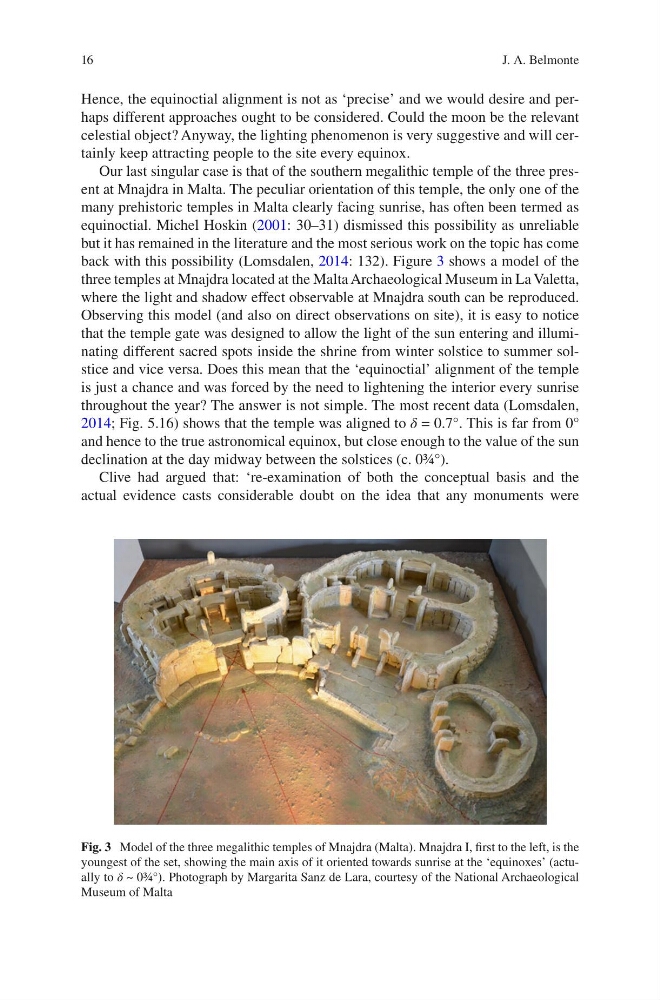
back with this possibility (Lomsdalen, 2014: 132). Figure 3 shows a model of the
three temples at Mnajdra located at the Malta Archaeological Museum in La Valetta,
where the light and shadow effect observable at Mnajdra south can be reproduced.
Observing this model (and also on direct observations on site), it is easy to notice
that the temple gate was designed to allow the light of the sun entering and illuminating different sacred spots inside the shrine from winter solstice to summer solstice and vice versa. Does this mean that the ‘equinoctial’ alignment of the temple
is just a chance and was forced by the need to lightening the interior every sunrise
throughout the year? The answer is not simple. The most recent data (Lomsdalen,
2014; Fig. 5.16) shows that the temple was aligned to δ = 0.7°. This is far from 0°
and hence to the true astronomical equinox, but close enough to the value of the sun
declination at the day midway between the solstices (c. 0¾°).
Clive had argued that: ‘re-examination of both the conceptual basis and the
actual evidence casts considerable doubt on the idea that any monuments were
Fig. 3 Model of the three megalithic temples of Mnajdra (Malta). Mnajdra I, first to the left, is the
youngest of the set, showing the main axis of it oriented towards sunrise at the ‘equinoxes’ (actually to δ ~ 0¾°). Photograph by Margarita Sanz de Lara, courtesy of the National Archaeological
Museum of Malta
J. A. Belmonte
Hence, the equinoctial alignment is not as ‘precise’ and we would desire and perhaps different approaches ought to be considered. Could the moon be the relevant
celestial object? Anyway, the lighting phenomenon is very suggestive and will certainly keep attracting people to the site every equinox.
Our last singular case is that of the southern megalithic temple of the three present at Mnajdra in Malta. The peculiar orientation of this temple, the only one of the
many prehistoric temples in Malta clearly facing sunrise, has often been termed as
equinoctial. Michel Hoskin (2001: 30–31) dismissed this possibility as unreliable
but it has remained in the literature and the most serious work on the topic has come
back with this possibility (Lomsdalen, 2014: 132). Figure 3 shows a model of the
three temples at Mnajdra located at the Malta Archaeological Museum in La Valetta,
where the light and shadow effect observable at Mnajdra south can be reproduced.
Observing this model (and also on direct observations on site), it is easy to notice
that the temple gate was designed to allow the light of the sun entering and illuminating different sacred spots inside the shrine from winter solstice to summer solstice and vice versa. Does this mean that the ‘equinoctial’ alignment of the temple
is just a chance and was forced by the need to lightening the interior every sunrise
throughout the year? The answer is not simple. The most recent data (Lomsdalen,
2014; Fig. 5.16) shows that the temple was aligned to δ = 0.7°. This is far from 0°
and hence to the true astronomical equinox, but close enough to the value of the sun
declination at the day midway between the solstices (c. 0¾°).
Clive had argued that: ‘re-examination of both the conceptual basis and the
actual evidence casts considerable doubt on the idea that any monuments were
Fig. 3 Model of the three megalithic temples of Mnajdra (Malta). Mnajdra I, first to the left, is the
youngest of the set, showing the main axis of it oriented towards sunrise at the ‘equinoxes’ (actually to δ ~ 0¾°). Photograph by Margarita Sanz de Lara, courtesy of the National Archaeological
Museum of Malta
J. A. Belmonte