

3
standards and dealing with cultural context remained, with differing emphases, the
guiding themes of Clive’s work.
Clive’s evolving approach is further indicated by the suggestive title of the volume of thematic papers from the third “Oxford” Conference at St. Andrews,
Scotland, which he edited with Nick Saunders, Astronomies and Cultures. Ruggles
and Saunders titled their chapter “The Study of Cultural Astronomy”, foreshadowing the changing focus of the discipline from archaeoastronomy to cultural astronomy (Tirapios, 2019). Despite their growing focus on the need to understand and
describe the concepts by which another culture expresses their notions of reality,
they still maintained that statistical rigour was required “for estimating the likelihood that observed patterns have real (and quantifiable) cultural significance”
(Ruggles & Saunders, 1993: 15).
At the ninth “Oxford” conference, in Lima, Peru, Clive addressed the increasing
role of social theory in our discipline, crediting Stanislaw Iwaniszewski (who also
contributes to this volume) with “the first attempt to introduce the topic into the
Oxford agenda at Oxford II” (Ruggles, 2011: 7). A new “interpretative archaeoastronomy” addressed issues that Clive now considered to be more fundamental
(Ruggles, 2011: 3). He explicitly noted the tension between change and continuity
in his own shifting emphasis, conceding that while he had “long since abandoned
my insistence of 30 years ago upon a statistical objectivity … I stand by the need for
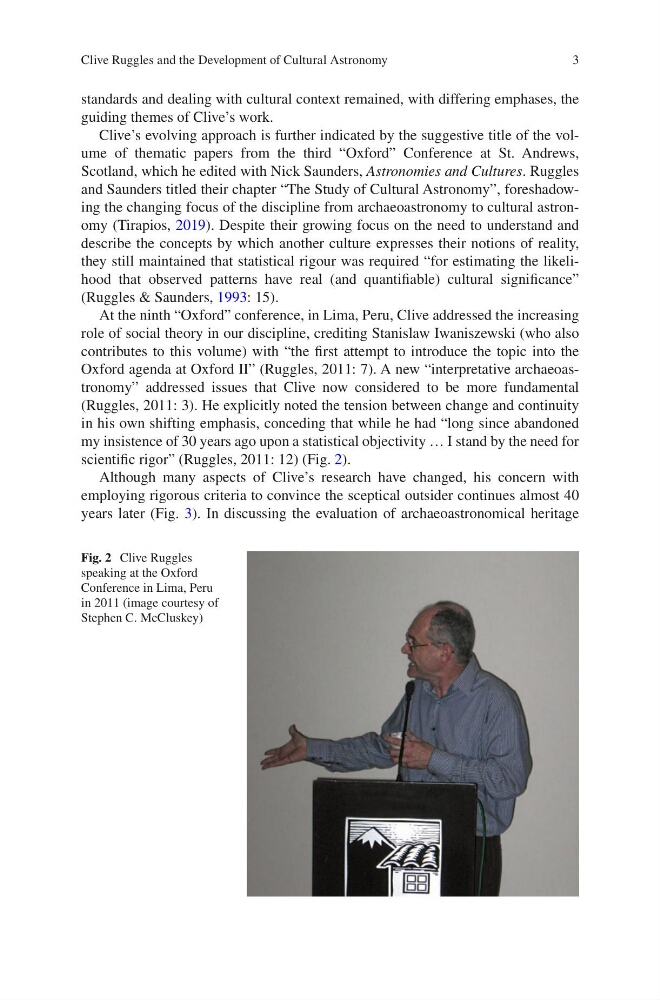
scientific rigor” (Ruggles, 2011: 12) (Fig. 2).
Although many aspects of Clive’s research have changed, his concern with
employing rigorous criteria to convince the sceptical outsider continues almost 40
years later (Fig. 3). In discussing the evaluation of archaeoastronomical heritage
Fig. 2 Clive Ruggles
speaking at the Oxford
Conference in Lima, Peru
in 2011 (image courtesy of
Stephen C. McCluskey)
Clive Ruggles and the Development of Cultural Astronomy
standards and dealing with cultural context remained, with differing emphases, the
guiding themes of Clive’s work.
Clive’s evolving approach is further indicated by the suggestive title of the volume of thematic papers from the third “Oxford” Conference at St. Andrews,
Scotland, which he edited with Nick Saunders, Astronomies and Cultures. Ruggles
and Saunders titled their chapter “The Study of Cultural Astronomy”, foreshadowing the changing focus of the discipline from archaeoastronomy to cultural astronomy (Tirapios, 2019). Despite their growing focus on the need to understand and
describe the concepts by which another culture expresses their notions of reality,
they still maintained that statistical rigour was required “for estimating the likelihood that observed patterns have real (and quantifiable) cultural significance”
(Ruggles & Saunders, 1993: 15).
At the ninth “Oxford” conference, in Lima, Peru, Clive addressed the increasing
role of social theory in our discipline, crediting Stanislaw Iwaniszewski (who also
contributes to this volume) with “the first attempt to introduce the topic into the
Oxford agenda at Oxford II” (Ruggles, 2011: 7). A new “interpretative archaeoastronomy” addressed issues that Clive now considered to be more fundamental
(Ruggles, 2011: 3). He explicitly noted the tension between change and continuity
in his own shifting emphasis, conceding that while he had “long since abandoned
my insistence of 30 years ago upon a statistical objectivity … I stand by the need for
scientific rigor” (Ruggles, 2011: 12) (Fig. 2).
Although many aspects of Clive’s research have changed, his concern with
employing rigorous criteria to convince the sceptical outsider continues almost 40
years later (Fig. 3). In discussing the evaluation of archaeoastronomical heritage
Fig. 2 Clive Ruggles
speaking at the Oxford
Conference in Lima, Peru
in 2011 (image courtesy of
Stephen C. McCluskey)
Clive Ruggles and the Development of Cultural Astronomy