

2
independently of any other archaeological investigation of a site, with little attempt
to situate the findings within broader archaeological and contextual studies.
Furthermore, many of the assumed “obvious” astronomical alignments can be criticized for simply being those that are of interest to modern astronomers, which may
or may not be the same as what interested other societies. It established its validity
chiefly through the search for mathematical precision informed by statistical analysis of a large number of sites. Although Ruggles’ early papers share the same concern with quantitative rigour, he came increasingly to recognize the need for cultural
context.
Ruggles was thus among the first scholars to advocate the embedding of archaeoastronomy, which had until the 1980s been largely the preserve of astronomers dabbling in archaeology, within mainstream archaeology and to develop solid
methodologies for the study of sites with possible astronomical meaning. He also
sought to bring the study of archaeoastronomy into a wider discourse with ethnoastronomers studying living astronomical traditions and historians of astronomy
working with written texts and preserved artefacts.
In his investigation of a group of Scottish recumbent stone circles, Clive continued to insist on establishing statistically significant results, but noted they could be
combined with other archaeological data to generate cultural hypotheses. The quantitative data drawn from a well-defined sample still came first, but no longer stood
by itself. It was now seen as being combined with archaeological evidence to contribute, in some way, to the framing of “cultural hypotheses” (Cooke et al., 1977:
S55). As an indication of his early approach, its short title on the cover of the Journal
for the History of Astronomy was “Objectivity in Archaeoastronomy”. Reflecting
that theme, it opened with sections on a “Code of Practice at Megalithic Sites” and
“Classification and Selection Criteria”. These two concerns of establishing rigorous
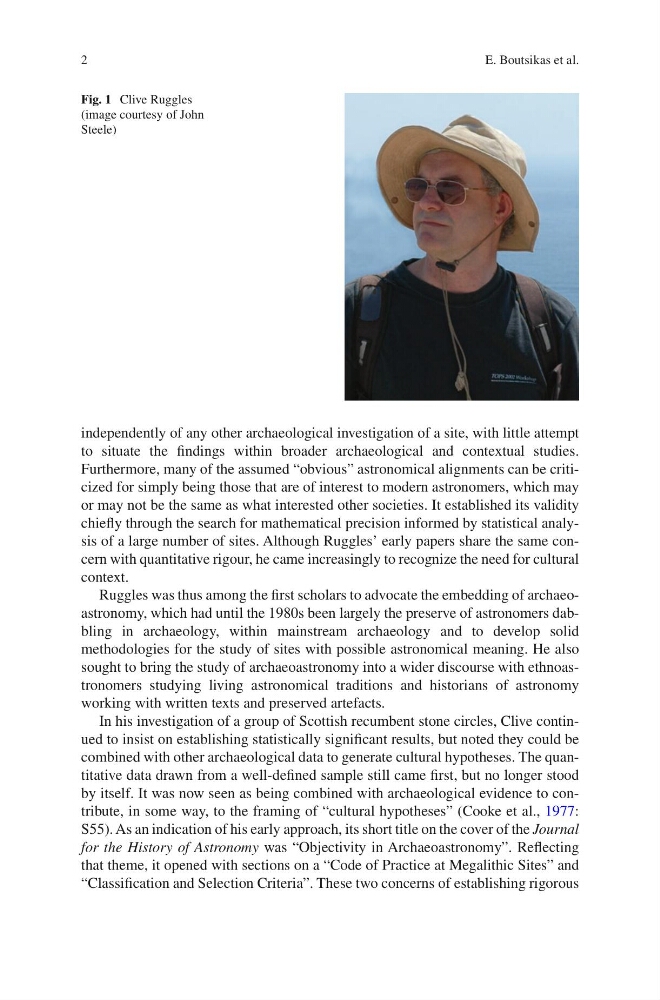
Fig. 1 Clive Ruggles
(image courtesy of John
Steele)
E. Boutsikas et al.
independently of any other archaeological investigation of a site, with little attempt
to situate the findings within broader archaeological and contextual studies.
Furthermore, many of the assumed “obvious” astronomical alignments can be criticized for simply being those that are of interest to modern astronomers, which may
or may not be the same as what interested other societies. It established its validity
chiefly through the search for mathematical precision informed by statistical analysis of a large number of sites. Although Ruggles’ early papers share the same concern with quantitative rigour, he came increasingly to recognize the need for cultural
context.
Ruggles was thus among the first scholars to advocate the embedding of archaeoastronomy, which had until the 1980s been largely the preserve of astronomers dabbling in archaeology, within mainstream archaeology and to develop solid
methodologies for the study of sites with possible astronomical meaning. He also
sought to bring the study of archaeoastronomy into a wider discourse with ethnoastronomers studying living astronomical traditions and historians of astronomy
working with written texts and preserved artefacts.
In his investigation of a group of Scottish recumbent stone circles, Clive continued to insist on establishing statistically significant results, but noted they could be
combined with other archaeological data to generate cultural hypotheses. The quantitative data drawn from a well-defined sample still came first, but no longer stood
by itself. It was now seen as being combined with archaeological evidence to contribute, in some way, to the framing of “cultural hypotheses” (Cooke et al., 1977:
S55). As an indication of his early approach, its short title on the cover of the Journal
for the History of Astronomy was “Objectivity in Archaeoastronomy”. Reflecting
that theme, it opened with sections on a “Code of Practice at Megalithic Sites” and
“Classification and Selection Criteria”. These two concerns of establishing rigorous
Fig. 1 Clive Ruggles
(image courtesy of John
Steele)
E. Boutsikas et al.