

8 Bio-microelectromechanical Systems (BioMEMS) …
171
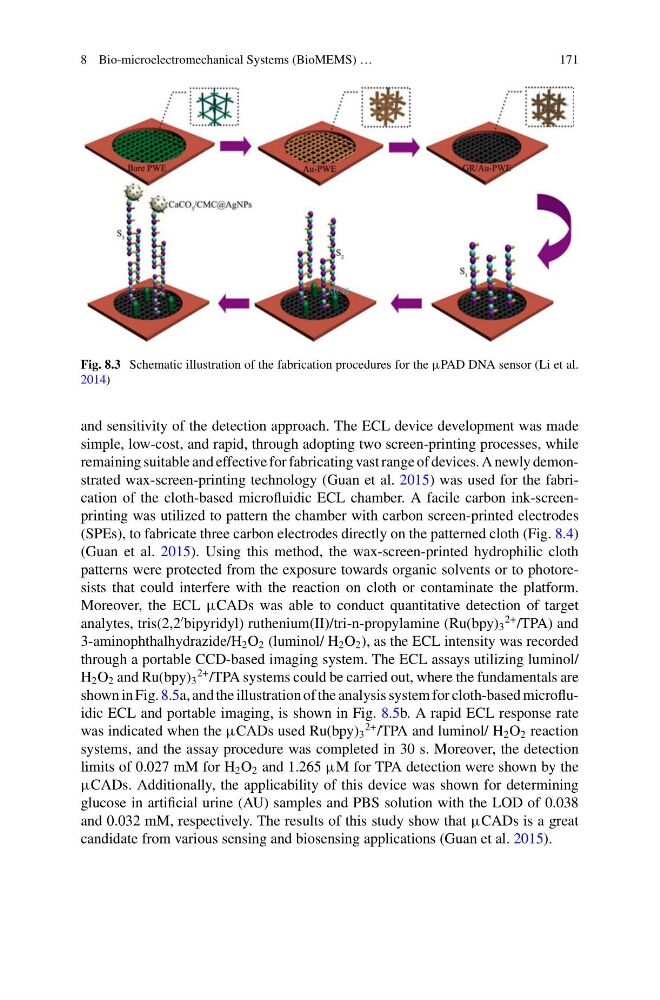
Fig. 8.3 Schematic illustration of the fabrication procedures for the µPAD DNA sensor (Li et al.
2014)
and sensitivity of the detection approach. The ECL device development was made
simple, low-cost, and rapid, through adopting two screen-printing processes, while
remaining suitable and effective for fabricating vast range of devices. A newly demonstrated wax-screen-printing technology (Guan et al. 2015) was used for the fabrication of the cloth-based microfluidic ECL chamber. A facile carbon ink-screenprinting was utilized to pattern the chamber with carbon screen-printed electrodes
(SPEs), to fabricate three carbon electrodes directly on the patterned cloth (Fig. 8.4)
(Guan et al. 2015). Using this method, the wax-screen-printed hydrophilic cloth
patterns were protected from the exposure towards organic solvents or to photoresists that could interfere with the reaction on cloth or contaminate the platform.
Moreover, the ECL µCADs was able to conduct quantitative detection of target
analytes, tris(2,2
bipyridyl) ruthenium(II)/tri-n-propylamine (Ru(bpy) 3
2+ /TPA) and
3-aminophthalhydrazide/H 2 O 2 (luminol/ H 2 O 2 ), as the ECL intensity was recorded
through a portable CCD-based imaging system. The ECL assays utilizing luminol/
H 2 O 2 and Ru(bpy) 3
2+ /TPA systems could be carried out, where the fundamentals are
shown in Fig. 8.5a, and the illustration of the analysis system for cloth-based microfluidic ECL and portable imaging, is shown in Fig. 8.5b. A rapid ECL response rate
was indicated when the µCADs used Ru(bpy) 3
2+ /TPA and luminol/ H 2 O 2 reaction
systems, and the assay procedure was completed in 30 s. Moreover, the detection
limits of 0.027 mM for H 2 O 2 and 1.265 µM for TPA detection were shown by the
µCADs. Additionally, the applicability of this device was shown for determining
glucose in artificial urine (AU) samples and PBS solution with the LOD of 0.038
and 0.032 mM, respectively. The results of this study show that µCADs is a great
candidate from various sensing and biosensing applications (Guan et al. 2015).
171
Fig. 8.3 Schematic illustration of the fabrication procedures for the µPAD DNA sensor (Li et al.
2014)
and sensitivity of the detection approach. The ECL device development was made
simple, low-cost, and rapid, through adopting two screen-printing processes, while
remaining suitable and effective for fabricating vast range of devices. A newly demonstrated wax-screen-printing technology (Guan et al. 2015) was used for the fabrication of the cloth-based microfluidic ECL chamber. A facile carbon ink-screenprinting was utilized to pattern the chamber with carbon screen-printed electrodes
(SPEs), to fabricate three carbon electrodes directly on the patterned cloth (Fig. 8.4)
(Guan et al. 2015). Using this method, the wax-screen-printed hydrophilic cloth
patterns were protected from the exposure towards organic solvents or to photoresists that could interfere with the reaction on cloth or contaminate the platform.
Moreover, the ECL µCADs was able to conduct quantitative detection of target
analytes, tris(2,2
bipyridyl) ruthenium(II)/tri-n-propylamine (Ru(bpy) 3
2+ /TPA) and
3-aminophthalhydrazide/H 2 O 2 (luminol/ H 2 O 2 ), as the ECL intensity was recorded
through a portable CCD-based imaging system. The ECL assays utilizing luminol/
H 2 O 2 and Ru(bpy) 3
2+ /TPA systems could be carried out, where the fundamentals are
shown in Fig. 8.5a, and the illustration of the analysis system for cloth-based microfluidic ECL and portable imaging, is shown in Fig. 8.5b. A rapid ECL response rate
was indicated when the µCADs used Ru(bpy) 3
2+ /TPA and luminol/ H 2 O 2 reaction
systems, and the assay procedure was completed in 30 s. Moreover, the detection
limits of 0.027 mM for H 2 O 2 and 1.265 µM for TPA detection were shown by the
µCADs. Additionally, the applicability of this device was shown for determining
glucose in artificial urine (AU) samples and PBS solution with the LOD of 0.038
and 0.032 mM, respectively. The results of this study show that µCADs is a great
candidate from various sensing and biosensing applications (Guan et al. 2015).