

8 Bio-microelectromechanical Systems (BioMEMS) …
169
(CA 199), a constant potential-triggered sandwich-type immunosensor was implemented into the PoP-ECL device. CA 199 is a popular tumor labeler utilized for
pancreas and colon cancer diagnostic (Metzgar et al. 1982; Herlyn et al. 1982). To
promote simplicity, the authors suggested to make use of a regular 6B-type black
pencil to fabricate electrodes on the paper. The PoP-ECL apparatus composed of
two PoP electrodes made up of commercially available pencil and caryon and a
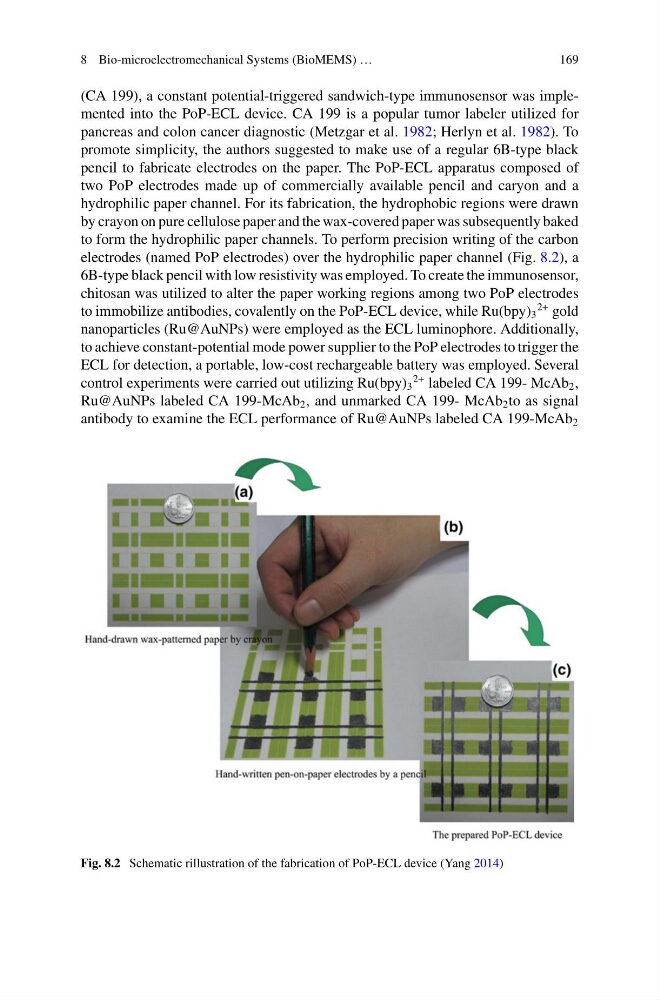
hydrophilic paper channel. For its fabrication, the hydrophobic regions were drawn
by crayon on pure cellulose paper and the wax-covered paper was subsequently baked
to form the hydrophilic paper channels. To perform precision writing of the carbon
electrodes (named PoP electrodes) over the hydrophilic paper channel (Fig. 8.2), a
6B-type black pencil with low resistivity was employed. To create the immunosensor,
chitosan was utilized to alter the paper working regions among two PoP electrodes
to immobilize antibodies, covalently on the PoP-ECL device, while Ru(bpy) 3
2+ gold
nanoparticles (Ru@AuNPs) were employed as the ECL luminophore. Additionally,
to achieve constant-potential mode power supplier to the PoP electrodes to trigger the
ECL for detection, a portable, low-cost rechargeable battery was employed. Several
control experiments were carried out utilizing Ru(bpy) 3
2+ labeled CA 199- McAb 2 ,
Ru@AuNPs labeled CA 199-McAb 2 , and unmarked CA 199- McAb 2 to as signal
antibody to examine the ECL performance of Ru@AuNPs labeled CA 199-McAb 2
Fig. 8.2 Schematic rillustration of the fabrication of PoP-ECL device (Yang 2014)
169
(CA 199), a constant potential-triggered sandwich-type immunosensor was implemented into the PoP-ECL device. CA 199 is a popular tumor labeler utilized for
pancreas and colon cancer diagnostic (Metzgar et al. 1982; Herlyn et al. 1982). To
promote simplicity, the authors suggested to make use of a regular 6B-type black
pencil to fabricate electrodes on the paper. The PoP-ECL apparatus composed of
two PoP electrodes made up of commercially available pencil and caryon and a
hydrophilic paper channel. For its fabrication, the hydrophobic regions were drawn
by crayon on pure cellulose paper and the wax-covered paper was subsequently baked
to form the hydrophilic paper channels. To perform precision writing of the carbon
electrodes (named PoP electrodes) over the hydrophilic paper channel (Fig. 8.2), a
6B-type black pencil with low resistivity was employed. To create the immunosensor,
chitosan was utilized to alter the paper working regions among two PoP electrodes
to immobilize antibodies, covalently on the PoP-ECL device, while Ru(bpy) 3
2+ gold
nanoparticles (Ru@AuNPs) were employed as the ECL luminophore. Additionally,
to achieve constant-potential mode power supplier to the PoP electrodes to trigger the
ECL for detection, a portable, low-cost rechargeable battery was employed. Several
control experiments were carried out utilizing Ru(bpy) 3
2+ labeled CA 199- McAb 2 ,
Ru@AuNPs labeled CA 199-McAb 2 , and unmarked CA 199- McAb 2 to as signal
antibody to examine the ECL performance of Ru@AuNPs labeled CA 199-McAb 2
Fig. 8.2 Schematic rillustration of the fabrication of PoP-ECL device (Yang 2014)