

168
A. S. Cerda-Kipper and S. Hosseini
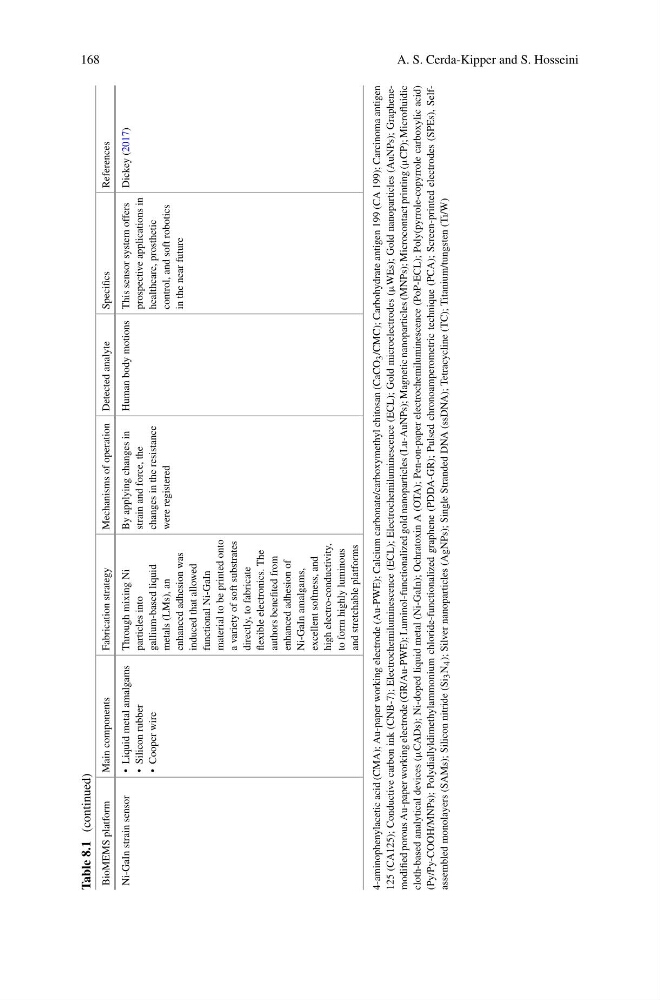
Table 8.1
(continued)
BioMEMS platform
Main components
Fabrication strategy
Mechanisms of operation Detected analyte
Specifics
References
Ni-GaIn strain sensor
• Liquid metal amalgams
• Silicon rubber
• Cooper wire
Through mixing Ni
particles into
gallium-based liquid
metals (LMs), an
enhanced adhesion was
induced that allowed
functional Ni-GaIn
material to be printed onto
a variety of soft substrates
directly, to fabricate
flexible electronics. The
authors benefited from
enhanced adhesion of
Ni-GaIn amalgams,
excellent softness, and
high electro-conductivity,
to form highly luminous
and stretchable platforms
By applying changes in
strain and force, the
changes in the resistance
were registered
Human body motions This sensor system offers
prospective applications in
healthcare, prosthetic
control, and soft robotics
in the near future
Dickey (2017)
4-aminophenylacetic acid (CMA); Au-paper working electrode (Au-PWE); Calcium carbonate/carboxymethyl chitosan (CaCO
3 /CMC); Carbohydrate antigen 199 (CA 199); Carcinoma antigen
125 (CA125); Conductive carbon ink (CNB-7); Electrochemiluminescence (ECL); Electrochemiluminescence (ECL); Gold microelectrodes (µWEs); Gold nanoparticles (AuNPs); Graphenemodified porous Au-paper working electrode (GR/Au-PWE); Luminol-functionalized gold nanoparticles (Lu-AuNPs); Magnetic nanoparticles (MNPs); Microcontact printing (µCP); Microfluidic
cloth-based analytical devices (µCADs); Ni-doped liquid metal (Ni-GaIn); Ochratoxin A (OTA); Pen-on-paper electrochemiluminescence (PoP-ECL); Poly(pyrrole-copyrrole carboxylic acid)
(Py/Py-COOH/MNPs); Polydiallyldimethylammonium chloride-functionalized graphene (PDDA-GR); Pulsed chronoamperometric technique (PCA); Screen-printed electrodes (SPEs), Selfassembled monolayers (SAMs); Silicon nitride (Si
3 N
4 ); Silver nanoparticles (AgNPs); Single Stranded DNA (ssDNA); Tetracycline (TC); Titanium/tungsten (Ti/W)
A. S. Cerda-Kipper and S. Hosseini
Table 8.1
(continued)
BioMEMS platform
Main components
Fabrication strategy
Mechanisms of operation Detected analyte
Specifics
References
Ni-GaIn strain sensor
• Liquid metal amalgams
• Silicon rubber
• Cooper wire
Through mixing Ni
particles into
gallium-based liquid
metals (LMs), an
enhanced adhesion was
induced that allowed
functional Ni-GaIn
material to be printed onto
a variety of soft substrates
directly, to fabricate
flexible electronics. The
authors benefited from
enhanced adhesion of
Ni-GaIn amalgams,
excellent softness, and
high electro-conductivity,
to form highly luminous
and stretchable platforms
By applying changes in
strain and force, the
changes in the resistance
were registered
Human body motions This sensor system offers
prospective applications in
healthcare, prosthetic
control, and soft robotics
in the near future
Dickey (2017)
4-aminophenylacetic acid (CMA); Au-paper working electrode (Au-PWE); Calcium carbonate/carboxymethyl chitosan (CaCO
3 /CMC); Carbohydrate antigen 199 (CA 199); Carcinoma antigen
125 (CA125); Conductive carbon ink (CNB-7); Electrochemiluminescence (ECL); Electrochemiluminescence (ECL); Gold microelectrodes (µWEs); Gold nanoparticles (AuNPs); Graphenemodified porous Au-paper working electrode (GR/Au-PWE); Luminol-functionalized gold nanoparticles (Lu-AuNPs); Magnetic nanoparticles (MNPs); Microcontact printing (µCP); Microfluidic
cloth-based analytical devices (µCADs); Ni-doped liquid metal (Ni-GaIn); Ochratoxin A (OTA); Pen-on-paper electrochemiluminescence (PoP-ECL); Poly(pyrrole-copyrrole carboxylic acid)
(Py/Py-COOH/MNPs); Polydiallyldimethylammonium chloride-functionalized graphene (PDDA-GR); Pulsed chronoamperometric technique (PCA); Screen-printed electrodes (SPEs), Selfassembled monolayers (SAMs); Silicon nitride (Si
3 N
4 ); Silver nanoparticles (AgNPs); Single Stranded DNA (ssDNA); Tetracycline (TC); Titanium/tungsten (Ti/W)