

164
A. S. Cerda-Kipper and S. Hosseini
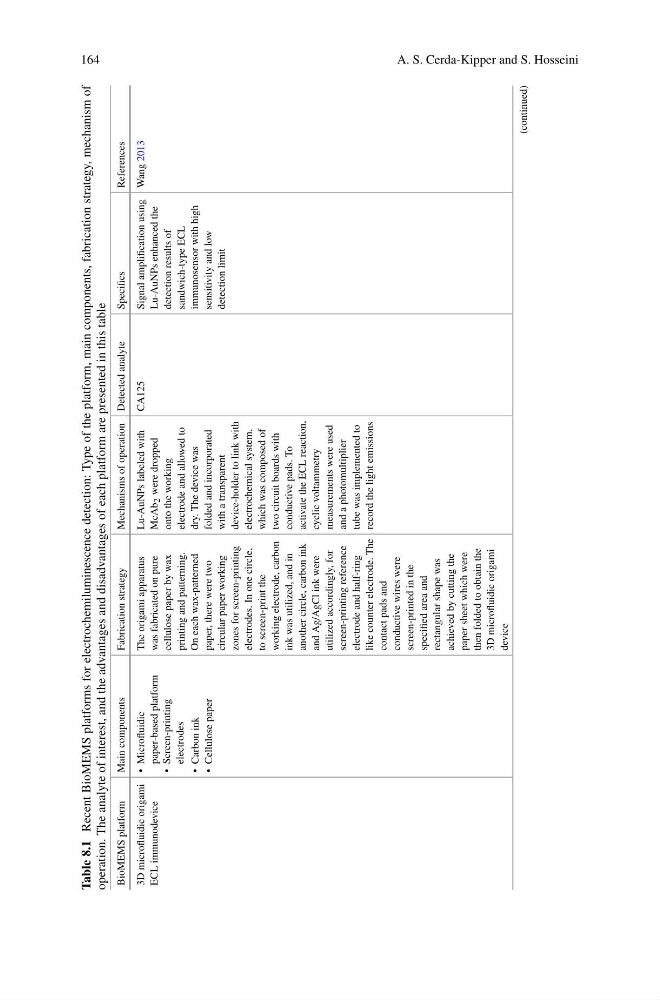
Table 8.1
Recent BioMEMS platforms for electrochemiluminescence detection: Type of the platform, main components, fabrication strategy, mechanism of
operation. The analyte of interest, and the advantages and disadvantages of each platform are presented in this table
BioMEMS platform
Main components
Fabrication strategy
Mechanisms of operation Detected analyte
Specifics
References
3D microfluidic origami
ECL immunodevice
• Microfluidic
paper-based platform
• Screen-printing
electrodes
• Carbon ink
• Cellulose paper
The origami apparatus
was fabricated on pure
cellulose paper by wax
printing and patterning.
On each wax-patterned
paper, there were two
circular paper working
zones for screen-printing
electrodes. In one circle,
to screen-print the
working electrode, carbon
ink was utilized, and in
another circle, carbon ink
and Ag/AgCl ink were
utilized accordingly, for
screen-printing reference
electrode and half-ring
like counter electrode. The
contact pads and
conductive wires were
screen-printed in the
specified area and
rectangular shape was
achieved by cutting the
paper sheet which were
then folded to obtain the
3D microfluidic origami
device
Lu-AuNPs labeled with
McAb
2 were dropped
onto the working
electrode and allowed to
dry. The device was
folded and incorporated
with a transparent
device-holder to link with
electrochemical system,
which was composed of
two circuit boards with
conductive pads. To
activate the ECL reaction,
cyclic voltammetry
measurements were used
and a photomultiplier
tube was implemented to
record the light emissions
CA125
Signal amplification using
Lu-AuNPs enhanced the
detection results of
sandwich-type ECL
immunosensor with high
sensitivity and low
detection limit
Wang 2013
(continued)
A. S. Cerda-Kipper and S. Hosseini
Table 8.1
Recent BioMEMS platforms for electrochemiluminescence detection: Type of the platform, main components, fabrication strategy, mechanism of
operation. The analyte of interest, and the advantages and disadvantages of each platform are presented in this table
BioMEMS platform
Main components
Fabrication strategy
Mechanisms of operation Detected analyte
Specifics
References
3D microfluidic origami
ECL immunodevice
• Microfluidic
paper-based platform
• Screen-printing
electrodes
• Carbon ink
• Cellulose paper
The origami apparatus
was fabricated on pure
cellulose paper by wax
printing and patterning.
On each wax-patterned
paper, there were two
circular paper working
zones for screen-printing
electrodes. In one circle,
to screen-print the
working electrode, carbon
ink was utilized, and in
another circle, carbon ink
and Ag/AgCl ink were
utilized accordingly, for
screen-printing reference
electrode and half-ring
like counter electrode. The
contact pads and
conductive wires were
screen-printed in the
specified area and
rectangular shape was
achieved by cutting the
paper sheet which were
then folded to obtain the
3D microfluidic origami
device
Lu-AuNPs labeled with
McAb
2 were dropped
onto the working
electrode and allowed to
dry. The device was
folded and incorporated
with a transparent
device-holder to link with
electrochemical system,
which was composed of
two circuit boards with
conductive pads. To
activate the ECL reaction,
cyclic voltammetry
measurements were used
and a photomultiplier
tube was implemented to
record the light emissions
CA125
Signal amplification using
Lu-AuNPs enhanced the
detection results of
sandwich-type ECL
immunosensor with high
sensitivity and low
detection limit
Wang 2013
(continued)