

8 Bio-microelectromechanical Systems (BioMEMS) …
165
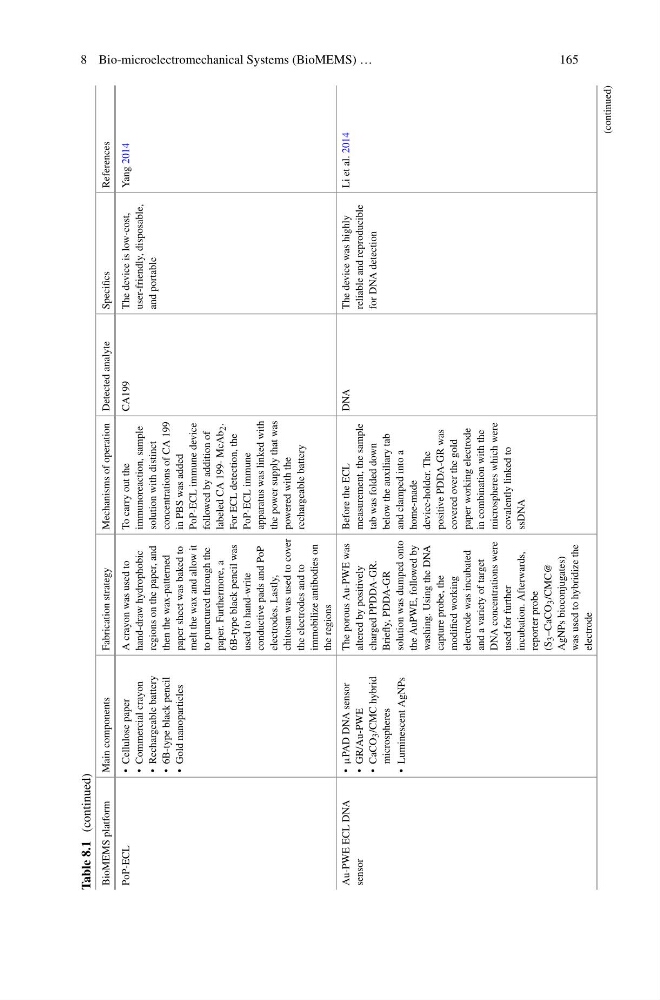
Table 8.1
(continued)
BioMEMS platform
Main components
Fabrication strategy
Mechanisms of operation Detected analyte
Specifics
References
PoP-ECL
• Cellulose paper
• Commercial crayon
• Rechargeable battery
• 6B-type black pencil
• Gold nanoparticles
A crayon was used to
hand-draw hydrophobic
regions on the paper, and
then the wax-patterned
paper sheet was baked to
melt the wax and allow it
to punctured through the
paper. Furthermore, a
6B-type black pencil was
used to hand-write
conductive pads and PoP
electrodes. Lastly,
chitosan was used to cover
the electrodes and to
immobilize antibodies on
the regions
To carry out the
immunoreaction, sample
solution with distinct
concentrations of CA 199
in PBS was added
PoP-ECL immune device
followed by addition of
labeled CA 199- McAb
2 .
For ECL detection, the
PoP-ECL immune
apparatus was linked with
the power supply that was
powered with the
rechargeable battery
CA199
The device is low-cost,
user-friendly, disposable,
and portable
Yang 2014
Au-PWE ECL DNA
sensor
•
µPAD DNA sensor
• GR/Au-PWE
• CaCO
3 /CMC hybrid
microspheres
• Luminescent AgNPs
The porous Au-PWE was
altered by positively
charged PPDDA-GR.
Briefly, PDDA-GR
solution was dumped onto
the AuPWE, followed by
washing. Using the DNA
capture probe, the
modified working
electrode was incubated
and a variety of target
DNA concentrations were
used for further
incubation. Afterwards,
reporter probe
(S
3 –CaCO
3 /CMC@
AgNPs bioconjugates)
was used to hybridize the
electrode
Before the ECL
measurement, the sample
tab was folded down
below the auxiliary tab
and clamped into a
home-made
device-holder. The
positive PDDA-GR was
covered over the gold
paper working electrode
in combination with the
microspheres which were
covalently linked to
ssDNA
DNA
The device was highly
reliable and reproducible
for DNA detection
Li et al. 2014
(continued)
165
Table 8.1
(continued)
BioMEMS platform
Main components
Fabrication strategy
Mechanisms of operation Detected analyte
Specifics
References
PoP-ECL
• Cellulose paper
• Commercial crayon
• Rechargeable battery
• 6B-type black pencil
• Gold nanoparticles
A crayon was used to
hand-draw hydrophobic
regions on the paper, and
then the wax-patterned
paper sheet was baked to
melt the wax and allow it
to punctured through the
paper. Furthermore, a
6B-type black pencil was
used to hand-write
conductive pads and PoP
electrodes. Lastly,
chitosan was used to cover
the electrodes and to
immobilize antibodies on
the regions
To carry out the
immunoreaction, sample
solution with distinct
concentrations of CA 199
in PBS was added
PoP-ECL immune device
followed by addition of
labeled CA 199- McAb
2 .
For ECL detection, the
PoP-ECL immune
apparatus was linked with
the power supply that was
powered with the
rechargeable battery
CA199
The device is low-cost,
user-friendly, disposable,
and portable
Yang 2014
Au-PWE ECL DNA
sensor
•
µPAD DNA sensor
• GR/Au-PWE
• CaCO
3 /CMC hybrid
microspheres
• Luminescent AgNPs
The porous Au-PWE was
altered by positively
charged PPDDA-GR.
Briefly, PDDA-GR
solution was dumped onto
the AuPWE, followed by
washing. Using the DNA
capture probe, the
modified working
electrode was incubated
and a variety of target
DNA concentrations were
used for further
incubation. Afterwards,
reporter probe
(S
3 –CaCO
3 /CMC@
AgNPs bioconjugates)
was used to hybridize the
electrode
Before the ECL
measurement, the sample
tab was folded down
below the auxiliary tab
and clamped into a
home-made
device-holder. The
positive PDDA-GR was
covered over the gold
paper working electrode
in combination with the
microspheres which were
covalently linked to
ssDNA
DNA
The device was highly
reliable and reproducible
for DNA detection
Li et al. 2014
(continued)