

8 Bio-microelectromechanical Systems (BioMEMS) …
163
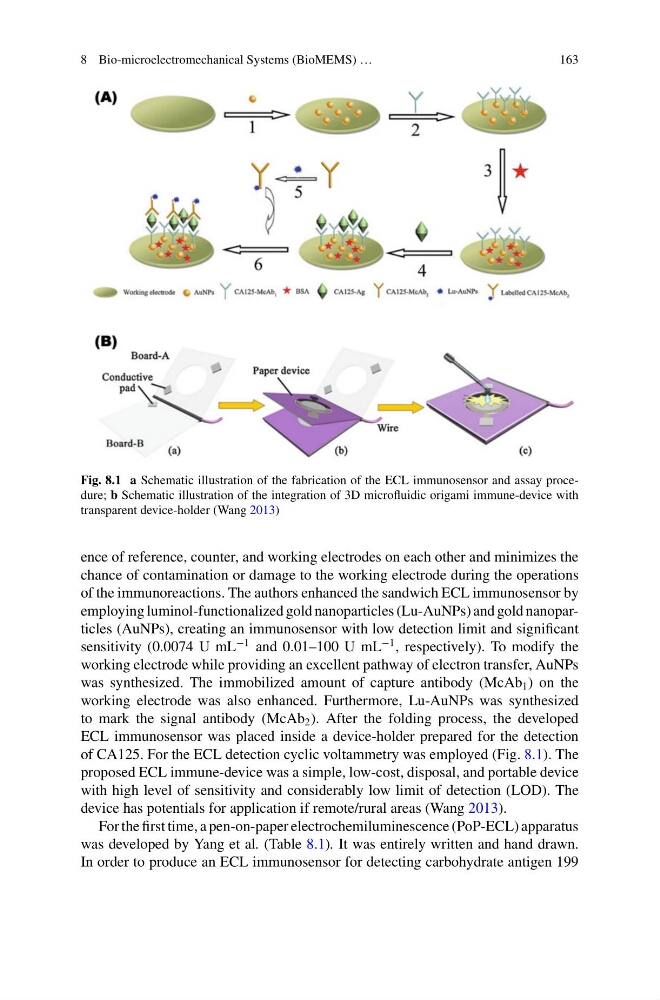
Fig. 8.1 a Schematic illustration of the fabrication of the ECL immunosensor and assay procedure; b Schematic illustration of the integration of 3D microfluidic origami immune-device with
transparent device-holder (Wang 2013)
ence of reference, counter, and working electrodes on each other and minimizes the
chance of contamination or damage to the working electrode during the operations
of the immunoreactions. The authors enhanced the sandwich ECL immunosensor by
employing luminol-functionalized gold nanoparticles (Lu-AuNPs) and gold nanoparticles (AuNPs), creating an immunosensor with low detection limit and significant
sensitivity (0.0074 U mL
−1 and 0.01–100 U mL
−1 , respectively). To modify the
working electrode while providing an excellent pathway of electron transfer, AuNPs
was synthesized. The immobilized amount of capture antibody (McAb 1 ) on the
working electrode was also enhanced. Furthermore, Lu-AuNPs was synthesized
to mark the signal antibody (McAb 2 ). After the folding process, the developed
ECL immunosensor was placed inside a device-holder prepared for the detection
of CA125. For the ECL detection cyclic voltammetry was employed (Fig. 8.1). The
proposed ECL immune-device was a simple, low-cost, disposal, and portable device
with high level of sensitivity and considerably low limit of detection (LOD). The
device has potentials for application if remote/rural areas (Wang 2013).
For the first time, a pen-on-paper electrochemiluminescence (PoP-ECL) apparatus
was developed by Yang et al. (Table 8.1). It was entirely written and hand drawn.
In order to produce an ECL immunosensor for detecting carbohydrate antigen 199
163
Fig. 8.1 a Schematic illustration of the fabrication of the ECL immunosensor and assay procedure; b Schematic illustration of the integration of 3D microfluidic origami immune-device with
transparent device-holder (Wang 2013)
ence of reference, counter, and working electrodes on each other and minimizes the
chance of contamination or damage to the working electrode during the operations
of the immunoreactions. The authors enhanced the sandwich ECL immunosensor by
employing luminol-functionalized gold nanoparticles (Lu-AuNPs) and gold nanoparticles (AuNPs), creating an immunosensor with low detection limit and significant
sensitivity (0.0074 U mL
−1 and 0.01–100 U mL
−1 , respectively). To modify the
working electrode while providing an excellent pathway of electron transfer, AuNPs
was synthesized. The immobilized amount of capture antibody (McAb 1 ) on the
working electrode was also enhanced. Furthermore, Lu-AuNPs was synthesized
to mark the signal antibody (McAb 2 ). After the folding process, the developed
ECL immunosensor was placed inside a device-holder prepared for the detection
of CA125. For the ECL detection cyclic voltammetry was employed (Fig. 8.1). The
proposed ECL immune-device was a simple, low-cost, disposal, and portable device
with high level of sensitivity and considerably low limit of detection (LOD). The
device has potentials for application if remote/rural areas (Wang 2013).
For the first time, a pen-on-paper electrochemiluminescence (PoP-ECL) apparatus
was developed by Yang et al. (Table 8.1). It was entirely written and hand drawn.
In order to produce an ECL immunosensor for detecting carbohydrate antigen 199