

4 Bio-microelectromechanical Systems (BioMEMS) in Bio-sensing …
101
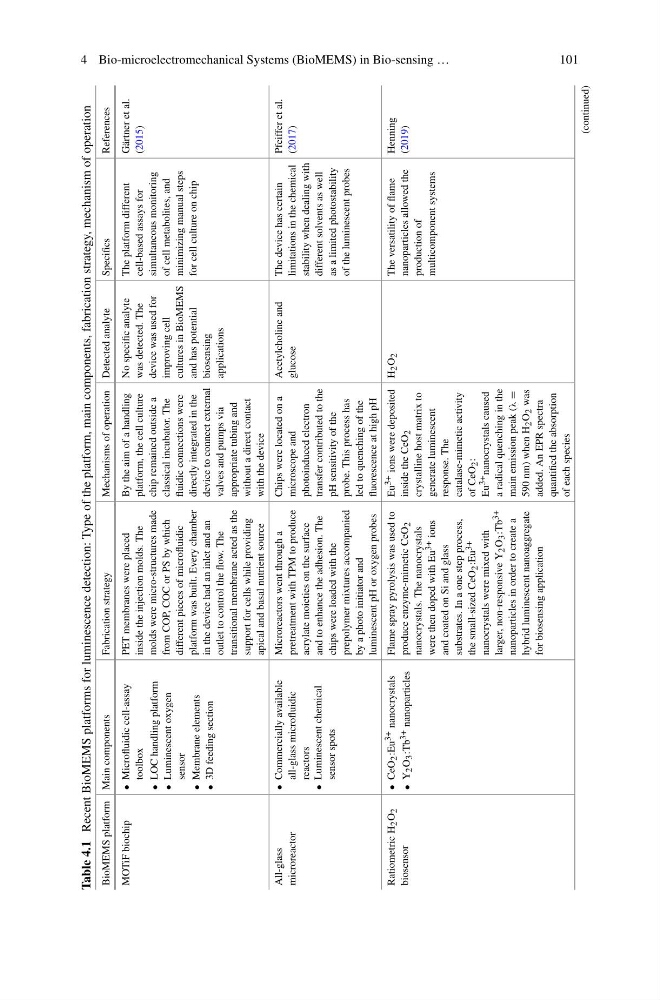
Table 4.1
Recent BioMEMS platforms for luminescence detection: Type of the platform, main components, fabrication strategy, mechanism of operation
BioMEMS platform Main components
Fabrication strategy
Mechanisms of operation Detected analyte
Specifics
References
MOTiF biochip
• Microfluidic cell-assay
toolbox
• LOC handling platform
• Luminescent oxygen
sensor
• Membrane elements
• 3D feeding section
PET membranes were placed
inside the injection molds. The
molds were micro-structures made
from COP, COC or PS by which
different pieces of microfluidic
platform was built. Every chamber
in the device had an inlet and an
outlet to control the flow. The
transitional membrane acted as the
support for cells while providing
apical and basal nutrient source
By the aim of a handling
platform, the cell culture
chip remained outside a
classical incubator. The
fluidic connections were
directly integrated in the
device to connect external
valves and pumps via
appropriate tubing and
without a direct contact
with the device
No specific analyte
was detected. The
device was used for
improving cell
cultures in BioMEMS
and has potential
biosensing
applications
The platform different
cell-based assays for
simultaneous monitoring
of cell metabolites, and
minimizing manual steps
for cell culture on chip
Gärtner et al.
(2015)
All-glass
microreactor
• Commercially available
all-glass microfluidic
reactors
• Luminescent chemical
sensor spots
Microreactors went through a
pretreatment with TPM to produce
acrylate moieties on the surface
and to enhance the adhesion. The
chips were loaded with the
prepolymer mixtures accompanied
by a photo initiator and
luminescent pH or oxygen probes
Chips were located on a
microscope and
photoinduced electron
transfer contributed to the
pH sensitivity of the
probe. This process has
led to quenching of the
fluorescence at high pH
Acetylcholine and
glucose
The device has certain
limitations in the chemical
stability when dealing with
different solvents as well
as a limited photostability
of the luminescent probes
Pfeiffer et al.
(2017)
Ratiometric H
2 O
2
biosensor
• CeO
2 :Eu 3+
nanocrystals
• Y
2 O
3 :Tb 3+
nanoparticles
Flame spray pyrolysis was used to
produce enzyme-mimetic CeO
2
nanocrystals. The nanocrystals
were then doped with Eu 3+
ions
and coated on Si and glass
substrates. In a one step process,
the small-sized CeO
2 :Eu 3+
nanocrystals were mixed with
larger, non-responsive Y
2 O
3 :Tb 3+
nanoparticles in order to create a
hybrid luminescent nanoaggregate
for biosensing application
Eu 3+
ions were deposited
inside the CeO
2
crystalline host matrix to
generate luminescent
response. The
catalase-mimetic activity
of CeO
2 :
Eu 3+
nanocrystals caused
a radical quenching in the
main emission peak (λ
=
590 nm) when H
2 O
2 was
added. An EPR spectra
quantified the absorption
of each species
H
2 O
2
The versatility of flame
nanoparticles allowed the
production of
multicomponent systems
Henning
(2019)
(continued)
101
Table 4.1
Recent BioMEMS platforms for luminescence detection: Type of the platform, main components, fabrication strategy, mechanism of operation
BioMEMS platform Main components
Fabrication strategy
Mechanisms of operation Detected analyte
Specifics
References
MOTiF biochip
• Microfluidic cell-assay
toolbox
• LOC handling platform
• Luminescent oxygen
sensor
• Membrane elements
• 3D feeding section
PET membranes were placed
inside the injection molds. The
molds were micro-structures made
from COP, COC or PS by which
different pieces of microfluidic
platform was built. Every chamber
in the device had an inlet and an
outlet to control the flow. The
transitional membrane acted as the
support for cells while providing
apical and basal nutrient source
By the aim of a handling
platform, the cell culture
chip remained outside a
classical incubator. The
fluidic connections were
directly integrated in the
device to connect external
valves and pumps via
appropriate tubing and
without a direct contact
with the device
No specific analyte
was detected. The
device was used for
improving cell
cultures in BioMEMS
and has potential
biosensing
applications
The platform different
cell-based assays for
simultaneous monitoring
of cell metabolites, and
minimizing manual steps
for cell culture on chip
Gärtner et al.
(2015)
All-glass
microreactor
• Commercially available
all-glass microfluidic
reactors
• Luminescent chemical
sensor spots
Microreactors went through a
pretreatment with TPM to produce
acrylate moieties on the surface
and to enhance the adhesion. The
chips were loaded with the
prepolymer mixtures accompanied
by a photo initiator and
luminescent pH or oxygen probes
Chips were located on a
microscope and
photoinduced electron
transfer contributed to the
pH sensitivity of the
probe. This process has
led to quenching of the
fluorescence at high pH
Acetylcholine and
glucose
The device has certain
limitations in the chemical
stability when dealing with
different solvents as well
as a limited photostability
of the luminescent probes
Pfeiffer et al.
(2017)
Ratiometric H
2 O
2
biosensor
• CeO
2 :Eu 3+
nanocrystals
• Y
2 O
3 :Tb 3+
nanoparticles
Flame spray pyrolysis was used to
produce enzyme-mimetic CeO
2
nanocrystals. The nanocrystals
were then doped with Eu 3+
ions
and coated on Si and glass
substrates. In a one step process,
the small-sized CeO
2 :Eu 3+
nanocrystals were mixed with
larger, non-responsive Y
2 O
3 :Tb 3+
nanoparticles in order to create a
hybrid luminescent nanoaggregate
for biosensing application
Eu 3+
ions were deposited
inside the CeO
2
crystalline host matrix to
generate luminescent
response. The
catalase-mimetic activity
of CeO
2 :
Eu 3+
nanocrystals caused
a radical quenching in the
main emission peak (λ
=
590 nm) when H
2 O
2 was
added. An EPR spectra
quantified the absorption
of each species
H
2 O
2
The versatility of flame
nanoparticles allowed the
production of
multicomponent systems
Henning
(2019)
(continued)