

102
A. S. Cerda-Kipper and S. Hosseini
Table 4.1
(continued)
BioMEMS platform Main components
Fabrication strategy
Mechanisms of operation Detected analyte
Specifics
References
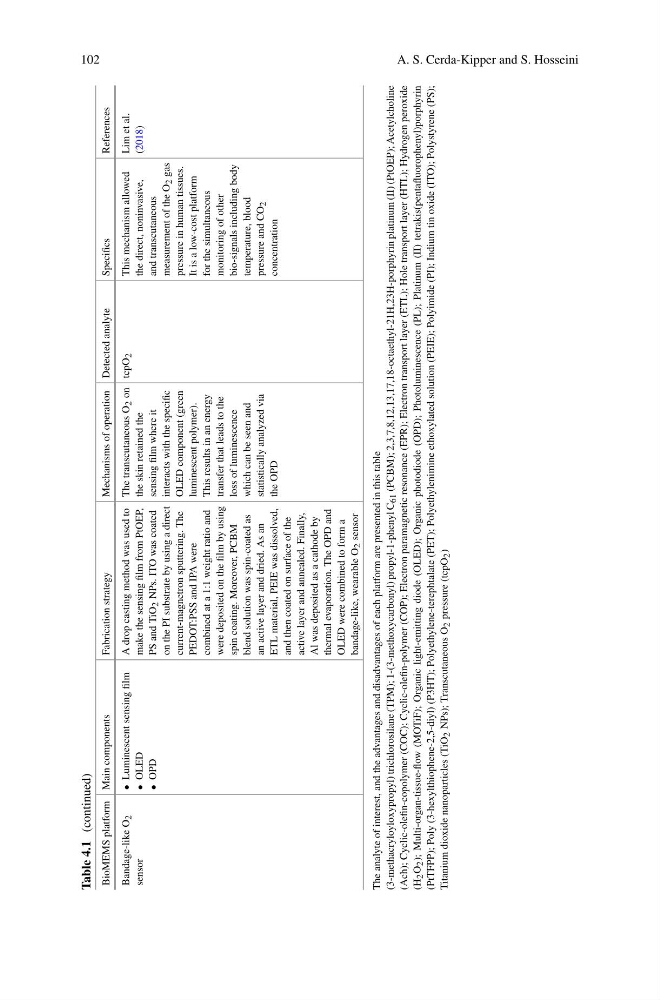
Bandage-like O
2
sensor
• Luminescent sensing film
• OLED
• OPD
A drop casting method was used to
make the sensing film from PtOEP,
PS and TiO
2 NPs. ITO was coated
on the PI substrate by using a direct
current-magnetron sputtering. The
PEDOT:PSS and IPA were
combined at a 1:1 weight ratio and
were deposited on the film by using
spin coating. Moreover, PCBM
blend solution was spin-coated as
an active layer and dried. As an
ETL material, PEIE was dissolved,
and then coated on surface of the
active layer and annealed. Finally,
Al was deposited as a cathode by
thermal evaporation. The OPD and
OLED were combined to form a
bandage-like, wearable O
2 sensor
The transcutaneous O
2 on
the skin retained the
sensing film where it
interacts with the specific
OLED component (green
luminescent polymer).
This results in an energy
transfer that leads to the
loss of luminescence
which can be seen and
statistically analyzed via
the OPD
tcpO
2
This mechanism allowed
the direct, noninvasive,
and transcutaneous
measurement of the O
2 gas
pressure in human tissues.
It is a low-cost platform
for the simultaneous
monitoring of other
bio-signals including body
temperature, blood
pressure and CO
2
concentration
Lim et al.
(2018)
The analyte of interest, and the advantages and disadvantages of each platform are presented in this table
(3-methacryloyloxypropyl) trichlorosilane (TPM); 1-(3-methoxycarbonyl) propyl-1-phenyl C
61 (PCBM); 2,3,7,8,12,13,17,18-octaethyl-21H,23H-porphyrin platinum (II) (PtOEP); Acetylcholine
(Ach); Cyclic-olefin-copolymer (COC); Cyclic-olefin-polymer (COP); Electron paramagnetic resonance (EPR); Electron transport layer (ETL); Hole transport layer (HTL); Hydrogen peroxide
(H
2 O
2 ); Multi-organ-tissue-flow (MOTiF); Organic light-emitting diode (OLED); Organic photodiode (OPD); Photoluminescence (PL); Platinum (II) tetrakis(pentafluorophenyl)porphyrin
(PtTFPP); Poly (3-hexylthiophene-2,5-diyl) (P3HT); Polyethylene-terephtalate (PET); Polyethylenimine ethoxylated solution (PEIE); Polyimide (PI); Indium tin oxide (ITO); Polystyrene (PS);
Titanium dioxide nanoparticles (TiO
2 NPs); Transcutaneous O
2 pressure (tcpO
2 )
A. S. Cerda-Kipper and S. Hosseini
Table 4.1
(continued)
BioMEMS platform Main components
Fabrication strategy
Mechanisms of operation Detected analyte
Specifics
References
Bandage-like O
2
sensor
• Luminescent sensing film
• OLED
• OPD
A drop casting method was used to
make the sensing film from PtOEP,
PS and TiO
2 NPs. ITO was coated
on the PI substrate by using a direct
current-magnetron sputtering. The
PEDOT:PSS and IPA were
combined at a 1:1 weight ratio and
were deposited on the film by using
spin coating. Moreover, PCBM
blend solution was spin-coated as
an active layer and dried. As an
ETL material, PEIE was dissolved,
and then coated on surface of the
active layer and annealed. Finally,
Al was deposited as a cathode by
thermal evaporation. The OPD and
OLED were combined to form a
bandage-like, wearable O
2 sensor
The transcutaneous O
2 on
the skin retained the
sensing film where it
interacts with the specific
OLED component (green
luminescent polymer).
This results in an energy
transfer that leads to the
loss of luminescence
which can be seen and
statistically analyzed via
the OPD
tcpO
2
This mechanism allowed
the direct, noninvasive,
and transcutaneous
measurement of the O
2 gas
pressure in human tissues.
It is a low-cost platform
for the simultaneous
monitoring of other
bio-signals including body
temperature, blood
pressure and CO
2
concentration
Lim et al.
(2018)
The analyte of interest, and the advantages and disadvantages of each platform are presented in this table
(3-methacryloyloxypropyl) trichlorosilane (TPM); 1-(3-methoxycarbonyl) propyl-1-phenyl C
61 (PCBM); 2,3,7,8,12,13,17,18-octaethyl-21H,23H-porphyrin platinum (II) (PtOEP); Acetylcholine
(Ach); Cyclic-olefin-copolymer (COC); Cyclic-olefin-polymer (COP); Electron paramagnetic resonance (EPR); Electron transport layer (ETL); Hole transport layer (HTL); Hydrogen peroxide
(H
2 O
2 ); Multi-organ-tissue-flow (MOTiF); Organic light-emitting diode (OLED); Organic photodiode (OPD); Photoluminescence (PL); Platinum (II) tetrakis(pentafluorophenyl)porphyrin
(PtTFPP); Poly (3-hexylthiophene-2,5-diyl) (P3HT); Polyethylene-terephtalate (PET); Polyethylenimine ethoxylated solution (PEIE); Polyimide (PI); Indium tin oxide (ITO); Polystyrene (PS);
Titanium dioxide nanoparticles (TiO
2 NPs); Transcutaneous O
2 pressure (tcpO
2 )