

94
L. Acosta-Soto and S. Hosseini
The BHQ 2 served as an organic quencher that signals the acquisition of target
sequence. The functionalized DNA-QD’s exhibited a high degree of specificity in
binding to target analyte, while avoiding interactions with other genetic sequences.
The previously alluded capability of FITC to tailor its fluorescent response to
excitation depending on the pH of its medium was further investigated by Ding et al.
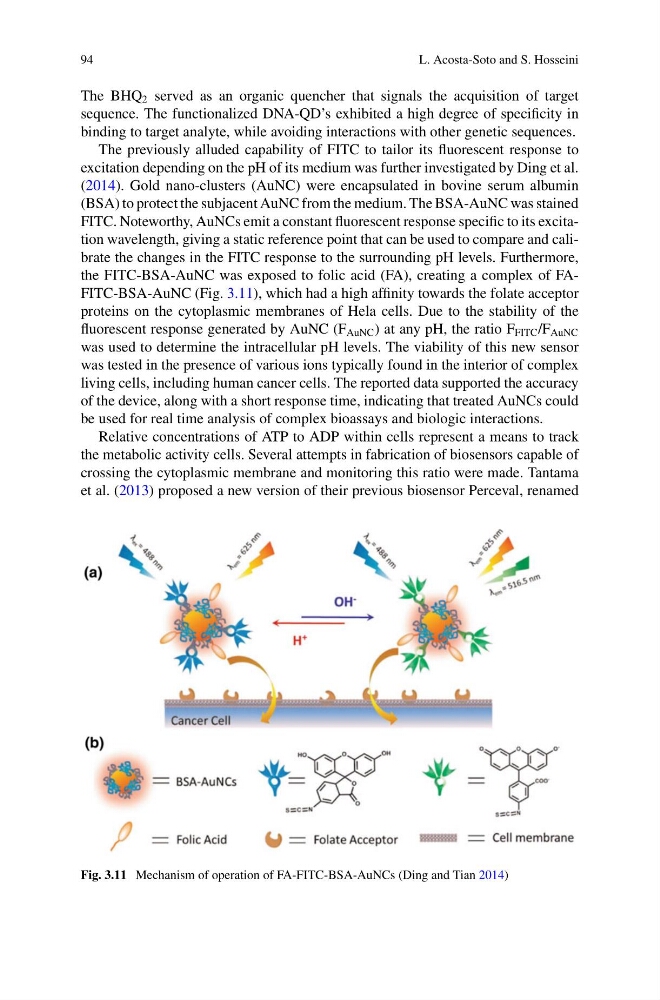
(2014). Gold nano-clusters (AuNC) were encapsulated in bovine serum albumin
(BSA) to protect the subjacent AuNC from the medium. The BSA-AuNC was stained
FITC. Noteworthy, AuNCs emit a constant fluorescent response specific to its excitation wavelength, giving a static reference point that can be used to compare and calibrate the changes in the FITC response to the surrounding pH levels. Furthermore,
the FITC-BSA-AuNC was exposed to folic acid (FA), creating a complex of FAFITC-BSA-AuNC (Fig. 3.11), which had a high affinity towards the folate acceptor
proteins on the cytoplasmic membranes of Hela cells. Due to the stability of the
fluorescent response generated by AuNC (F AuNC ) at any pH, the ratio F FITC /F AuNC
was used to determine the intracellular pH levels. The viability of this new sensor
was tested in the presence of various ions typically found in the interior of complex
living cells, including human cancer cells. The reported data supported the accuracy
of the device, along with a short response time, indicating that treated AuNCs could
be used for real time analysis of complex bioassays and biologic interactions.
Relative concentrations of ATP to ADP within cells represent a means to track
the metabolic activity cells. Several attempts in fabrication of biosensors capable of
crossing the cytoplasmic membrane and monitoring this ratio were made. Tantama
et al. (2013) proposed a new version of their previous biosensor Perceval, renamed
Fig. 3.11 Mechanism of operation of FA-FITC-BSA-AuNCs (Ding and Tian 2014)
L. Acosta-Soto and S. Hosseini
The BHQ 2 served as an organic quencher that signals the acquisition of target
sequence. The functionalized DNA-QD’s exhibited a high degree of specificity in
binding to target analyte, while avoiding interactions with other genetic sequences.
The previously alluded capability of FITC to tailor its fluorescent response to
excitation depending on the pH of its medium was further investigated by Ding et al.
(2014). Gold nano-clusters (AuNC) were encapsulated in bovine serum albumin
(BSA) to protect the subjacent AuNC from the medium. The BSA-AuNC was stained
FITC. Noteworthy, AuNCs emit a constant fluorescent response specific to its excitation wavelength, giving a static reference point that can be used to compare and calibrate the changes in the FITC response to the surrounding pH levels. Furthermore,
the FITC-BSA-AuNC was exposed to folic acid (FA), creating a complex of FAFITC-BSA-AuNC (Fig. 3.11), which had a high affinity towards the folate acceptor
proteins on the cytoplasmic membranes of Hela cells. Due to the stability of the
fluorescent response generated by AuNC (F AuNC ) at any pH, the ratio F FITC /F AuNC
was used to determine the intracellular pH levels. The viability of this new sensor
was tested in the presence of various ions typically found in the interior of complex
living cells, including human cancer cells. The reported data supported the accuracy
of the device, along with a short response time, indicating that treated AuNCs could
be used for real time analysis of complex bioassays and biologic interactions.
Relative concentrations of ATP to ADP within cells represent a means to track
the metabolic activity cells. Several attempts in fabrication of biosensors capable of
crossing the cytoplasmic membrane and monitoring this ratio were made. Tantama
et al. (2013) proposed a new version of their previous biosensor Perceval, renamed
Fig. 3.11 Mechanism of operation of FA-FITC-BSA-AuNCs (Ding and Tian 2014)