

3.4 Experimental Implementation of RP-THz-TDS
59
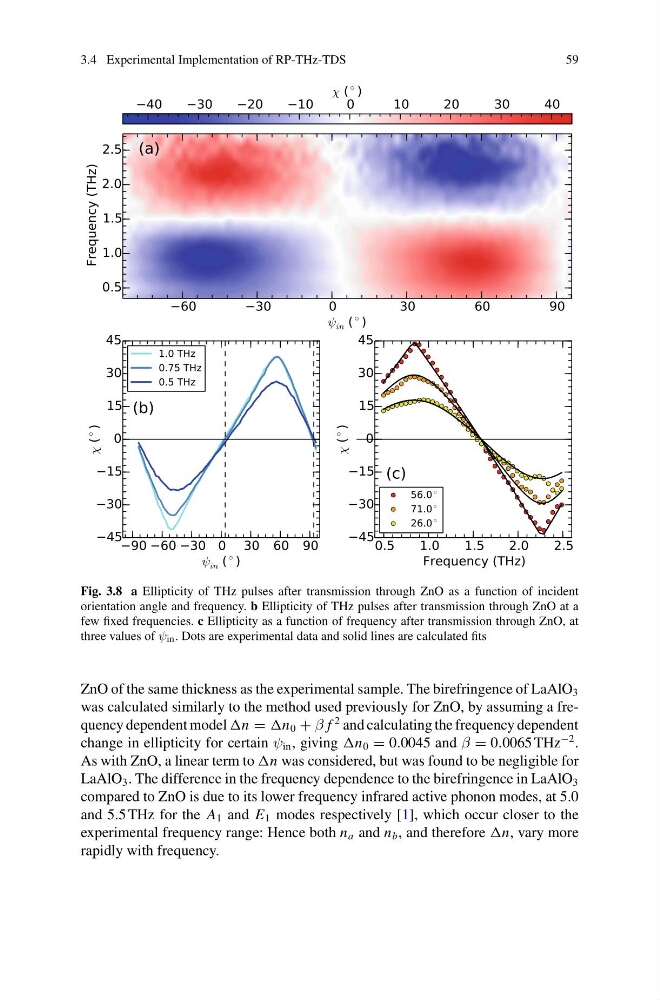
Fig. 3.8 a Ellipticity of THz pulses after transmission through ZnO as a function of incident
orientation angle and frequency. b Ellipticity of THz pulses after transmission through ZnO at a
few fixed frequencies. c Ellipticity as a function of frequency after transmission through ZnO, at
three values of ψ in . Dots are experimental data and solid lines are calculated fits
ZnO of the same thickness as the experimental sample. The birefringence of LaAlO 3
was calculated similarly to the method used previously for ZnO, by assuming a frequency dependent model = 0 + β f
2 and calculating the frequency dependent
change in ellipticity for certain ψ in , giving 0 = 0.0045 and β = 0.0065 THz
−2 .
As with ZnO, a linear term to was considered, but was found to be negligible for
LaAlO 3 . The difference in the frequency dependence to the birefringence in LaAlO 3
compared to ZnO is due to its lower frequency infrared active phonon modes, at 5.0
and 5.5 THz for the A 1 and E 1 modes respectively [1], which occur closer to the
experimental frequency range: Hence both n a and n b , and therefore vary more
rapidly with frequency.
59
Fig. 3.8 a Ellipticity of THz pulses after transmission through ZnO as a function of incident
orientation angle and frequency. b Ellipticity of THz pulses after transmission through ZnO at a
few fixed frequencies. c Ellipticity as a function of frequency after transmission through ZnO, at
three values of ψ in . Dots are experimental data and solid lines are calculated fits
ZnO of the same thickness as the experimental sample. The birefringence of LaAlO 3
was calculated similarly to the method used previously for ZnO, by assuming a frequency dependent model = 0 + β f
2 and calculating the frequency dependent
change in ellipticity for certain ψ in , giving 0 = 0.0045 and β = 0.0065 THz
−2 .
As with ZnO, a linear term to was considered, but was found to be negligible for
LaAlO 3 . The difference in the frequency dependence to the birefringence in LaAlO 3
compared to ZnO is due to its lower frequency infrared active phonon modes, at 5.0
and 5.5 THz for the A 1 and E 1 modes respectively [1], which occur closer to the
experimental frequency range: Hence both n a and n b , and therefore vary more
rapidly with frequency.