

thermodynamic and dynamic conditions locally that also
contribute to rainfall occurrence. In general, climate simulations hint that the global warming is expected to enhance the
Indian summer monsoon precipitation by 5–10%, albeit some
climate models suggest less. In the Indian monsoon region,
the seasonal movement of the ITCZ brings rainfall over land,
and the convection is strongly coupled with large-scale circulation (Goswami 2006; Joseph and Sabin 2008; Gadgil
2018). However, this convective-coupling is relatively weak
in most of the CMIP5 models and mostly simulating an
increase in precipitation irrespective of the anomalous
decrease in monsoon circulation (Krishnan et al. 2016).
Sabeerali et al. (2015) postulated that the increase in future
ISMR simulated in CMIP5 models is a result of unrealistic
local convective precipitation enhancement that is not related
to large-scale monsoon dynamics, which is mainly due to the
unrealistic representation of stratiform and convective cloud
ratio in the coupled model. Using CMIP5 outputs, Sabeerali
and Ajaymohan (2018) showed that there is a possibility of a
shorter rainy season (defined using tropospheric temperature
gradient as outlined by Goswami and Xavier (2005)) by the
end of the twenty-first century in the RCP8.5 scenario.
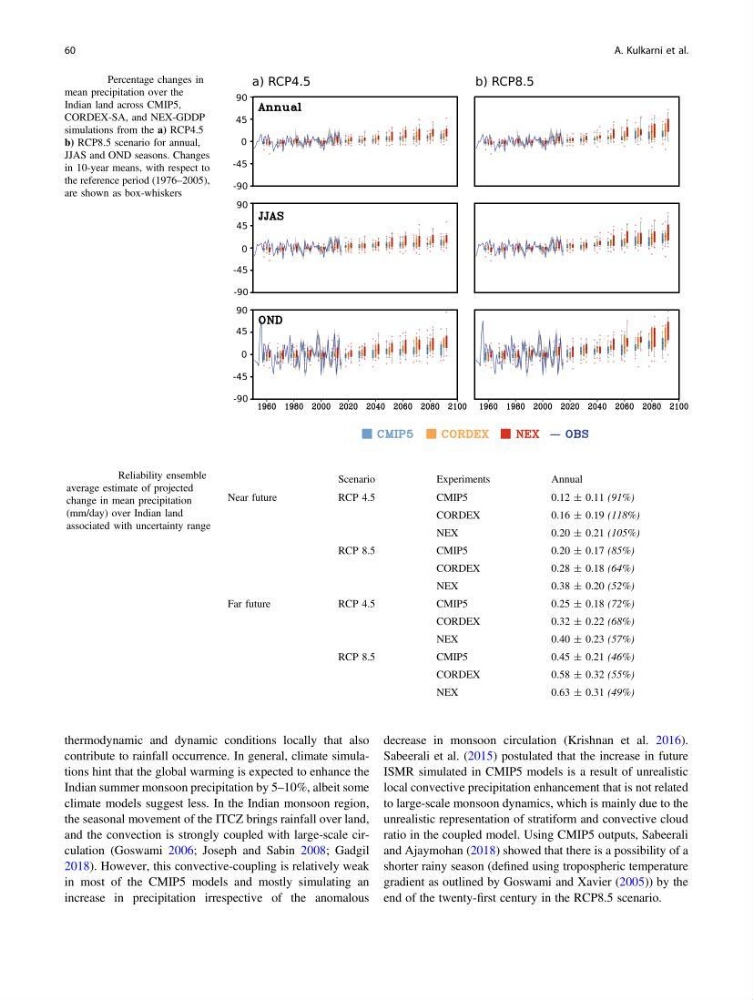
Fig. 3.7 Percentage changes in
mean precipitation over the
Indian land across CMIP5,
CORDEX-SA, and NEX-GDDP
simulations from the a) RCP4.5
b) RCP8.5 scenario for annual,
JJAS and OND seasons. Changes
in 10-year means, with respect to
the reference period (1976–2005),
are shown as box-whiskers
Table 3.4 Reliability ensemble
average estimate of projected
change in mean precipitation
(mm/day) over Indian land
associated with uncertainty range
Scenario
Experiments
Annual
Near future
RCP 4.5
CMIP5
0.12 ± 0.11 (91%)
CORDEX
0.16 ± 0.19 (118%)
NEX
0.20 ± 0.21 (105%)
RCP 8.5
CMIP5
0.20 ± 0.17 (85%)
CORDEX
0.28 ± 0.18 (64%)
NEX
0.38 ± 0.20 (52%)
Far future
RCP 4.5
CMIP5
0.25 ± 0.18 (72%)
CORDEX
0.32 ± 0.22 (68%)
NEX
0.40 ± 0.23 (57%)
RCP 8.5
CMIP5
0.45 ± 0.21 (46%)
CORDEX
0.58 ± 0.32 (55%)
NEX
0.63 ± 0.31 (49%)
60
A. Kulkarni et al.
contribute to rainfall occurrence. In general, climate simulations hint that the global warming is expected to enhance the
Indian summer monsoon precipitation by 5–10%, albeit some
climate models suggest less. In the Indian monsoon region,
the seasonal movement of the ITCZ brings rainfall over land,
and the convection is strongly coupled with large-scale circulation (Goswami 2006; Joseph and Sabin 2008; Gadgil
2018). However, this convective-coupling is relatively weak
in most of the CMIP5 models and mostly simulating an
increase in precipitation irrespective of the anomalous
decrease in monsoon circulation (Krishnan et al. 2016).
Sabeerali et al. (2015) postulated that the increase in future
ISMR simulated in CMIP5 models is a result of unrealistic
local convective precipitation enhancement that is not related
to large-scale monsoon dynamics, which is mainly due to the
unrealistic representation of stratiform and convective cloud
ratio in the coupled model. Using CMIP5 outputs, Sabeerali
and Ajaymohan (2018) showed that there is a possibility of a
shorter rainy season (defined using tropospheric temperature
gradient as outlined by Goswami and Xavier (2005)) by the
end of the twenty-first century in the RCP8.5 scenario.
Fig. 3.7 Percentage changes in
mean precipitation over the
Indian land across CMIP5,
CORDEX-SA, and NEX-GDDP
simulations from the a) RCP4.5
b) RCP8.5 scenario for annual,
JJAS and OND seasons. Changes
in 10-year means, with respect to
the reference period (1976–2005),
are shown as box-whiskers
Table 3.4 Reliability ensemble
average estimate of projected
change in mean precipitation
(mm/day) over Indian land
associated with uncertainty range
Scenario
Experiments
Annual
Near future
RCP 4.5
CMIP5
0.12 ± 0.11 (91%)
CORDEX
0.16 ± 0.19 (118%)
NEX
0.20 ± 0.21 (105%)
RCP 8.5
CMIP5
0.20 ± 0.17 (85%)
CORDEX
0.28 ± 0.18 (64%)
NEX
0.38 ± 0.20 (52%)
Far future
RCP 4.5
CMIP5
0.25 ± 0.18 (72%)
CORDEX
0.32 ± 0.22 (68%)
NEX
0.40 ± 0.23 (57%)
RCP 8.5
CMIP5
0.45 ± 0.21 (46%)
CORDEX
0.58 ± 0.32 (55%)
NEX
0.63 ± 0.31 (49%)
60
A. Kulkarni et al.