

overly strong control by ENSO. As such, a positive IOD is
associated with an ISM rainfall reduction in the simulated
present-day climate. They further highlight that the uncertainties in ISM rainfall projection can be in part due to the
present-day simulation of ENSO, the IOD, their relationship,
and their rainfall correlations. Thus, the natural variability
also plays a dominant role in the diverse ENSO-monsoon
relationship during the twentieth century (Li and Ting 2015).
From CMIP5 models, the analysis by Li et al. (2017) further
showed that in future, the enhance SST warming could likely
lead to a weak ENSO-monsoon relation as well.
Multi-model average changes considered in the different
model sources, in general, suggest wetter future conditions.
CMIP5 models project an increase of 6% (RCP4.5) and 8%
(RCP8.5) in the near future over the central Indian region
(core monsoon zone defined by Rajeevan et al. 2008). Projected changes in rainfall by the end of the twenty-first
century are 10% (RCP4.5) and 14% (RCP8.5), respectively.
The vast majority of the CMIP models shows enhanced
monsoon precipitation due to global warming (e.g. Kitoh
et al. 1997; Douville et al. 2000; Ueda et al. 2006; Cherchi
et al. 2011; Rajendran et al. 2012; Krishnan et al. 2013);
however, they indicate a likely weakening of large-scale
monsoonal circulation (Krishnan et al. 2016). Many studies
noted that the poor skill in simulating monsoon amplifies the
ambiguities in understanding the future changes in projected
monsoon rainfall (e.g. Chaturvedi et al. 2012; Saha et al.
2014; Sharmila et al. 2015; Krishnan et al. 2016). Studies
have highlighted the wide inter-model spread in the simulated precipitation changes over South Asia, which therefore
makes the assessment of regional hydroclimatic response a
bit ambiguous in reality (e.g. Kripalani et al. 2007; Annamalai et al. 2007; Turner and Slingo 2009; Sabade
et al. 2011; Fan et al. 2010; Hasson et al. 2013; Saha et al.
2014).
Applying the Clausius–Clapeyron equation, the water
vapour holding capacity of the atmosphere is expected to
increase by about 7% per degree of warming. The enhanced
availability of moisture can naturally lead to more precipitation over different parts of the globe (Trenberth 1998;
Meehl et al. 2005). Indeed, there is a considerable multiscale
feedback through large-scale circulation and various
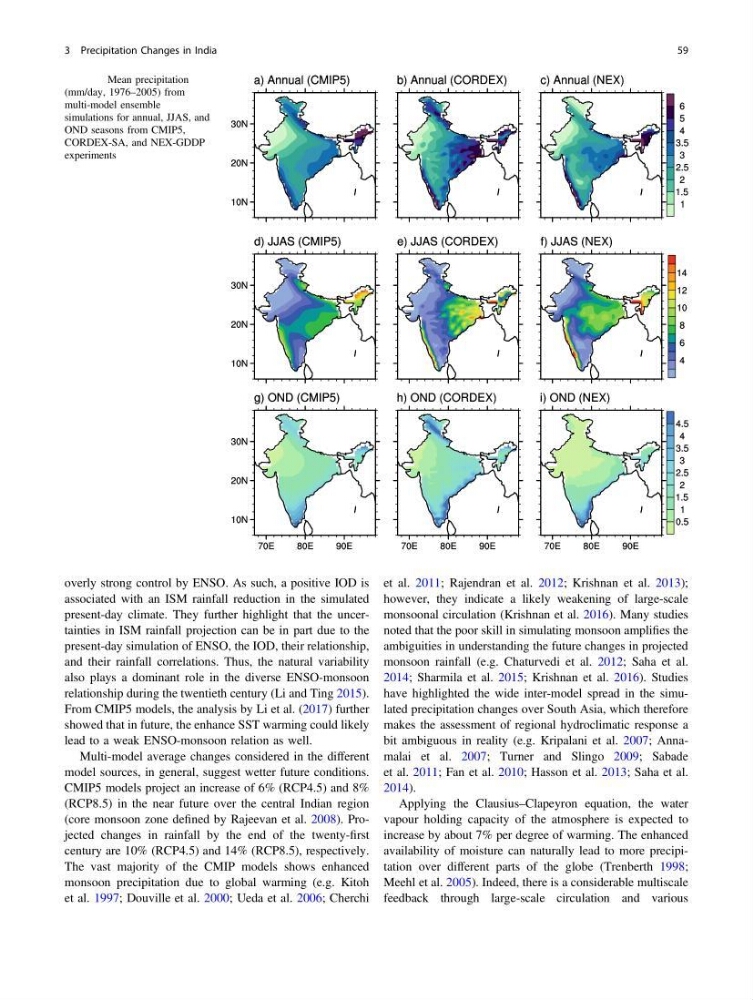
Fig. 3.6 Mean precipitation
(mm/day, 1976–2005) from
multi-model ensemble
simulations for annual, JJAS, and
OND seasons from CMIP5,
CORDEX-SA, and NEX-GDDP
experiments
3 Precipitation Changes in India
59
associated with an ISM rainfall reduction in the simulated
present-day climate. They further highlight that the uncertainties in ISM rainfall projection can be in part due to the
present-day simulation of ENSO, the IOD, their relationship,
and their rainfall correlations. Thus, the natural variability
also plays a dominant role in the diverse ENSO-monsoon
relationship during the twentieth century (Li and Ting 2015).
From CMIP5 models, the analysis by Li et al. (2017) further
showed that in future, the enhance SST warming could likely
lead to a weak ENSO-monsoon relation as well.
Multi-model average changes considered in the different
model sources, in general, suggest wetter future conditions.
CMIP5 models project an increase of 6% (RCP4.5) and 8%
(RCP8.5) in the near future over the central Indian region
(core monsoon zone defined by Rajeevan et al. 2008). Projected changes in rainfall by the end of the twenty-first
century are 10% (RCP4.5) and 14% (RCP8.5), respectively.
The vast majority of the CMIP models shows enhanced
monsoon precipitation due to global warming (e.g. Kitoh
et al. 1997; Douville et al. 2000; Ueda et al. 2006; Cherchi
et al. 2011; Rajendran et al. 2012; Krishnan et al. 2013);
however, they indicate a likely weakening of large-scale
monsoonal circulation (Krishnan et al. 2016). Many studies
noted that the poor skill in simulating monsoon amplifies the
ambiguities in understanding the future changes in projected
monsoon rainfall (e.g. Chaturvedi et al. 2012; Saha et al.
2014; Sharmila et al. 2015; Krishnan et al. 2016). Studies
have highlighted the wide inter-model spread in the simulated precipitation changes over South Asia, which therefore
makes the assessment of regional hydroclimatic response a
bit ambiguous in reality (e.g. Kripalani et al. 2007; Annamalai et al. 2007; Turner and Slingo 2009; Sabade
et al. 2011; Fan et al. 2010; Hasson et al. 2013; Saha et al.
2014).
Applying the Clausius–Clapeyron equation, the water
vapour holding capacity of the atmosphere is expected to
increase by about 7% per degree of warming. The enhanced
availability of moisture can naturally lead to more precipitation over different parts of the globe (Trenberth 1998;
Meehl et al. 2005). Indeed, there is a considerable multiscale
feedback through large-scale circulation and various
Fig. 3.6 Mean precipitation
(mm/day, 1976–2005) from
multi-model ensemble
simulations for annual, JJAS, and
OND seasons from CMIP5,
CORDEX-SA, and NEX-GDDP
experiments
3 Precipitation Changes in India
59