

future climate is noted in all three experiments, especially for
the RCP8.5 scenario as noted by Singh and Achutarao 2018.
The quantitative estimate of future changes in annual mean
precipitation from different Reliability Ensemble Average
(REA) for projected change in precipitation (mm/day) along
with uncertainty range is summarized in Table 3.4.
The percentage change in projected mean precipitation
pattern for near and far future from RCP4.5 and RCP 8.5 is
shown in Fig. 3.8. Multi-model mean change suggests
wetter condition over India in near and far future on average.
Slightly different scenario is projected in the CORDEX
simulations over the northwest Indian region with a 10%
drier condition than its present-day mean for near future in
RCP4.5 simulations. During the winter months, northeast
India is projected to witness a moderate deficit condition in
the near future (both in CMIP5 and NEX); in addition to
this, CORDEX models suggest a potential reduction over the
Himachal and Jammu belt. From the extreme scenario
(RCP8.5, both near and far future) and far future in RCP4.5,
consistent pattern emerges among the three sources, irrespective of variations in their spatial resolution and
methodologies followed. The changes in annual mean precipitation surpass 10% above baseline over the west coast
and southern locale of the Indian landmass in the RCP4.5
scenario in the near future, and exceed 20% in far future
(Figs. 3.8 and 3.9). Over the rest of India, the precipitation
changes are not significant for the near future up to the
mid-twenty-first century, yet in the long-term; increment
surpasses 10% over northwest and the adjoining territory of
the nation. The long-term projected annual precipitation
increment surpasses 10% over most parts the Indian
landmass.
3.3.1 Future Changes in the Summer Monsoon
ENSO and IOD typically exert an offsetting impact on
Indian summer monsoon rainfall (ISMR), with an El Niño
event tending to lower, whereas a positive IOD tending to
increase ISM rainfall (Ashok and Saji 2007). In a recent
study, Li et al. (2017) showed that CMIP5 models simulate
an unrealistic present-day IOD-ISMR correlation due to an
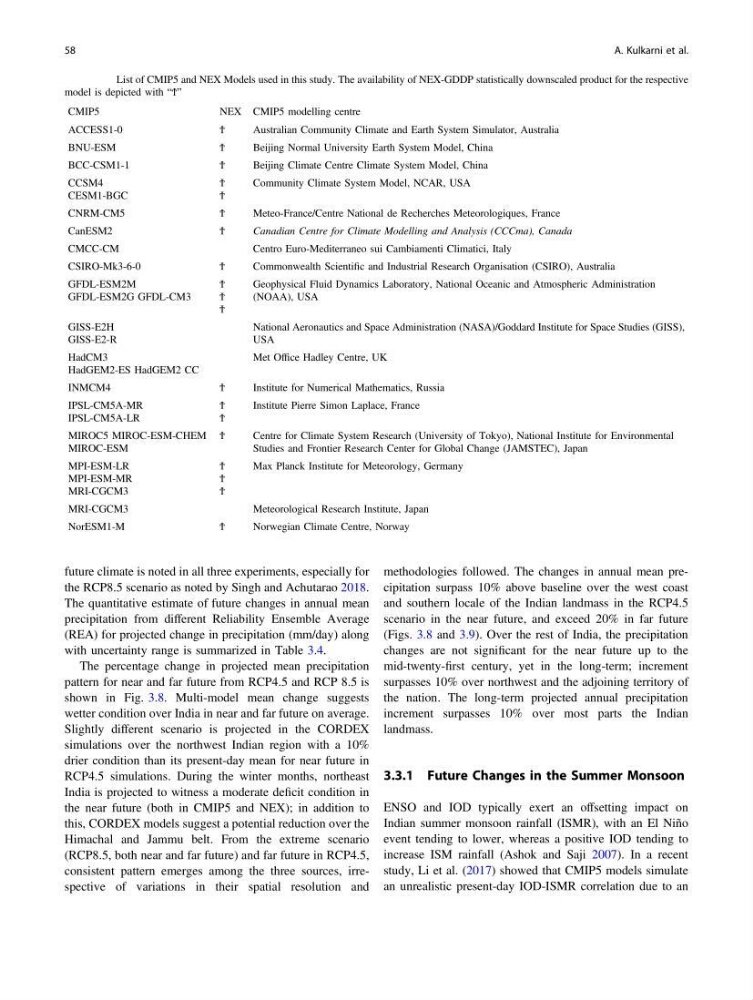
Table 3.3 List of CMIP5 and NEX Models used in this study. The availability of NEX-GDDP statistically downscaled product for the respective
model is depicted with “Ϯ”
CMIP5
NEX CMIP5 modelling centre
ACCESS1-0
Ϯ
Australian Community Climate and Earth System Simulator, Australia
BNU-ESM
Ϯ
Beijing Normal University Earth System Model, China
BCC-CSM1-1
Ϯ
Beijing Climate Centre Climate System Model, China
CCSM4
CESM1-BGC
Ϯ
Ϯ
Community Climate System Model, NCAR, USA
CNRM-CM5
Ϯ
Meteo-France/Centre National de Recherches Meteorologiques, France
CanESM2
Ϯ
Canadian Centre for Climate Modelling and Analysis (CCCma), Canada
CMCC-CM
Centro Euro-Mediterraneo sui Cambiamenti Climatici, Italy
CSIRO-Mk3-6-0
Ϯ
Commonwealth Scientific and Industrial Research Organisation (CSIRO), Australia
GFDL-ESM2M
GFDL-ESM2G GFDL-CM3
Ϯ
Ϯ
Ϯ
Geophysical Fluid Dynamics Laboratory, National Oceanic and Atmospheric Administration
(NOAA), USA
GISS-E2H
GISS-E2-R
National Aeronautics and Space Administration (NASA)/Goddard Institute for Space Studies (GISS),
USA
HadCM3
HadGEM2-ES HadGEM2 CC
Met Office Hadley Centre, UK
INMCM4
Ϯ
Institute for Numerical Mathematics, Russia
IPSL-CM5A-MR
IPSL-CM5A-LR
Ϯ
Ϯ
Institute Pierre Simon Laplace, France
MIROC5 MIROC-ESM-CHEM
MIROC-ESM
Ϯ
Centre for Climate System Research (University of Tokyo), National Institute for Environmental
Studies and Frontier Research Center for Global Change (JAMSTEC), Japan
MPI-ESM-LR
MPI-ESM-MR
MRI-CGCM3
Ϯ
Ϯ
Ϯ
Max Planck Institute for Meteorology, Germany
MRI-CGCM3
Meteorological Research Institute, Japan
NorESM1-M
Ϯ
Norwegian Climate Centre, Norway
58
A. Kulkarni et al.
the RCP8.5 scenario as noted by Singh and Achutarao 2018.
The quantitative estimate of future changes in annual mean
precipitation from different Reliability Ensemble Average
(REA) for projected change in precipitation (mm/day) along
with uncertainty range is summarized in Table 3.4.
The percentage change in projected mean precipitation
pattern for near and far future from RCP4.5 and RCP 8.5 is
shown in Fig. 3.8. Multi-model mean change suggests
wetter condition over India in near and far future on average.
Slightly different scenario is projected in the CORDEX
simulations over the northwest Indian region with a 10%
drier condition than its present-day mean for near future in
RCP4.5 simulations. During the winter months, northeast
India is projected to witness a moderate deficit condition in
the near future (both in CMIP5 and NEX); in addition to
this, CORDEX models suggest a potential reduction over the
Himachal and Jammu belt. From the extreme scenario
(RCP8.5, both near and far future) and far future in RCP4.5,
consistent pattern emerges among the three sources, irrespective of variations in their spatial resolution and
methodologies followed. The changes in annual mean precipitation surpass 10% above baseline over the west coast
and southern locale of the Indian landmass in the RCP4.5
scenario in the near future, and exceed 20% in far future
(Figs. 3.8 and 3.9). Over the rest of India, the precipitation
changes are not significant for the near future up to the
mid-twenty-first century, yet in the long-term; increment
surpasses 10% over northwest and the adjoining territory of
the nation. The long-term projected annual precipitation
increment surpasses 10% over most parts the Indian
landmass.
3.3.1 Future Changes in the Summer Monsoon
ENSO and IOD typically exert an offsetting impact on
Indian summer monsoon rainfall (ISMR), with an El Niño
event tending to lower, whereas a positive IOD tending to
increase ISM rainfall (Ashok and Saji 2007). In a recent
study, Li et al. (2017) showed that CMIP5 models simulate
an unrealistic present-day IOD-ISMR correlation due to an
Table 3.3 List of CMIP5 and NEX Models used in this study. The availability of NEX-GDDP statistically downscaled product for the respective
model is depicted with “Ϯ”
CMIP5
NEX CMIP5 modelling centre
ACCESS1-0
Ϯ
Australian Community Climate and Earth System Simulator, Australia
BNU-ESM
Ϯ
Beijing Normal University Earth System Model, China
BCC-CSM1-1
Ϯ
Beijing Climate Centre Climate System Model, China
CCSM4
CESM1-BGC
Ϯ
Ϯ
Community Climate System Model, NCAR, USA
CNRM-CM5
Ϯ
Meteo-France/Centre National de Recherches Meteorologiques, France
CanESM2
Ϯ
Canadian Centre for Climate Modelling and Analysis (CCCma), Canada
CMCC-CM
Centro Euro-Mediterraneo sui Cambiamenti Climatici, Italy
CSIRO-Mk3-6-0
Ϯ
Commonwealth Scientific and Industrial Research Organisation (CSIRO), Australia
GFDL-ESM2M
GFDL-ESM2G GFDL-CM3
Ϯ
Ϯ
Ϯ
Geophysical Fluid Dynamics Laboratory, National Oceanic and Atmospheric Administration
(NOAA), USA
GISS-E2H
GISS-E2-R
National Aeronautics and Space Administration (NASA)/Goddard Institute for Space Studies (GISS),
USA
HadCM3
HadGEM2-ES HadGEM2 CC
Met Office Hadley Centre, UK
INMCM4
Ϯ
Institute for Numerical Mathematics, Russia
IPSL-CM5A-MR
IPSL-CM5A-LR
Ϯ
Ϯ
Institute Pierre Simon Laplace, France
MIROC5 MIROC-ESM-CHEM
MIROC-ESM
Ϯ
Centre for Climate System Research (University of Tokyo), National Institute for Environmental
Studies and Frontier Research Center for Global Change (JAMSTEC), Japan
MPI-ESM-LR
MPI-ESM-MR
MRI-CGCM3
Ϯ
Ϯ
Ϯ
Max Planck Institute for Meteorology, Germany
MRI-CGCM3
Meteorological Research Institute, Japan
NorESM1-M
Ϯ
Norwegian Climate Centre, Norway
58
A. Kulkarni et al.