

Even though there is ambiguity in changes in projected
seasonal mean precipitation, future projections from CMIP5
models show a significant increase in interannual variation
during the summer monsoon season (Menon et al. 2013).
Studies such as Sarita and Rajeevan (2016) have suggested
that the periodicity of El Ninos is likely to shift to a shorter
period (2.5–3 year) compared to present day (3–5 year)
which will have serious implication on monsoon in interannual timescale. The increase in summer monsoon precipitation over South Asian region projected by CMIP5 models
is mostly sustained by an increase in moisture supply due to
enhanced warming (Mei et al. 2015). By analysing 14 CMIP
models, they further showed that towards the end of the
century the precipitable water over Indian landmass may
increase by 8–16 mm/day, the evapotranspiration by around
0.6 mm/day while the change in moisture convergence
around 2.4 mm/day or more under RCP8.5 scenario. Figure 3.10 shows the change in vertically integrated moisture
convergence towards the end of the century under RCP4.5
and RCP8.5.
3.3.2 Future Changes in Northeast Monsoon
Interannual variations in the northeast monsoon are much
larger compared to the southwest monsoons (Fig. 3.7).
Projected changes for the near future and far future from
CORDEX, NEX, and CMIP5 show a moderate increase in
rainfall over the Indian landmass. Note that significant
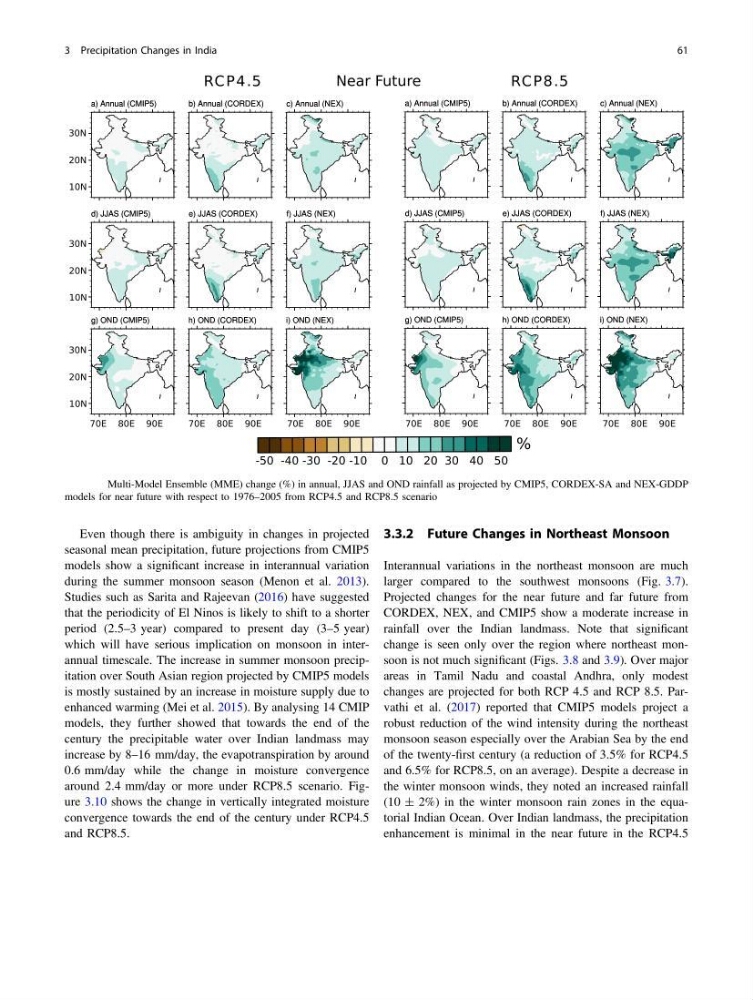
change is seen only over the region where northeast monsoon is not much significant (Figs. 3.8 and 3.9). Over major
areas in Tamil Nadu and coastal Andhra, only modest
changes are projected for both RCP 4.5 and RCP 8.5. Parvathi et al. (2017) reported that CMIP5 models project a
robust reduction of the wind intensity during the northeast
monsoon season especially over the Arabian Sea by the end
of the twenty-first century (a reduction of 3.5% for RCP4.5
and 6.5% for RCP8.5, on an average). Despite a decrease in
the winter monsoon winds, they noted an increased rainfall
(10 ± 2%) in the winter monsoon rain zones in the equatorial Indian Ocean. Over Indian landmass, the precipitation
enhancement is minimal in the near future in the RCP4.5
Fig. 3.8 Multi-Model Ensemble (MME) change (%) in annual, JJAS and OND rainfall as projected by CMIP5, CORDEX-SA and NEX-GDDP
models for near future with respect to 1976–2005 from RCP4.5 and RCP8.5 scenario
3 Precipitation Changes in India
61
seasonal mean precipitation, future projections from CMIP5
models show a significant increase in interannual variation
during the summer monsoon season (Menon et al. 2013).
Studies such as Sarita and Rajeevan (2016) have suggested
that the periodicity of El Ninos is likely to shift to a shorter
period (2.5–3 year) compared to present day (3–5 year)
which will have serious implication on monsoon in interannual timescale. The increase in summer monsoon precipitation over South Asian region projected by CMIP5 models
is mostly sustained by an increase in moisture supply due to
enhanced warming (Mei et al. 2015). By analysing 14 CMIP
models, they further showed that towards the end of the
century the precipitable water over Indian landmass may
increase by 8–16 mm/day, the evapotranspiration by around
0.6 mm/day while the change in moisture convergence
around 2.4 mm/day or more under RCP8.5 scenario. Figure 3.10 shows the change in vertically integrated moisture
convergence towards the end of the century under RCP4.5
and RCP8.5.
3.3.2 Future Changes in Northeast Monsoon
Interannual variations in the northeast monsoon are much
larger compared to the southwest monsoons (Fig. 3.7).
Projected changes for the near future and far future from
CORDEX, NEX, and CMIP5 show a moderate increase in
rainfall over the Indian landmass. Note that significant
change is seen only over the region where northeast monsoon is not much significant (Figs. 3.8 and 3.9). Over major
areas in Tamil Nadu and coastal Andhra, only modest
changes are projected for both RCP 4.5 and RCP 8.5. Parvathi et al. (2017) reported that CMIP5 models project a
robust reduction of the wind intensity during the northeast
monsoon season especially over the Arabian Sea by the end
of the twenty-first century (a reduction of 3.5% for RCP4.5
and 6.5% for RCP8.5, on an average). Despite a decrease in
the winter monsoon winds, they noted an increased rainfall
(10 ± 2%) in the winter monsoon rain zones in the equatorial Indian Ocean. Over Indian landmass, the precipitation
enhancement is minimal in the near future in the RCP4.5
Fig. 3.8 Multi-Model Ensemble (MME) change (%) in annual, JJAS and OND rainfall as projected by CMIP5, CORDEX-SA and NEX-GDDP
models for near future with respect to 1976–2005 from RCP4.5 and RCP8.5 scenario
3 Precipitation Changes in India
61