

Box 2.4 Climate Model Projections and Weighting
The climate change projections for the twenty-first
century at the regional or subcontinental spatial scales
are based on transient simulations with coupled
atmosphere–ocean general circulation models
(AOGCMs) including relevant anthropogenic forcings, for example, due to greenhouse gases (GHG) and
atmospheric aerosols. These projections have been
characterized by a low level of confidence and a high
level of uncertainty deriving from different sources:
estimates of future anthropogenic forcings, the
response of a climate model to a given forcing, the
natural variability of the climate system. One of the
major sources of uncertainty in future temperature
projections is that the different AOGCMs respond
differently to the same forcing resulting in differences
in the projected changes. These differences are due to
the differences in representing the real climate system
through a set of mathematically approximated physical, chemical, and biological processes. A recent study
assessed that the component of uncertainty due to
CMIP5 model spread tends to be larger than that
arising due to natural internal variability for temperature in most regions within India, and the model
spread tends to grow with time (Singh and AchutaRao
2018). Therefore, a comprehensive assessment of
regional change projection needs to be based on the
collective information from the ensemble of AOGCM
simulations.
A quantitative method called “reliability ensemble
averaging” (REA) was introduced by Giorgi and
Mearns (2002) for calculating the average, uncertainty
range and collective reliability of regional climate
change projections from ensembles of different
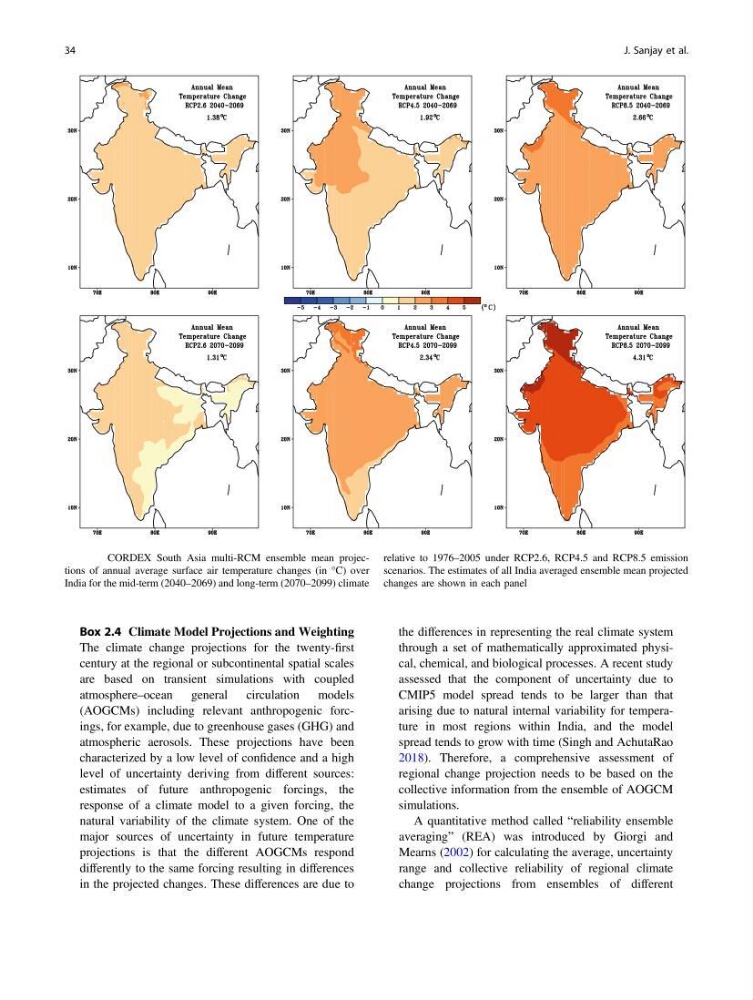
Fig. 2.7 CORDEX South Asia multi-RCM ensemble mean projections of annual average surface air temperature changes (in °C) over
India for the mid-term (2040–2069) and long-term (2070–2099) climate
relative to 1976–2005 under RCP2.6, RCP4.5 and RCP8.5 emission
scenarios. The estimates of all India averaged ensemble mean projected
changes are shown in each panel
34
J. Sanjay et al.
The climate change projections for the twenty-first
century at the regional or subcontinental spatial scales
are based on transient simulations with coupled
atmosphere–ocean general circulation models
(AOGCMs) including relevant anthropogenic forcings, for example, due to greenhouse gases (GHG) and
atmospheric aerosols. These projections have been
characterized by a low level of confidence and a high
level of uncertainty deriving from different sources:
estimates of future anthropogenic forcings, the
response of a climate model to a given forcing, the
natural variability of the climate system. One of the
major sources of uncertainty in future temperature
projections is that the different AOGCMs respond
differently to the same forcing resulting in differences
in the projected changes. These differences are due to
the differences in representing the real climate system
through a set of mathematically approximated physical, chemical, and biological processes. A recent study
assessed that the component of uncertainty due to
CMIP5 model spread tends to be larger than that
arising due to natural internal variability for temperature in most regions within India, and the model
spread tends to grow with time (Singh and AchutaRao
2018). Therefore, a comprehensive assessment of
regional change projection needs to be based on the
collective information from the ensemble of AOGCM
simulations.
A quantitative method called “reliability ensemble
averaging” (REA) was introduced by Giorgi and
Mearns (2002) for calculating the average, uncertainty
range and collective reliability of regional climate
change projections from ensembles of different
Fig. 2.7 CORDEX South Asia multi-RCM ensemble mean projections of annual average surface air temperature changes (in °C) over
India for the mid-term (2040–2069) and long-term (2070–2099) climate
relative to 1976–2005 under RCP2.6, RCP4.5 and RCP8.5 emission
scenarios. The estimates of all India averaged ensemble mean projected
changes are shown in each panel
34
J. Sanjay et al.