

light-absorbing aerosols (e.g. black carbon) over snowcovered regions, which causes warming by reducing surface
albedo (Bond et al. 2013; Lau et al. 2018; Lau and Kim
2010). However, the climatic effects of black carbon on the
Himalayan glaciers are not adequately understood, in part
due to the large spatio-temporal variability of black carbon
in the region (Kopacz et al. 2011, Chap. 5).
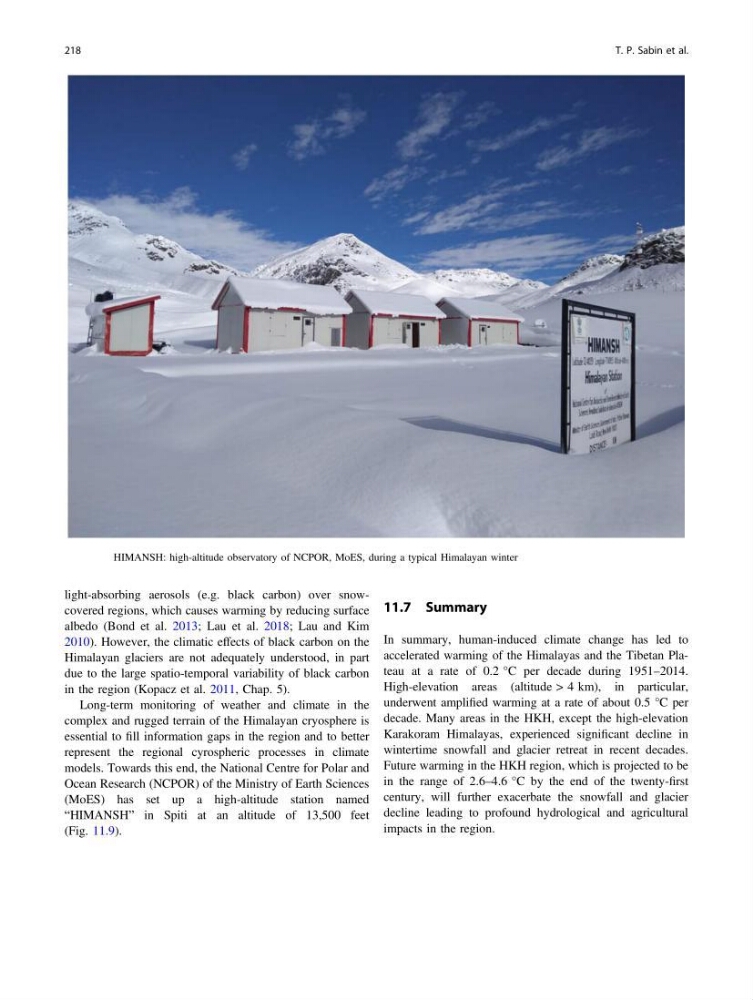
Long-term monitoring of weather and climate in the
complex and rugged terrain of the Himalayan cryosphere is
essential to fill information gaps in the region and to better
represent the regional cyrospheric processes in climate
models. Towards this end, the National Centre for Polar and
Ocean Research (NCPOR) of the Ministry of Earth Sciences
(MoES) has set up a high-altitude station named
“HIMANSH” in Spiti at an altitude of 13,500 feet
(Fig. 11.9).
11.7 Summary
In summary, human-induced climate change has led to
accelerated warming of the Himalayas and the Tibetan Plateau at a rate of 0.2 °C per decade during 1951–2014.
High-elevation areas (altitude > 4 km), in particular,
underwent amplified warming at a rate of about 0.5 °C per
decade. Many areas in the HKH, except the high-elevation
Karakoram Himalayas, experienced significant decline in
wintertime snowfall and glacier retreat in recent decades.
Future warming in the HKH region, which is projected to be
in the range of 2.6–4.6 °C by the end of the twenty-first
century, will further exacerbate the snowfall and glacier
decline leading to profound hydrological and agricultural
impacts in the region.
Fig. 11.9 HIMANSH: high-altitude observatory of NCPOR, MoES, during a typical Himalayan winter
218
T. P. Sabin et al.
albedo (Bond et al. 2013; Lau et al. 2018; Lau and Kim
2010). However, the climatic effects of black carbon on the
Himalayan glaciers are not adequately understood, in part
due to the large spatio-temporal variability of black carbon
in the region (Kopacz et al. 2011, Chap. 5).
Long-term monitoring of weather and climate in the
complex and rugged terrain of the Himalayan cryosphere is
essential to fill information gaps in the region and to better
represent the regional cyrospheric processes in climate
models. Towards this end, the National Centre for Polar and
Ocean Research (NCPOR) of the Ministry of Earth Sciences
(MoES) has set up a high-altitude station named
“HIMANSH” in Spiti at an altitude of 13,500 feet
(Fig. 11.9).
11.7 Summary
In summary, human-induced climate change has led to
accelerated warming of the Himalayas and the Tibetan Plateau at a rate of 0.2 °C per decade during 1951–2014.
High-elevation areas (altitude > 4 km), in particular,
underwent amplified warming at a rate of about 0.5 °C per
decade. Many areas in the HKH, except the high-elevation
Karakoram Himalayas, experienced significant decline in
wintertime snowfall and glacier retreat in recent decades.
Future warming in the HKH region, which is projected to be
in the range of 2.6–4.6 °C by the end of the twenty-first
century, will further exacerbate the snowfall and glacier
decline leading to profound hydrological and agricultural
impacts in the region.
Fig. 11.9 HIMANSH: high-altitude observatory of NCPOR, MoES, during a typical Himalayan winter
218
T. P. Sabin et al.