

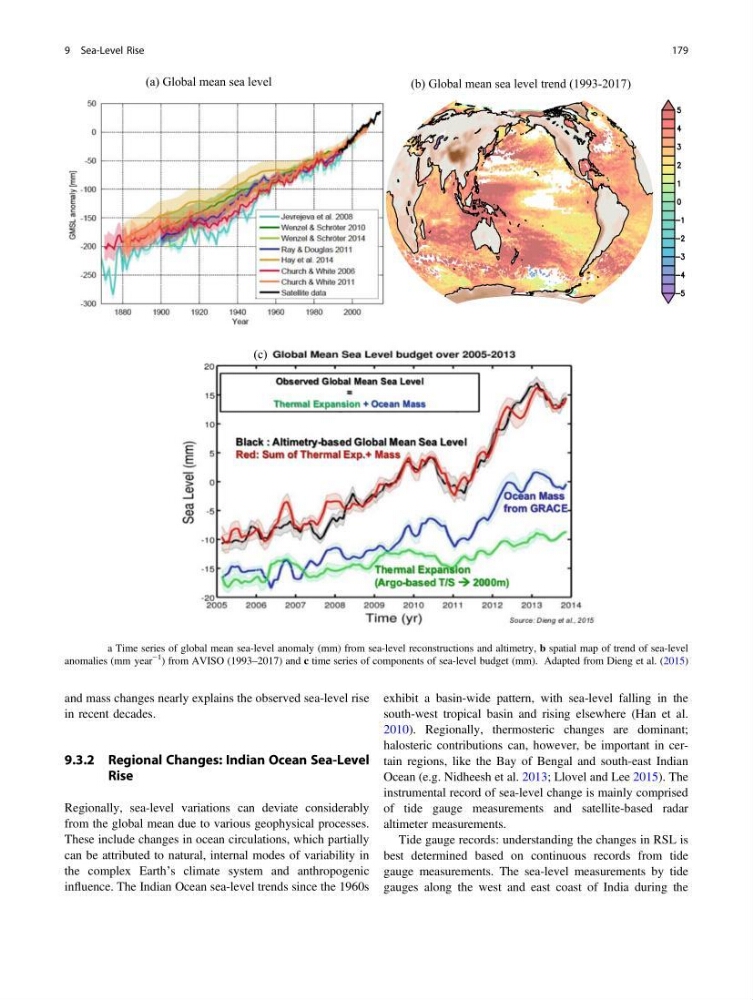
and mass changes nearly explains the observed sea-level rise
in recent decades.
9.3.2 Regional Changes: Indian Ocean Sea-Level
Rise
Regionally, sea-level variations can deviate considerably
from the global mean due to various geophysical processes.
These include changes in ocean circulations, which partially
can be attributed to natural, internal modes of variability in
the complex Earth’s climate system and anthropogenic
influence. The Indian Ocean sea-level trends since the 1960s
exhibit a basin-wide pattern, with sea-level falling in the
south-west tropical basin and rising elsewhere (Han et al.
2010). Regionally, thermosteric changes are dominant;
halosteric contributions can, however, be important in certain regions, like the Bay of Bengal and south-east Indian
Ocean (e.g. Nidheesh et al. 2013; Llovel and Lee 2015). The
instrumental record of sea-level change is mainly comprised
of tide gauge measurements and satellite-based radar
altimeter measurements.
Tide gauge records: understanding the changes in RSL is
best determined based on continuous records from tide
gauge measurements. The sea-level measurements by tide
gauges along the west and east coast of India during the
(a) Global mean sea level
(b) Global mean sea level trend (1993-2017)
(c)
Fig. 9.2 a Time series of global mean sea-level anomaly (mm) from sea-level reconstructions and altimetry, b spatial map of trend of sea-level
anomalies (mm year
−1
) from AVISO (1993–2017) and c time series of components of sea-level budget (mm). Adapted from Dieng et al. (2015)
9 Sea-Level Rise
179
in recent decades.
9.3.2 Regional Changes: Indian Ocean Sea-Level
Rise
Regionally, sea-level variations can deviate considerably
from the global mean due to various geophysical processes.
These include changes in ocean circulations, which partially
can be attributed to natural, internal modes of variability in
the complex Earth’s climate system and anthropogenic
influence. The Indian Ocean sea-level trends since the 1960s
exhibit a basin-wide pattern, with sea-level falling in the
south-west tropical basin and rising elsewhere (Han et al.
2010). Regionally, thermosteric changes are dominant;
halosteric contributions can, however, be important in certain regions, like the Bay of Bengal and south-east Indian
Ocean (e.g. Nidheesh et al. 2013; Llovel and Lee 2015). The
instrumental record of sea-level change is mainly comprised
of tide gauge measurements and satellite-based radar
altimeter measurements.
Tide gauge records: understanding the changes in RSL is
best determined based on continuous records from tide
gauge measurements. The sea-level measurements by tide
gauges along the west and east coast of India during the
(a) Global mean sea level
(b) Global mean sea level trend (1993-2017)
(c)
Fig. 9.2 a Time series of global mean sea-level anomaly (mm) from sea-level reconstructions and altimetry, b spatial map of trend of sea-level
anomalies (mm year
−1
) from AVISO (1993–2017) and c time series of components of sea-level budget (mm). Adapted from Dieng et al. (2015)
9 Sea-Level Rise
179