

Indian subcontinent receives rainfall amounts more than 6 cm
from mini-cloudburst events during July–August months, and
these events have been observed to be very intense over the
eastern part of Indo-Gangetic plains during the withdrawal
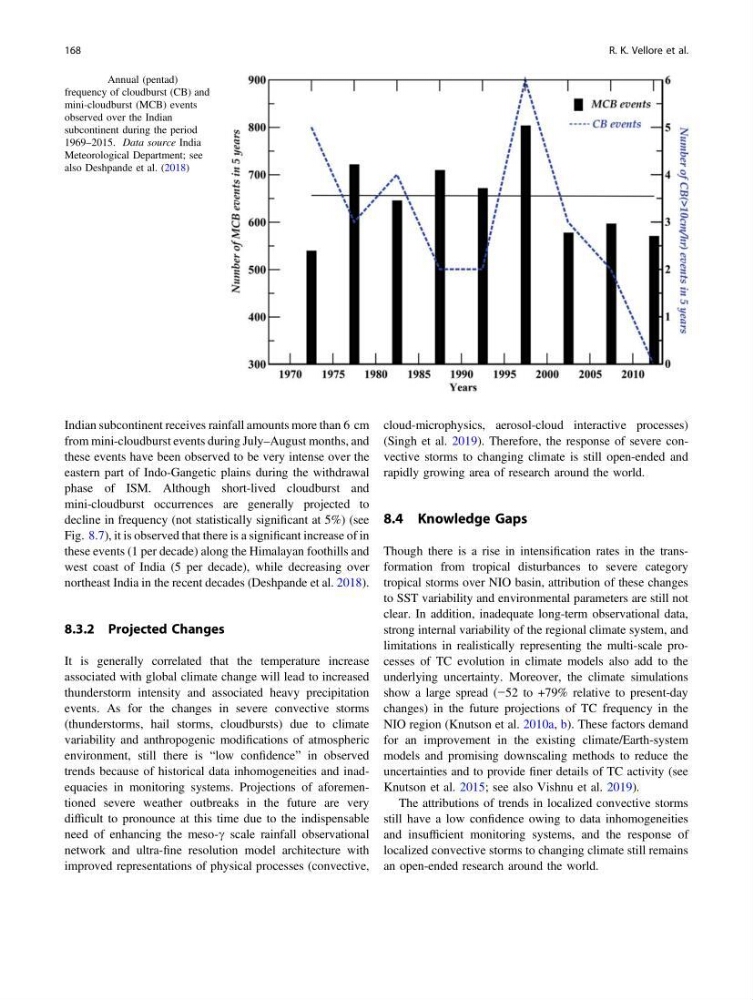
phase of ISM. Although short-lived cloudburst and
mini-cloudburst occurrences are generally projected to
decline in frequency (not statistically significant at 5%) (see
Fig. 8.7), it is observed that there is a significant increase of in
these events (1 per decade) along the Himalayan foothills and
west coast of India (5 per decade), while decreasing over
northeast India in the recent decades (Deshpande et al. 2018).
8.3.2 Projected Changes
It is generally correlated that the temperature increase
associated with global climate change will lead to increased
thunderstorm intensity and associated heavy precipitation
events. As for the changes in severe convective storms
(thunderstorms, hail storms, cloudbursts) due to climate
variability and anthropogenic modifications of atmospheric
environment, still there is “low confidence” in observed
trends because of historical data inhomogeneities and inadequacies in monitoring systems. Projections of aforementioned severe weather outbreaks in the future are very
difficult to pronounce at this time due to the indispensable
need of enhancing the meso-c scale rainfall observational
network and ultra-fine resolution model architecture with
improved representations of physical processes (convective,
cloud-microphysics, aerosol-cloud interactive processes)
(Singh et al. 2019). Therefore, the response of severe convective storms to changing climate is still open-ended and
rapidly growing area of research around the world.
8.4 Knowledge Gaps
Though there is a rise in intensification rates in the transformation from tropical disturbances to severe category
tropical storms over NIO basin, attribution of these changes
to SST variability and environmental parameters are still not
clear. In addition, inadequate long-term observational data,
strong internal variability of the regional climate system, and
limitations in realistically representing the multi-scale processes of TC evolution in climate models also add to the
underlying uncertainty. Moreover, the climate simulations
show a large spread (−52 to +79% relative to present-day
changes) in the future projections of TC frequency in the
NIO region (Knutson et al. 2010a, b). These factors demand
for an improvement in the existing climate/Earth-system
models and promising downscaling methods to reduce the
uncertainties and to provide finer details of TC activity (see
Knutson et al. 2015; see also Vishnu et al. 2019).
The attributions of trends in localized convective storms
still have a low confidence owing to data inhomogeneities
and insufficient monitoring systems, and the response of
localized convective storms to changing climate still remains
an open-ended research around the world.
Fig. 8.7 Annual (pentad)
frequency of cloudburst (CB) and
mini-cloudburst (MCB) events
observed over the Indian
subcontinent during the period
1969–2015. Data source India
Meteorological Department; see
also Deshpande et al. (2018)
168
R. K. Vellore et al.
from mini-cloudburst events during July–August months, and
these events have been observed to be very intense over the
eastern part of Indo-Gangetic plains during the withdrawal
phase of ISM. Although short-lived cloudburst and
mini-cloudburst occurrences are generally projected to
decline in frequency (not statistically significant at 5%) (see
Fig. 8.7), it is observed that there is a significant increase of in
these events (1 per decade) along the Himalayan foothills and
west coast of India (5 per decade), while decreasing over
northeast India in the recent decades (Deshpande et al. 2018).
8.3.2 Projected Changes
It is generally correlated that the temperature increase
associated with global climate change will lead to increased
thunderstorm intensity and associated heavy precipitation
events. As for the changes in severe convective storms
(thunderstorms, hail storms, cloudbursts) due to climate
variability and anthropogenic modifications of atmospheric
environment, still there is “low confidence” in observed
trends because of historical data inhomogeneities and inadequacies in monitoring systems. Projections of aforementioned severe weather outbreaks in the future are very
difficult to pronounce at this time due to the indispensable
need of enhancing the meso-c scale rainfall observational
network and ultra-fine resolution model architecture with
improved representations of physical processes (convective,
cloud-microphysics, aerosol-cloud interactive processes)
(Singh et al. 2019). Therefore, the response of severe convective storms to changing climate is still open-ended and
rapidly growing area of research around the world.
8.4 Knowledge Gaps
Though there is a rise in intensification rates in the transformation from tropical disturbances to severe category
tropical storms over NIO basin, attribution of these changes
to SST variability and environmental parameters are still not
clear. In addition, inadequate long-term observational data,
strong internal variability of the regional climate system, and
limitations in realistically representing the multi-scale processes of TC evolution in climate models also add to the
underlying uncertainty. Moreover, the climate simulations
show a large spread (−52 to +79% relative to present-day
changes) in the future projections of TC frequency in the
NIO region (Knutson et al. 2010a, b). These factors demand
for an improvement in the existing climate/Earth-system
models and promising downscaling methods to reduce the
uncertainties and to provide finer details of TC activity (see
Knutson et al. 2015; see also Vishnu et al. 2019).
The attributions of trends in localized convective storms
still have a low confidence owing to data inhomogeneities
and insufficient monitoring systems, and the response of
localized convective storms to changing climate still remains
an open-ended research around the world.
Fig. 8.7 Annual (pentad)
frequency of cloudburst (CB) and
mini-cloudburst (MCB) events
observed over the Indian
subcontinent during the period
1969–2015. Data source India
Meteorological Department; see
also Deshpande et al. (2018)
168
R. K. Vellore et al.