

et al. 2015). Low pressure systems during the monsoon
season or active monsoon conditions or monsoon breaks are
the root cause of extreme floods in the South Asian rivers
(Ramaswamy 1962; Dhar and Nandargi 2003). Further
details on heavy rainfall occurrences and monsoon disturbances are given in Chaps. 3 and 7, respectively. In addition
to the intraseasonal variability, floods exhibit variations on
interannual to multidecadal timescales, in association with
the flood producing extreme rainfall events. The variations
in floods are reported to be also linked to the large-scale
climatic drivers such as ENSO, NAO, AMO, PDO
(Chowdhury 2003; Mirza 2003; Ward et al. 2016; Najibi and
Devineni 2018). In particular, flood duration appears to be
more sensitive to ENSO conditions in current climate. Long
duration floods mainly occur during El Niño and La Niña
years, compared to neutral years (Ward et al. 2016), while
the influence of ENSO on flood frequency is not so strong as
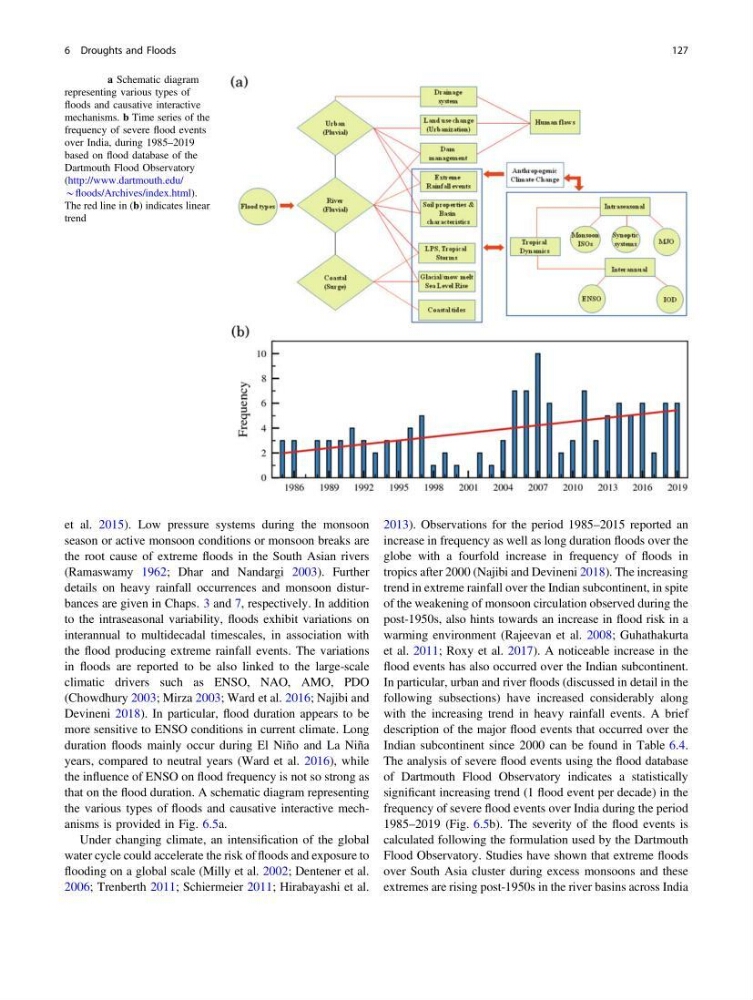
that on the flood duration. A schematic diagram representing
the various types of floods and causative interactive mechanisms is provided in Fig. 6.5a.
Under changing climate, an intensification of the global
water cycle could accelerate the risk of floods and exposure to
flooding on a global scale (Milly et al. 2002; Dentener et al.
2006; Trenberth 2011; Schiermeier 2011; Hirabayashi et al.
2013). Observations for the period 1985–2015 reported an
increase in frequency as well as long duration floods over the
globe with a fourfold increase in frequency of floods in
tropics after 2000 (Najibi and Devineni 2018). The increasing
trend in extreme rainfall over the Indian subcontinent, in spite
of the weakening of monsoon circulation observed during the
post-1950s, also hints towards an increase in flood risk in a
warming environment (Rajeevan et al. 2008; Guhathakurta
et al. 2011; Roxy et al. 2017). A noticeable increase in the
flood events has also occurred over the Indian subcontinent.
In particular, urban and river floods (discussed in detail in the
following subsections) have increased considerably along
with the increasing trend in heavy rainfall events. A brief
description of the major flood events that occurred over the
Indian subcontinent since 2000 can be found in Table 6.4.
The analysis of severe flood events using the flood database
of Dartmouth Flood Observatory indicates a statistically
significant increasing trend (1 flood event per decade) in the
frequency of severe flood events over India during the period
1985–2019 (Fig. 6.5b). The severity of the flood events is
calculated following the formulation used by the Dartmouth
Flood Observatory. Studies have shown that extreme floods
over South Asia cluster during excess monsoons and these
extremes are rising post-1950s in the river basins across India
Fig. 6.5 a Schematic diagram
representing various types of
floods and causative interactive
mechanisms. b Time series of the
frequency of severe flood events
over India, during 1985–2019
based on flood database of the
Dartmouth Flood Observatory
(http://www.dartmouth.edu/
*floods/Archives/index.html).
The red line in (b) indicates linear
trend
6 Droughts and Floods
127
season or active monsoon conditions or monsoon breaks are
the root cause of extreme floods in the South Asian rivers
(Ramaswamy 1962; Dhar and Nandargi 2003). Further
details on heavy rainfall occurrences and monsoon disturbances are given in Chaps. 3 and 7, respectively. In addition
to the intraseasonal variability, floods exhibit variations on
interannual to multidecadal timescales, in association with
the flood producing extreme rainfall events. The variations
in floods are reported to be also linked to the large-scale
climatic drivers such as ENSO, NAO, AMO, PDO
(Chowdhury 2003; Mirza 2003; Ward et al. 2016; Najibi and
Devineni 2018). In particular, flood duration appears to be
more sensitive to ENSO conditions in current climate. Long
duration floods mainly occur during El Niño and La Niña
years, compared to neutral years (Ward et al. 2016), while
the influence of ENSO on flood frequency is not so strong as
that on the flood duration. A schematic diagram representing
the various types of floods and causative interactive mechanisms is provided in Fig. 6.5a.
Under changing climate, an intensification of the global
water cycle could accelerate the risk of floods and exposure to
flooding on a global scale (Milly et al. 2002; Dentener et al.
2006; Trenberth 2011; Schiermeier 2011; Hirabayashi et al.
2013). Observations for the period 1985–2015 reported an
increase in frequency as well as long duration floods over the
globe with a fourfold increase in frequency of floods in
tropics after 2000 (Najibi and Devineni 2018). The increasing
trend in extreme rainfall over the Indian subcontinent, in spite
of the weakening of monsoon circulation observed during the
post-1950s, also hints towards an increase in flood risk in a
warming environment (Rajeevan et al. 2008; Guhathakurta
et al. 2011; Roxy et al. 2017). A noticeable increase in the
flood events has also occurred over the Indian subcontinent.
In particular, urban and river floods (discussed in detail in the
following subsections) have increased considerably along
with the increasing trend in heavy rainfall events. A brief
description of the major flood events that occurred over the
Indian subcontinent since 2000 can be found in Table 6.4.
The analysis of severe flood events using the flood database
of Dartmouth Flood Observatory indicates a statistically
significant increasing trend (1 flood event per decade) in the
frequency of severe flood events over India during the period
1985–2019 (Fig. 6.5b). The severity of the flood events is
calculated following the formulation used by the Dartmouth
Flood Observatory. Studies have shown that extreme floods
over South Asia cluster during excess monsoons and these
extremes are rising post-1950s in the river basins across India
Fig. 6.5 a Schematic diagram
representing various types of
floods and causative interactive
mechanisms. b Time series of the
frequency of severe flood events
over India, during 1985–2019
based on flood database of the
Dartmouth Flood Observatory
(http://www.dartmouth.edu/
*floods/Archives/index.html).
The red line in (b) indicates linear
trend
6 Droughts and Floods
127