

MISR (Multi-angle Imaging SpectroRadiometer) for the
period (March 2000–February 2010) also shows an
increasing trend in the range 0.01–0.04 year
−1 over urban
centers and densely populated rural areas (Dey and Di
Girolamo 2011). On the contrary, a significant and widespread decreasing trend in AOD is observed in the
pre-monsoon (MAM) period over certain parts of northern
India from satellite measurements (MODIS, MISR, and
OMI) (Pandey et al. 2017). However, the decrease in AOD
is more prominent over northwest India (−0.01 to
−0.02 year
−1 ), while a clear increasing trend (0.01–
0.02 year
−1 ) is observed in the eastern part of the
IGP. During the monsoon season, AOD trends do not exhibit
any statistically significant signal but show slight (significant
at 90%) positive values +0.003 to +0.0017 during the
post-monsoon season (SON) over the IGP. During this
period, strong positive trends (2–8%) are observed over
northeast India. Over the oceanic regions, significant positive trends (2–6% year
−1 ) have been reported during DJF
and MAM. A positive trend in AOD (>6% year
−1 ) was also
observed during JJAS over the Northern Bay of Bengal.
Box 5.3: How Aerosols Impact Monsoon Precipitation?
The non-uniform distribution of aerosols in the
atmosphere creates uneven atmospheric heating and
surface cooling patterns, which drive changes in
atmospheric circulation and regional rainfall. On
longer timescales, the declining trend in ISM precipitation post-1950s has been linked to the rising
anthropogenic aerosol burden over various regions
(Ramanathan et al. 2005; Bollasina et al. 2011; Ganguly et al. 2012; Sanap and Pandithurai 2015; Sanap
et al. 2015; Krishnan et al. 2016; Undorf et al. 2018).
Local and remote aerosols alter the land–sea temperature contrast as well as the tropospheric temperature
structure, both of which have a profound influence on
the onset and sustenance of south Asian monsoon. An
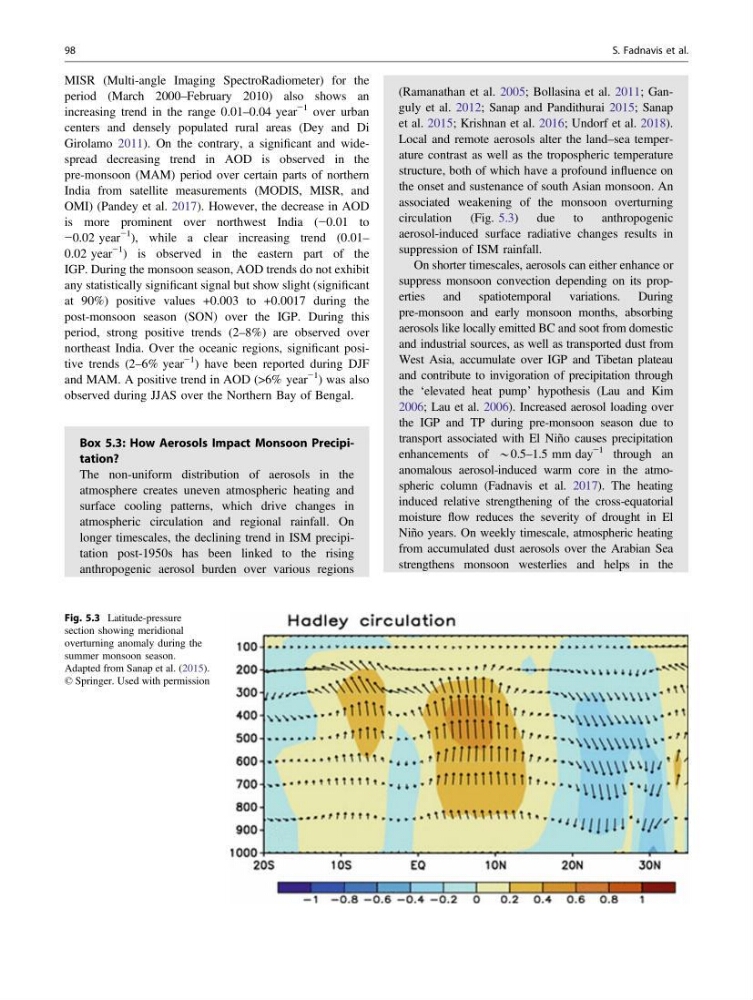
associated weakening of the monsoon overturning
circulation (Fig. 5.3) due to anthropogenic
aerosol-induced surface radiative changes results in
suppression of ISM rainfall.
On shorter timescales, aerosols can either enhance or
suppress monsoon convection depending on its properties and spatiotemporal variations. During
pre-monsoon and early monsoon months, absorbing
aerosols like locally emitted BC and soot from domestic
and industrial sources, as well as transported dust from
West Asia, accumulate over IGP and Tibetan plateau
and contribute to invigoration of precipitation through
the ‘elevated heat pump’ hypothesis (Lau and Kim
2006; Lau et al. 2006). Increased aerosol loading over
the IGP and TP during pre-monsoon season due to
transport associated with El Niño causes precipitation
enhancements of *0.5–1.5 mm day
−1 through an
anomalous aerosol-induced warm core in the atmospheric column (Fadnavis et al. 2017). The heating
induced relative strengthening of the cross-equatorial
moisture flow reduces the severity of drought in El
Niño years. On weekly timescale, atmospheric heating
from accumulated dust aerosols over the Arabian Sea
strengthens monsoon westerlies and helps in the
Fig. 5.3 Latitude-pressure
section showing meridional
overturning anomaly during the
summer monsoon season.
Adapted from Sanap et al. (2015).
© Springer. Used with permission
98
S. Fadnavis et al.
period (March 2000–February 2010) also shows an
increasing trend in the range 0.01–0.04 year
−1 over urban
centers and densely populated rural areas (Dey and Di
Girolamo 2011). On the contrary, a significant and widespread decreasing trend in AOD is observed in the
pre-monsoon (MAM) period over certain parts of northern
India from satellite measurements (MODIS, MISR, and
OMI) (Pandey et al. 2017). However, the decrease in AOD
is more prominent over northwest India (−0.01 to
−0.02 year
−1 ), while a clear increasing trend (0.01–
0.02 year
−1 ) is observed in the eastern part of the
IGP. During the monsoon season, AOD trends do not exhibit
any statistically significant signal but show slight (significant
at 90%) positive values +0.003 to +0.0017 during the
post-monsoon season (SON) over the IGP. During this
period, strong positive trends (2–8%) are observed over
northeast India. Over the oceanic regions, significant positive trends (2–6% year
−1 ) have been reported during DJF
and MAM. A positive trend in AOD (>6% year
−1 ) was also
observed during JJAS over the Northern Bay of Bengal.
Box 5.3: How Aerosols Impact Monsoon Precipitation?
The non-uniform distribution of aerosols in the
atmosphere creates uneven atmospheric heating and
surface cooling patterns, which drive changes in
atmospheric circulation and regional rainfall. On
longer timescales, the declining trend in ISM precipitation post-1950s has been linked to the rising
anthropogenic aerosol burden over various regions
(Ramanathan et al. 2005; Bollasina et al. 2011; Ganguly et al. 2012; Sanap and Pandithurai 2015; Sanap
et al. 2015; Krishnan et al. 2016; Undorf et al. 2018).
Local and remote aerosols alter the land–sea temperature contrast as well as the tropospheric temperature
structure, both of which have a profound influence on
the onset and sustenance of south Asian monsoon. An
associated weakening of the monsoon overturning
circulation (Fig. 5.3) due to anthropogenic
aerosol-induced surface radiative changes results in
suppression of ISM rainfall.
On shorter timescales, aerosols can either enhance or
suppress monsoon convection depending on its properties and spatiotemporal variations. During
pre-monsoon and early monsoon months, absorbing
aerosols like locally emitted BC and soot from domestic
and industrial sources, as well as transported dust from
West Asia, accumulate over IGP and Tibetan plateau
and contribute to invigoration of precipitation through
the ‘elevated heat pump’ hypothesis (Lau and Kim
2006; Lau et al. 2006). Increased aerosol loading over
the IGP and TP during pre-monsoon season due to
transport associated with El Niño causes precipitation
enhancements of *0.5–1.5 mm day
−1 through an
anomalous aerosol-induced warm core in the atmospheric column (Fadnavis et al. 2017). The heating
induced relative strengthening of the cross-equatorial
moisture flow reduces the severity of drought in El
Niño years. On weekly timescale, atmospheric heating
from accumulated dust aerosols over the Arabian Sea
strengthens monsoon westerlies and helps in the
Fig. 5.3 Latitude-pressure
section showing meridional
overturning anomaly during the
summer monsoon season.
Adapted from Sanap et al. (2015).
© Springer. Used with permission
98
S. Fadnavis et al.