

intensification of monsoon precipitation over central
India (Vinoj et al. 2014). Additionally, aerosols can
cause suppression of rainfall during monsoon breaks
via atmospheric stabilization and increased moisture
divergence (Dave et al. 2017).
5.2.3 Climate Model Simulations and Future
Projections of Aerosol Properties
Quantifying the effects of anthropogenic aerosols on regional climate cannot be done based on observations alone.
Modeling studies are needed to enumerate the aerosols–climate interactions and prediction of future climate change.
Model intercomparison projects like CMIP and AEROCOM
provide a multi-model platform for evaluating the capability
of various climate models to simulate the observed variability of atmospheric aerosols. Evaluation of the
present-day 550 nm AOD from several models participating
in CMIP, AEROCOM with satellite observations (MODIS,
MISR) reveals considerable bias (in the range *±0.3) in
aerosol optical properties estimations over the Indian subcontinent (Sanap et al. 2014; Pan et al. 2015; Misra et al.
2016). Very few models (HADGEM2-ES, HADGEM2-CC,
IPSL-CM5A-MR) can capture the observed spatiotemporal
distribution of aerosol loading over the subcontinent (Sanap
et al. 2014; Misra et al. 2016). In the majority of the models,
a negative anomaly in aerosol loading mainly occurs over
IGP, western India, and the Arabian Sea and is attributed to
significant underestimations in BC emissions and
wind-driven dust transport. Also, the comparison of modelsimulated extinction profiles with CALIOP observations
shows that the bias in the models generally occurs in the
lower tropospheric levels (below 2 km) and can be attributed
to low emissions from agricultural waste burning and biofuel
usage in the emission inventories
In the future, changing climate and changing emissions
would result in changes in aerosol concentration and associated forcing. Future projections of aerosol emissions for
2015–2100 have been integrated into the nine different
emission scenarios defined for CMIP6 based on new future
pathways of societal growth, the Shared Socioeconomic
Pathways (SSPs; Gidden et al. 2019). The yearly changes in
aerosol optical properties for future scenarios derived using
CMIP6 emission scenarios (Gidden et al. 2019) and
MAC-SP parametrization show a pronounced decrease in
global AOD by 2100 in all the scenarios excepting SSP3-70
and SSP4-60 (Fiedler et al. 2019). The time evolution of
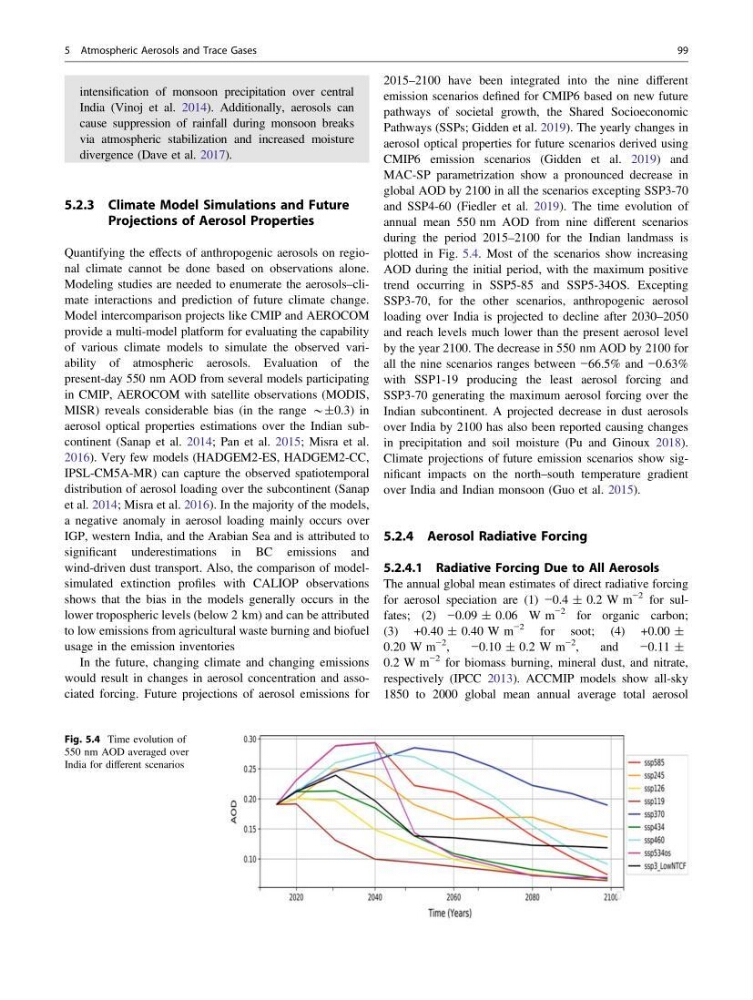
annual mean 550 nm AOD from nine different scenarios
during the period 2015–2100 for the Indian landmass is
plotted in Fig. 5.4. Most of the scenarios show increasing
AOD during the initial period, with the maximum positive
trend occurring in SSP5-85 and SSP5-34OS. Excepting
SSP3-70, for the other scenarios, anthropogenic aerosol
loading over India is projected to decline after 2030–2050
and reach levels much lower than the present aerosol level
by the year 2100. The decrease in 550 nm AOD by 2100 for
all the nine scenarios ranges between −66.5% and −0.63%
with SSP1-19 producing the least aerosol forcing and
SSP3-70 generating the maximum aerosol forcing over the
Indian subcontinent. A projected decrease in dust aerosols
over India by 2100 has also been reported causing changes
in precipitation and soil moisture (Pu and Ginoux 2018).
Climate projections of future emission scenarios show significant impacts on the north–south temperature gradient
over India and Indian monsoon (Guo et al. 2015).
5.2.4 Aerosol Radiative Forcing
5.2.4.1 Radiative Forcing Due to All Aerosols
The annual global mean estimates of direct radiative forcing
for aerosol speciation are (1) −0.4 ± 0.2 W m
−2 for sulfates; (2) −0.09 ± 0.06 W m
−2 for organic carbon;
(3) +0.40 ± 0.40 W m
−2
for soot; (4) +0.00 ±
0.20 W m
−2 ,
−0.10 ± 0.2 W m
−2 ,
and
−0.11 ±
0.2 W m
−2 for biomass burning, mineral dust, and nitrate,
respectively (IPCC 2013). ACCMIP models show all-sky
1850 to 2000 global mean annual average total aerosol
Fig. 5.4 Time evolution of
550 nm AOD averaged over
India for different scenarios
5 Atmospheric Aerosols and Trace Gases
99
India (Vinoj et al. 2014). Additionally, aerosols can
cause suppression of rainfall during monsoon breaks
via atmospheric stabilization and increased moisture
divergence (Dave et al. 2017).
5.2.3 Climate Model Simulations and Future
Projections of Aerosol Properties
Quantifying the effects of anthropogenic aerosols on regional climate cannot be done based on observations alone.
Modeling studies are needed to enumerate the aerosols–climate interactions and prediction of future climate change.
Model intercomparison projects like CMIP and AEROCOM
provide a multi-model platform for evaluating the capability
of various climate models to simulate the observed variability of atmospheric aerosols. Evaluation of the
present-day 550 nm AOD from several models participating
in CMIP, AEROCOM with satellite observations (MODIS,
MISR) reveals considerable bias (in the range *±0.3) in
aerosol optical properties estimations over the Indian subcontinent (Sanap et al. 2014; Pan et al. 2015; Misra et al.
2016). Very few models (HADGEM2-ES, HADGEM2-CC,
IPSL-CM5A-MR) can capture the observed spatiotemporal
distribution of aerosol loading over the subcontinent (Sanap
et al. 2014; Misra et al. 2016). In the majority of the models,
a negative anomaly in aerosol loading mainly occurs over
IGP, western India, and the Arabian Sea and is attributed to
significant underestimations in BC emissions and
wind-driven dust transport. Also, the comparison of modelsimulated extinction profiles with CALIOP observations
shows that the bias in the models generally occurs in the
lower tropospheric levels (below 2 km) and can be attributed
to low emissions from agricultural waste burning and biofuel
usage in the emission inventories
In the future, changing climate and changing emissions
would result in changes in aerosol concentration and associated forcing. Future projections of aerosol emissions for
2015–2100 have been integrated into the nine different
emission scenarios defined for CMIP6 based on new future
pathways of societal growth, the Shared Socioeconomic
Pathways (SSPs; Gidden et al. 2019). The yearly changes in
aerosol optical properties for future scenarios derived using
CMIP6 emission scenarios (Gidden et al. 2019) and
MAC-SP parametrization show a pronounced decrease in
global AOD by 2100 in all the scenarios excepting SSP3-70
and SSP4-60 (Fiedler et al. 2019). The time evolution of
annual mean 550 nm AOD from nine different scenarios
during the period 2015–2100 for the Indian landmass is
plotted in Fig. 5.4. Most of the scenarios show increasing
AOD during the initial period, with the maximum positive
trend occurring in SSP5-85 and SSP5-34OS. Excepting
SSP3-70, for the other scenarios, anthropogenic aerosol
loading over India is projected to decline after 2030–2050
and reach levels much lower than the present aerosol level
by the year 2100. The decrease in 550 nm AOD by 2100 for
all the nine scenarios ranges between −66.5% and −0.63%
with SSP1-19 producing the least aerosol forcing and
SSP3-70 generating the maximum aerosol forcing over the
Indian subcontinent. A projected decrease in dust aerosols
over India by 2100 has also been reported causing changes
in precipitation and soil moisture (Pu and Ginoux 2018).
Climate projections of future emission scenarios show significant impacts on the north–south temperature gradient
over India and Indian monsoon (Guo et al. 2015).
5.2.4 Aerosol Radiative Forcing
5.2.4.1 Radiative Forcing Due to All Aerosols
The annual global mean estimates of direct radiative forcing
for aerosol speciation are (1) −0.4 ± 0.2 W m
−2 for sulfates; (2) −0.09 ± 0.06 W m
−2 for organic carbon;
(3) +0.40 ± 0.40 W m
−2
for soot; (4) +0.00 ±
0.20 W m
−2 ,
−0.10 ± 0.2 W m
−2 ,
and
−0.11 ±
0.2 W m
−2 for biomass burning, mineral dust, and nitrate,
respectively (IPCC 2013). ACCMIP models show all-sky
1850 to 2000 global mean annual average total aerosol
Fig. 5.4 Time evolution of
550 nm AOD averaged over
India for different scenarios
5 Atmospheric Aerosols and Trace Gases
99