

13 Solutions for Selected Exercises
243
=
K e
−r f τ
√
2πσ 2 τ
∞
0
e
nx
−(x
−x)
2 /2σ
2 τ
− e
−(x
−x)
2 /2σ
2 τ
dx
. (13.33)
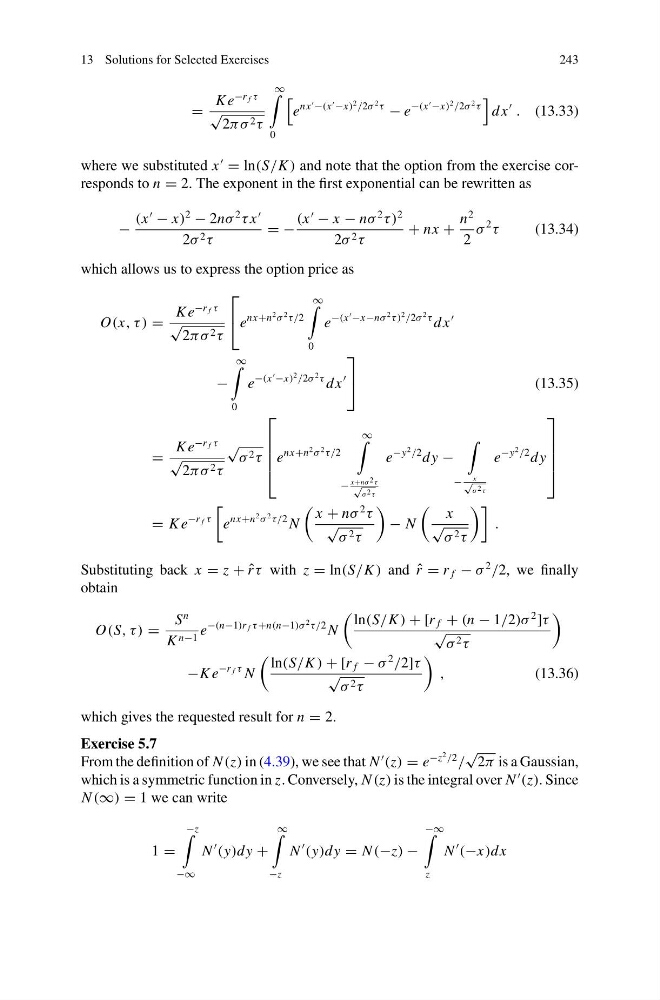
where we substituted x
= ln(S/K ) and note that the option from the exercise corresponds to n = 2. The exponent in the first exponential can be rewritten as
−
(x
− x)
2
− 2nσ
2
τ x
2σ 2 τ
= −
(x
− x − nσ
2
τ )
2
2σ 2 τ
+ nx +
n
2
2
σ
2
τ
(13.34)
which allows us to express the option price as
O(x, τ ) =
K e
−r f τ
√
2πσ 2 τ
⎡
⎣ e
nx+n
2 σ
2 τ/2
∞
0
e
−(x
−x−nσ
2 τ )
2 /2σ
2 τ dx
−
∞
0
e
−(x
−x)
2 /2σ
2 τ dx
⎤
⎦
(13.35)
=
K e
−r f τ
√
2πσ 2 τ
√ σ 2 τ
⎡
⎢
⎢
⎢
⎣
e
nx+n
2 σ
2 τ/2
∞
−
x+nσ 2 τ
√
σ 2 τ
e
−y
2 /2 dy −
−
x
√
σ 2 τ
e
−y
2 /2 dy
⎤
⎥
⎥
⎥
⎦
= K e
−r f τ
e
nx+n
2 σ
2 τ/2 N
x + nσ
2
τ
√ σ 2 τ
− N
x
√ σ 2 τ
.
Substituting back x = z + ˆ
r τ with z = ln(S/K ) and ˆ
r = r f − σ
2
/2, we finally
obtain
O(S, τ ) =
S
n
K n−1 e
−(n−1)r f τ +n(n−1)σ
2 τ/2 N
ln(S/K ) + [r f + (n − 1/2)σ
2
]τ
√ σ 2 τ
−K e
−r f τ N
ln(S/K ) + [r f − σ
2
/2]τ
√ σ 2 τ
,
(13.36)
which gives the requested result for n = 2.
Exercise 5.7
From the definition of N (z) in (4.39), we see that N
(z) = e
−z
2 /2
/
√
2π is a Gaussian,
which is a symmetric function in z. Conversely, N (z) is the integral over N
(z). Since
N (∞) = 1 we can write
1 =
−z
−∞
N
(y)dy +
∞
−z
N
(y)dy = N (−z) −
−∞
z
N
(−x)dx
243
=
K e
−r f τ
√
2πσ 2 τ
∞
0
e
nx
−(x
−x)
2 /2σ
2 τ
− e
−(x
−x)
2 /2σ
2 τ
dx
. (13.33)
where we substituted x
= ln(S/K ) and note that the option from the exercise corresponds to n = 2. The exponent in the first exponential can be rewritten as
−
(x
− x)
2
− 2nσ
2
τ x
2σ 2 τ
= −
(x
− x − nσ
2
τ )
2
2σ 2 τ
+ nx +
n
2
2
σ
2
τ
(13.34)
which allows us to express the option price as
O(x, τ ) =
K e
−r f τ
√
2πσ 2 τ
⎡
⎣ e
nx+n
2 σ
2 τ/2
∞
0
e
−(x
−x−nσ
2 τ )
2 /2σ
2 τ dx
−
∞
0
e
−(x
−x)
2 /2σ
2 τ dx
⎤
⎦
(13.35)
=
K e
−r f τ
√
2πσ 2 τ
√ σ 2 τ
⎡
⎢
⎢
⎢
⎣
e
nx+n
2 σ
2 τ/2
∞
−
x+nσ 2 τ
√
σ 2 τ
e
−y
2 /2 dy −
−
x
√
σ 2 τ
e
−y
2 /2 dy
⎤
⎥
⎥
⎥
⎦
= K e
−r f τ
e
nx+n
2 σ
2 τ/2 N
x + nσ
2
τ
√ σ 2 τ
− N
x
√ σ 2 τ
.
Substituting back x = z + ˆ
r τ with z = ln(S/K ) and ˆ
r = r f − σ
2
/2, we finally
obtain
O(S, τ ) =
S
n
K n−1 e
−(n−1)r f τ +n(n−1)σ
2 τ/2 N
ln(S/K ) + [r f + (n − 1/2)σ
2
]τ
√ σ 2 τ
−K e
−r f τ N
ln(S/K ) + [r f − σ
2
/2]τ
√ σ 2 τ
,
(13.36)
which gives the requested result for n = 2.
Exercise 5.7
From the definition of N (z) in (4.39), we see that N
(z) = e
−z
2 /2
/
√
2π is a Gaussian,
which is a symmetric function in z. Conversely, N (z) is the integral over N
(z). Since
N (∞) = 1 we can write
1 =
−z
−∞
N
(y)dy +
∞
−z
N
(y)dy = N (−z) −
−∞
z
N
(−x)dx