

13 Solutions for Selected Exercises
241
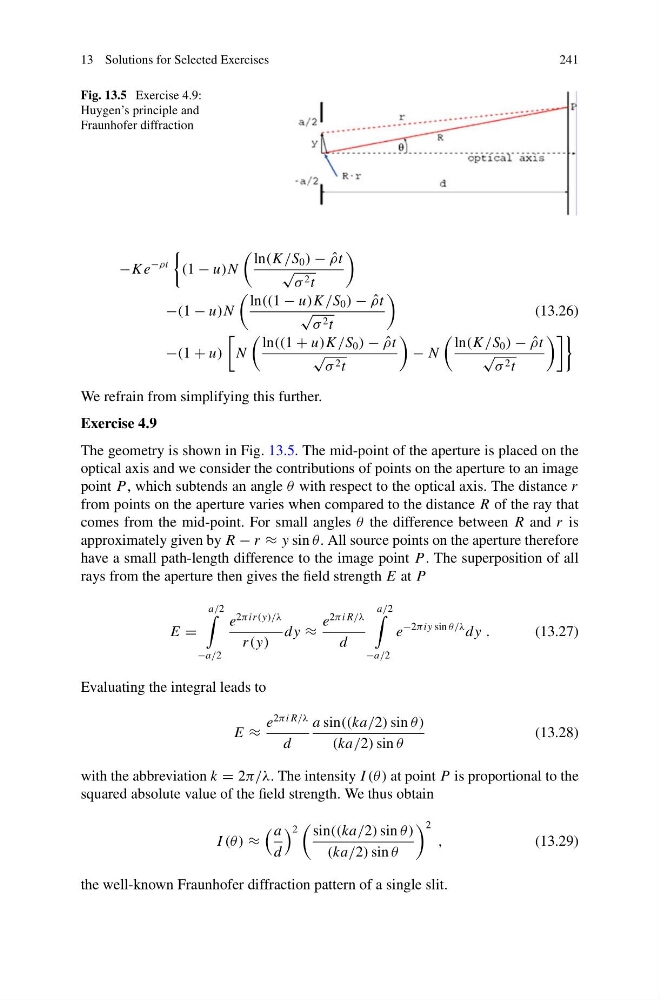
Fig. 13.5 Exercise 4.9:
Huygen’s principle and
Fraunhofer diffraction
−K e
−ρt
(1 − u)N
ln(K /S 0 ) − ˆ
ρt
√
σ 2 t
−(1 − u)N
ln((1 − u)K /S 0 ) − ˆ
ρt
√
σ 2 t
(13.26)
−(1 + u)
N
ln((1 + u)K /S 0 ) − ˆ
ρt
√
σ 2 t
− N
ln(K /S 0 ) − ˆ
ρt
√ σ 2 t
We refrain from simplifying this further.
Exercise 4.9
The geometry is shown in Fig. 13.5. The mid-point of the aperture is placed on the
optical axis and we consider the contributions of points on the aperture to an image
point P, which subtends an angle θ with respect to the optical axis. The distance r
from points on the aperture varies when compared to the distance R of the ray that
comes from the mid-point. For small angles θ the difference between R and r is
approximately given by R − r ≈ y sin θ . All source points on the aperture therefore
have a small path-length difference to the image point P. The superposition of all
rays from the aperture then gives the field strength E at P
E =
a/2
−a/2
e
2πir(y)/λ
r (y)
dy ≈
e
2πi R/λ
d
a/2
−a/2
e
−2πiy sin θ/λ dy .
(13.27)
Evaluating the integral leads to
E ≈
e
2πi R/λ
d
a sin((ka/2) sin θ)
(ka/2) sin θ
(13.28)
with the abbreviation k = 2π/λ. The intensity I (θ ) at point P is proportional to the
squared absolute value of the field strength. We thus obtain
I (θ ) ≈
a
d
2
sin((ka/2) sin θ)
(ka/2) sin θ
2
,
(13.29)
the well-known Fraunhofer diffraction pattern of a single slit.
241
Fig. 13.5 Exercise 4.9:
Huygen’s principle and
Fraunhofer diffraction
−K e
−ρt
(1 − u)N
ln(K /S 0 ) − ˆ
ρt
√
σ 2 t
−(1 − u)N
ln((1 − u)K /S 0 ) − ˆ
ρt
√
σ 2 t
(13.26)
−(1 + u)
N
ln((1 + u)K /S 0 ) − ˆ
ρt
√
σ 2 t
− N
ln(K /S 0 ) − ˆ
ρt
√ σ 2 t
We refrain from simplifying this further.
Exercise 4.9
The geometry is shown in Fig. 13.5. The mid-point of the aperture is placed on the
optical axis and we consider the contributions of points on the aperture to an image
point P, which subtends an angle θ with respect to the optical axis. The distance r
from points on the aperture varies when compared to the distance R of the ray that
comes from the mid-point. For small angles θ the difference between R and r is
approximately given by R − r ≈ y sin θ . All source points on the aperture therefore
have a small path-length difference to the image point P. The superposition of all
rays from the aperture then gives the field strength E at P
E =
a/2
−a/2
e
2πir(y)/λ
r (y)
dy ≈
e
2πi R/λ
d
a/2
−a/2
e
−2πiy sin θ/λ dy .
(13.27)
Evaluating the integral leads to
E ≈
e
2πi R/λ
d
a sin((ka/2) sin θ)
(ka/2) sin θ
(13.28)
with the abbreviation k = 2π/λ. The intensity I (θ ) at point P is proportional to the
squared absolute value of the field strength. We thus obtain
I (θ ) ≈
a
d
2
sin((ka/2) sin θ)
(ka/2) sin θ
2
,
(13.29)
the well-known Fraunhofer diffraction pattern of a single slit.