

240
13 Solutions for Selected Exercises
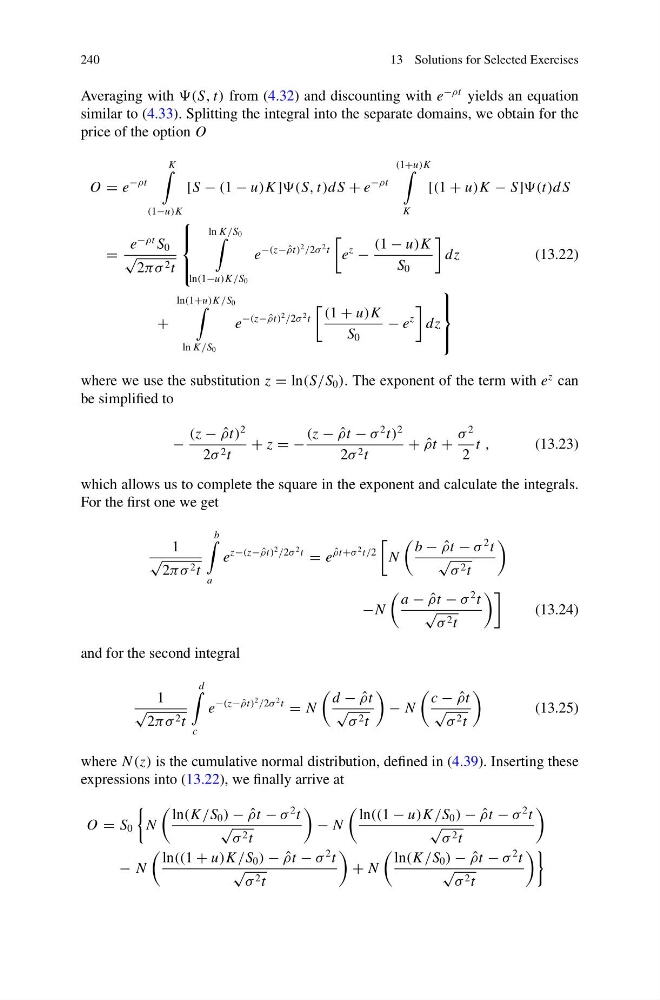
Averaging with (S, t) from (4.32) and discounting with e
−ρt yields an equation
similar to (4.33). Splitting the integral into the separate domains, we obtain for the
price of the option O
O = e
−ρt
K
(1−u)K
[S − (1 − u)K ](S, t)d S + e
−ρt
(1+u)K
K
[(1 + u)K − S](t)d S
=
e
−ρt S 0
√
2πσ 2 t
⎧
⎪ ⎨
⎪ ⎩
ln K /S 0
ln(1−u)K /S 0
e
−(z− ˆ
ρt)
2 /2σ
2 t
e
z
−
(1 − u)K
S 0
dz
(13.22)
+
ln(1+u)K /S 0
ln K /S 0
e
−(z− ˆ
ρt)
2 /2σ
2 t
(1 + u)K
S 0
− e
z
dz
⎫
⎪ ⎬
⎪ ⎭
where we use the substitution z = ln(S/S 0 ). The exponent of the term with e
z can
be simplified to
−
(z − ˆ
ρt)
2
2σ 2 t
+ z = −
(z − ˆ
ρt − σ
2 t)
2
2σ 2 t
+ ˆ
ρt +
σ
2
2
t ,
(13.23)
which allows us to complete the square in the exponent and calculate the integrals.
For the first one we get
1
√
2πσ 2 t
b
a
e
z−(z− ˆ
ρt)
2 /2σ
2 t
= e
ˆ
ρt+σ
2 t/2
N
b − ˆ
ρt − σ
2 t
√
σ 2 t
−N
a − ˆ
ρt − σ
2 t
√ σ 2 t
(13.24)
and for the second integral
1
√
2πσ 2 t
d
c
e
−(z− ˆ
ρt)
2 /2σ
2 t
= N
d − ˆ
ρt
√ σ 2 t
− N
c − ˆ
ρt
√
σ 2 t
(13.25)
where N (z) is the cumulative normal distribution, defined in (4.39). Inserting these
expressions into (13.22), we finally arrive at
O = S 0
N
ln(K /S 0 ) − ˆ
ρt − σ
2 t
√
σ 2 t
− N
ln((1 − u)K /S 0 ) − ˆ
ρt − σ
2 t
√
σ 2 t
− N
ln((1 + u)K /S 0 ) − ˆ
ρt − σ
2 t
√
σ 2 t
+ N
ln(K /S 0 ) − ˆ
ρt − σ
2 t
√
σ 2 t
13 Solutions for Selected Exercises
Averaging with (S, t) from (4.32) and discounting with e
−ρt yields an equation
similar to (4.33). Splitting the integral into the separate domains, we obtain for the
price of the option O
O = e
−ρt
K
(1−u)K
[S − (1 − u)K ](S, t)d S + e
−ρt
(1+u)K
K
[(1 + u)K − S](t)d S
=
e
−ρt S 0
√
2πσ 2 t
⎧
⎪ ⎨
⎪ ⎩
ln K /S 0
ln(1−u)K /S 0
e
−(z− ˆ
ρt)
2 /2σ
2 t
e
z
−
(1 − u)K
S 0
dz
(13.22)
+
ln(1+u)K /S 0
ln K /S 0
e
−(z− ˆ
ρt)
2 /2σ
2 t
(1 + u)K
S 0
− e
z
dz
⎫
⎪ ⎬
⎪ ⎭
where we use the substitution z = ln(S/S 0 ). The exponent of the term with e
z can
be simplified to
−
(z − ˆ
ρt)
2
2σ 2 t
+ z = −
(z − ˆ
ρt − σ
2 t)
2
2σ 2 t
+ ˆ
ρt +
σ
2
2
t ,
(13.23)
which allows us to complete the square in the exponent and calculate the integrals.
For the first one we get
1
√
2πσ 2 t
b
a
e
z−(z− ˆ
ρt)
2 /2σ
2 t
= e
ˆ
ρt+σ
2 t/2
N
b − ˆ
ρt − σ
2 t
√
σ 2 t
−N
a − ˆ
ρt − σ
2 t
√ σ 2 t
(13.24)
and for the second integral
1
√
2πσ 2 t
d
c
e
−(z− ˆ
ρt)
2 /2σ
2 t
= N
d − ˆ
ρt
√ σ 2 t
− N
c − ˆ
ρt
√
σ 2 t
(13.25)
where N (z) is the cumulative normal distribution, defined in (4.39). Inserting these
expressions into (13.22), we finally arrive at
O = S 0
N
ln(K /S 0 ) − ˆ
ρt − σ
2 t
√
σ 2 t
− N
ln((1 − u)K /S 0 ) − ˆ
ρt − σ
2 t
√
σ 2 t
− N
ln((1 + u)K /S 0 ) − ˆ
ρt − σ
2 t
√
σ 2 t
+ N
ln(K /S 0 ) − ˆ
ρt − σ
2 t
√
σ 2 t