

13 Solutions for Selected Exercises
239
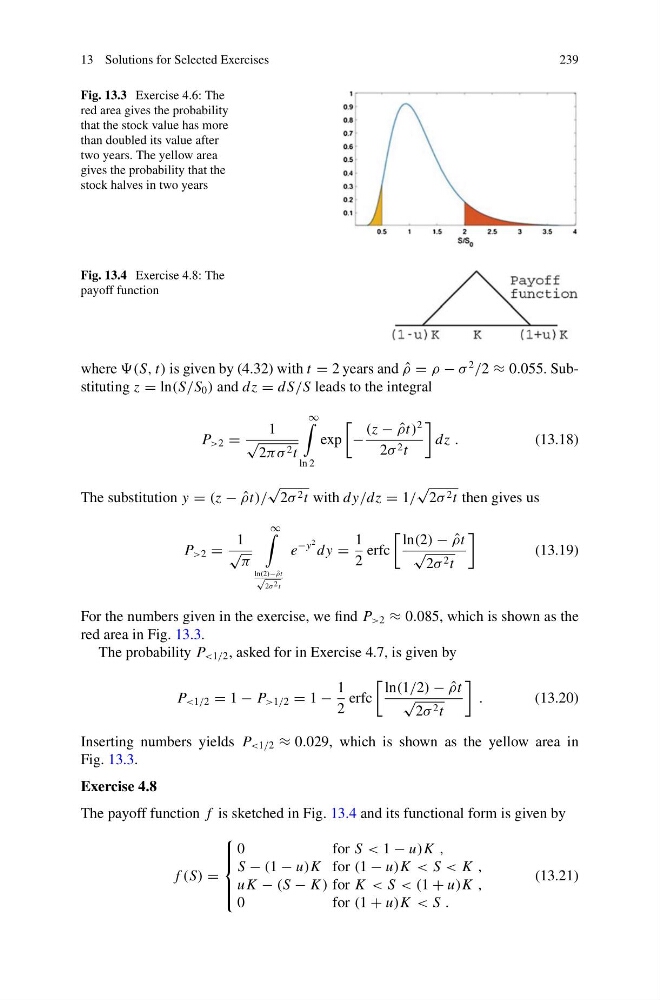
Fig. 13.3 Exercise 4.6: The
red area gives the probability
that the stock value has more
than doubled its value after
two years. The yellow area
gives the probability that the
stock halves in two years
Fig. 13.4 Exercise 4.8: The
payoff function
where (S, t) is given by (4.32) with t = 2 years and ˆ
ρ = ρ − σ
2
/2 ≈ 0.055. Substituting z = ln(S/S 0 ) and dz = d S/S leads to the integral
P >2 =
1
√
2πσ 2 t
∞
ln 2
exp
−
(z − ˆ
ρt)
2
2σ 2 t
dz .
(13.18)
The substitution y = (z − ˆ
ρt)/
√
2σ 2 t with dy/dz = 1/
√
2σ 2 t then gives us
P >2 =
1
√ π
∞
ln(2)− ˆ
ρt
√
2σ 2 t
e
−y
2 dy =
1
2
erfc
ln(2) − ˆ
ρt
√
2σ 2 t
(13.19)
For the numbers given in the exercise, we find P >2 ≈ 0.085, which is shown as the
red area in Fig. 13.3.
The probability P <1/2 , asked for in Exercise 4.7, is given by
P <1/2 = 1 − P >1/2 = 1 −
1
2
erfc
ln(1/2) − ˆ
ρt
√
2σ 2 t
.
(13.20)
Inserting numbers yields P <1/2 ≈ 0.029, which is shown as the yellow area in
Fig. 13.3.
Exercise 4.8
The payoff function f is sketched in Fig. 13.4 and its functional form is given by
f (S) =
⎧
⎪ ⎪ ⎨
⎪ ⎪ ⎩
0
f o rS < 1 − u)K ,
S − (1 − u)K for (1 − u)K < S < K ,
u K − (S − K ) for K < S < (1 + u)K ,
0
f o r (1 + u)K < S .
(13.21)
239
Fig. 13.3 Exercise 4.6: The
red area gives the probability
that the stock value has more
than doubled its value after
two years. The yellow area
gives the probability that the
stock halves in two years
Fig. 13.4 Exercise 4.8: The
payoff function
where (S, t) is given by (4.32) with t = 2 years and ˆ
ρ = ρ − σ
2
/2 ≈ 0.055. Substituting z = ln(S/S 0 ) and dz = d S/S leads to the integral
P >2 =
1
√
2πσ 2 t
∞
ln 2
exp
−
(z − ˆ
ρt)
2
2σ 2 t
dz .
(13.18)
The substitution y = (z − ˆ
ρt)/
√
2σ 2 t with dy/dz = 1/
√
2σ 2 t then gives us
P >2 =
1
√ π
∞
ln(2)− ˆ
ρt
√
2σ 2 t
e
−y
2 dy =
1
2
erfc
ln(2) − ˆ
ρt
√
2σ 2 t
(13.19)
For the numbers given in the exercise, we find P >2 ≈ 0.085, which is shown as the
red area in Fig. 13.3.
The probability P <1/2 , asked for in Exercise 4.7, is given by
P <1/2 = 1 − P >1/2 = 1 −
1
2
erfc
ln(1/2) − ˆ
ρt
√
2σ 2 t
.
(13.20)
Inserting numbers yields P <1/2 ≈ 0.029, which is shown as the yellow area in
Fig. 13.3.
Exercise 4.8
The payoff function f is sketched in Fig. 13.4 and its functional form is given by
f (S) =
⎧
⎪ ⎪ ⎨
⎪ ⎪ ⎩
0
f o rS < 1 − u)K ,
S − (1 − u)K for (1 − u)K < S < K ,
u K − (S − K ) for K < S < (1 + u)K ,
0
f o r (1 + u)K < S .
(13.21)