

238
13 Solutions for Selected Exercises
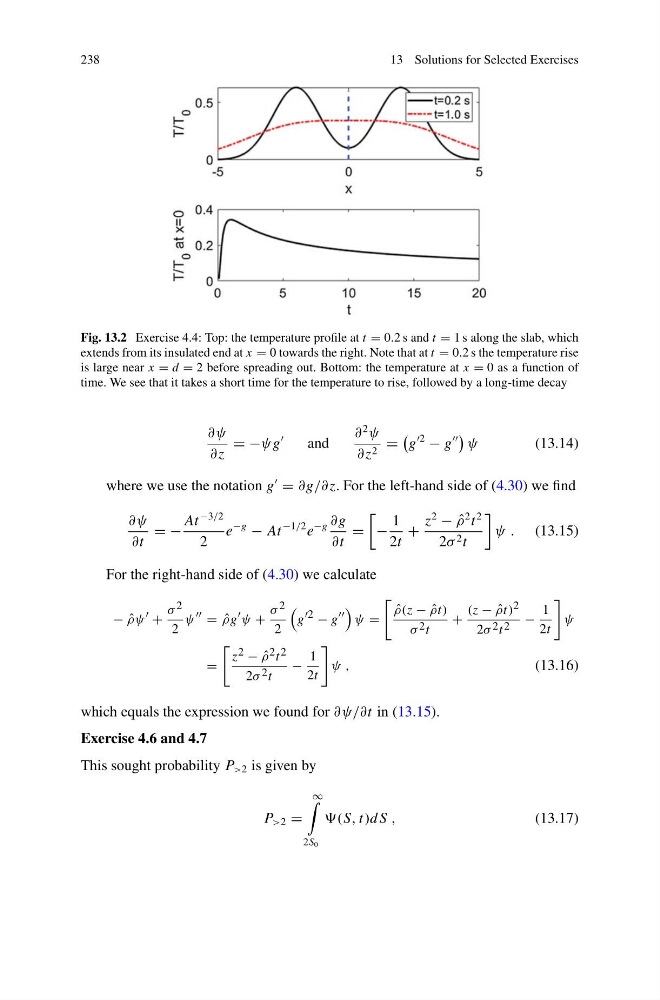
Fig. 13.2 Exercise 4.4: Top: the temperature profile at t = 0.2 s and t = 1 s along the slab, which
extends from its insulated end at x = 0 towards the right. Note that at t = 0.2 s the temperature rise
is large near x = d = 2 before spreading out. Bottom: the temperature at x = 0 as a function of
time. We see that it takes a short time for the temperature to rise, followed by a long-time decay
∂ψ
∂z
= −ψg
and
∂
2
ψ
∂z 2 =
g
2
− g
ψ
(13.14)
where we use the notation g
= ∂g/∂z. For the left-hand side of (4.30) we find
∂ψ
∂t
= −
At
−3/2
2
e
−g
− At
−1/2 e
−g ∂g
∂t
=
−
1
2t
+
z
2
− ˆ
ρ
2 t
2
2σ 2 t
ψ . (13.15)
For the right-hand side of (4.30) we calculate
− ˆ
ρψ +
σ 2
2
ψ = ˆ
ρg ψ +
σ 2
2
g 2 − g
ψ =
ˆ
ρ(z − ˆ
ρt)
σ 2 t
+
(z − ˆ
ρt) 2
2σ 2 t 2 −
1
2t
ψ
=
z 2 − ˆ
ρ 2 t 2
2σ 2 t
−
1
2t
ψ ,
(13.16)
which equals the expression we found for ∂ψ/∂t in (13.15).
Exercise 4.6 and 4.7
This sought probability P >2 is given by
P >2 =
∞
2S 0
(S, t)d S ,
(13.17)
13 Solutions for Selected Exercises
Fig. 13.2 Exercise 4.4: Top: the temperature profile at t = 0.2 s and t = 1 s along the slab, which
extends from its insulated end at x = 0 towards the right. Note that at t = 0.2 s the temperature rise
is large near x = d = 2 before spreading out. Bottom: the temperature at x = 0 as a function of
time. We see that it takes a short time for the temperature to rise, followed by a long-time decay
∂ψ
∂z
= −ψg
and
∂
2
ψ
∂z 2 =
g
2
− g
ψ
(13.14)
where we use the notation g
= ∂g/∂z. For the left-hand side of (4.30) we find
∂ψ
∂t
= −
At
−3/2
2
e
−g
− At
−1/2 e
−g ∂g
∂t
=
−
1
2t
+
z
2
− ˆ
ρ
2 t
2
2σ 2 t
ψ . (13.15)
For the right-hand side of (4.30) we calculate
− ˆ
ρψ +
σ 2
2
ψ = ˆ
ρg ψ +
σ 2
2
g 2 − g
ψ =
ˆ
ρ(z − ˆ
ρt)
σ 2 t
+
(z − ˆ
ρt) 2
2σ 2 t 2 −
1
2t
ψ
=
z 2 − ˆ
ρ 2 t 2
2σ 2 t
−
1
2t
ψ ,
(13.16)
which equals the expression we found for ∂ψ/∂t in (13.15).
Exercise 4.6 and 4.7
This sought probability P >2 is given by
P >2 =
∞
2S 0
(S, t)d S ,
(13.17)