

124
9 Bubbles, Crashes, Fat Tails and Lévy-Stable Distributions
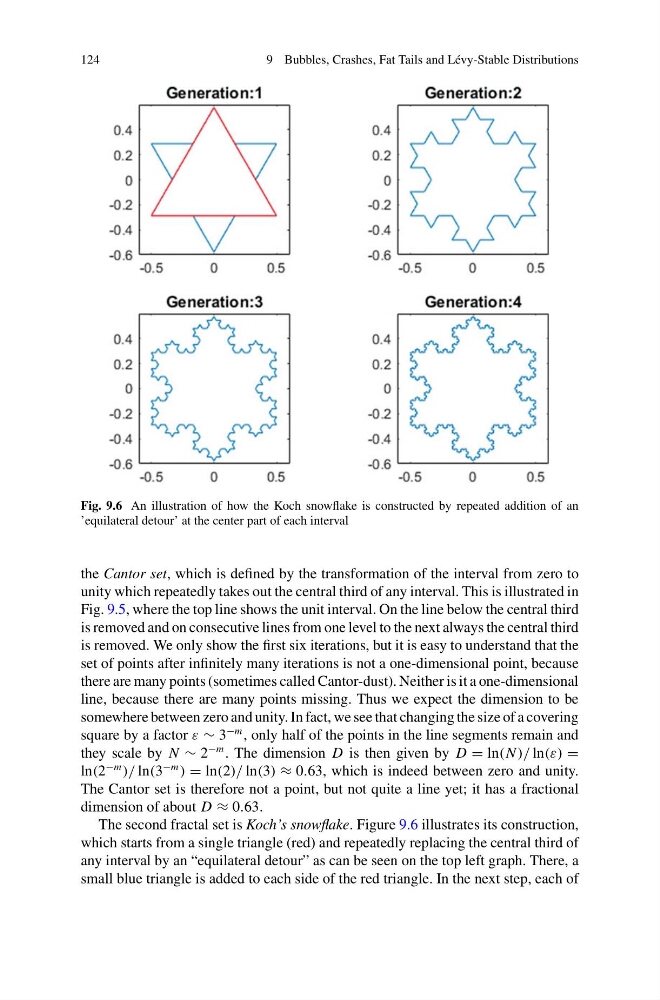
Fig. 9.6 An illustration of how the Koch snowflake is constructed by repeated addition of an
’equilateral detour’ at the center part of each interval
the Cantor set, which is defined by the transformation of the interval from zero to
unity which repeatedly takes out the central third of any interval. This is illustrated in
Fig. 9.5, where the top line shows the unit interval. On the line below the central third
is removed and on consecutive lines from one level to the next always the central third
is removed. We only show the first six iterations, but it is easy to understand that the
set of points after infinitely many iterations is not a one-dimensional point, because
there are many points (sometimes called Cantor-dust). Neither is it a one-dimensional
line, because there are many points missing. Thus we expect the dimension to be
somewhere between zero and unity. In fact, we see that changing the size of a covering
square by a factor ε ∼ 3
−m , only half of the points in the line segments remain and
they scale by N ∼ 2
−m . The dimension D is then given by D = ln(N )/ ln(ε) =
ln(2
−m
)/ ln(3
−m
) = ln(2)/ ln(3) ≈ 0.63, which is indeed between zero and unity.
The Cantor set is therefore not a point, but not quite a line yet; it has a fractional
dimension of about D ≈ 0.63.
The second fractal set is Koch’s snowflake. Figure 9.6 illustrates its construction,
which starts from a single triangle (red) and repeatedly replacing the central third of
any interval by an “equilateral detour” as can be seen on the top left graph. There, a
small blue triangle is added to each side of the red triangle. In the next step, each of
9 Bubbles, Crashes, Fat Tails and Lévy-Stable Distributions
Fig. 9.6 An illustration of how the Koch snowflake is constructed by repeated addition of an
’equilateral detour’ at the center part of each interval
the Cantor set, which is defined by the transformation of the interval from zero to
unity which repeatedly takes out the central third of any interval. This is illustrated in
Fig. 9.5, where the top line shows the unit interval. On the line below the central third
is removed and on consecutive lines from one level to the next always the central third
is removed. We only show the first six iterations, but it is easy to understand that the
set of points after infinitely many iterations is not a one-dimensional point, because
there are many points (sometimes called Cantor-dust). Neither is it a one-dimensional
line, because there are many points missing. Thus we expect the dimension to be
somewhere between zero and unity. In fact, we see that changing the size of a covering
square by a factor ε ∼ 3
−m , only half of the points in the line segments remain and
they scale by N ∼ 2
−m . The dimension D is then given by D = ln(N )/ ln(ε) =
ln(2
−m
)/ ln(3
−m
) = ln(2)/ ln(3) ≈ 0.63, which is indeed between zero and unity.
The Cantor set is therefore not a point, but not quite a line yet; it has a fractional
dimension of about D ≈ 0.63.
The second fractal set is Koch’s snowflake. Figure 9.6 illustrates its construction,
which starts from a single triangle (red) and repeatedly replacing the central third of
any interval by an “equilateral detour” as can be seen on the top left graph. There, a
small blue triangle is added to each side of the red triangle. In the next step, each of