

9.5 Power Laws
123
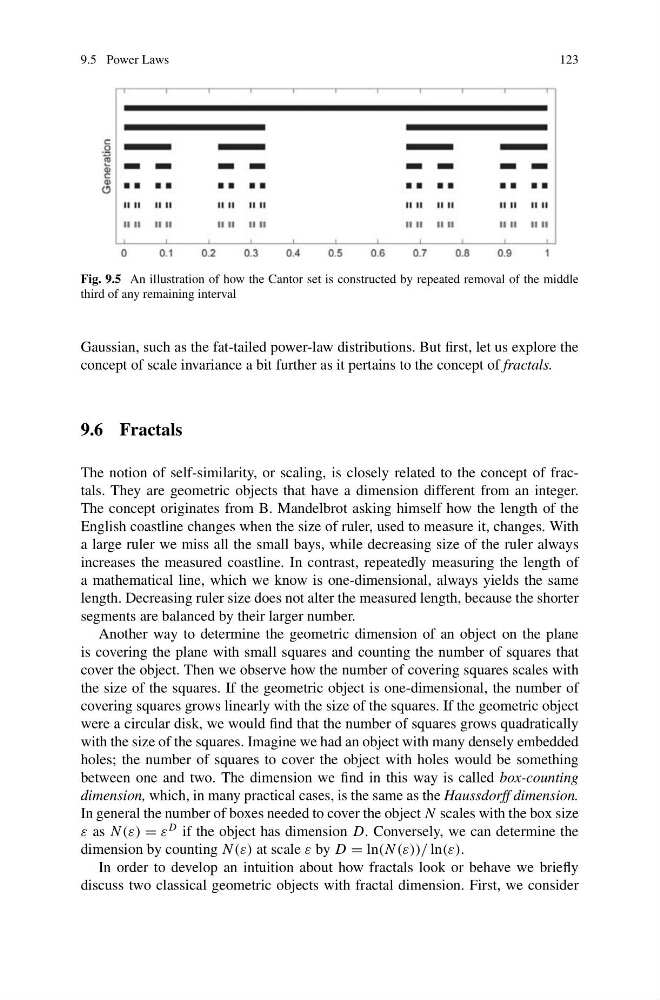
Fig. 9.5 An illustration of how the Cantor set is constructed by repeated removal of the middle
third of any remaining interval
Gaussian, such as the fat-tailed power-law distributions. But first, let us explore the
concept of scale invariance a bit further as it pertains to the concept of fractals.
9.6 Fractals
The notion of self-similarity, or scaling, is closely related to the concept of fractals. They are geometric objects that have a dimension different from an integer.
The concept originates from B. Mandelbrot asking himself how the length of the
English coastline changes when the size of ruler, used to measure it, changes. With
a large ruler we miss all the small bays, while decreasing size of the ruler always
increases the measured coastline. In contrast, repeatedly measuring the length of
a mathematical line, which we know is one-dimensional, always yields the same
length. Decreasing ruler size does not alter the measured length, because the shorter
segments are balanced by their larger number.
Another way to determine the geometric dimension of an object on the plane
is covering the plane with small squares and counting the number of squares that
cover the object. Then we observe how the number of covering squares scales with
the size of the squares. If the geometric object is one-dimensional, the number of
covering squares grows linearly with the size of the squares. If the geometric object
were a circular disk, we would find that the number of squares grows quadratically
with the size of the squares. Imagine we had an object with many densely embedded
holes; the number of squares to cover the object with holes would be something
between one and two. The dimension we find in this way is called box-counting
dimension, which, in many practical cases, is the same as the Haussdorff dimension.
In general the number of boxes needed to cover the object N scales with the box size
ε as N (ε) = ε
D if the object has dimension D. Conversely, we can determine the
dimension by counting N (ε) at scale ε by D = ln(N (ε))/ ln(ε).
In order to develop an intuition about how fractals look or behave we briefly
discuss two classical geometric objects with fractal dimension. First, we consider
123
Fig. 9.5 An illustration of how the Cantor set is constructed by repeated removal of the middle
third of any remaining interval
Gaussian, such as the fat-tailed power-law distributions. But first, let us explore the
concept of scale invariance a bit further as it pertains to the concept of fractals.
9.6 Fractals
The notion of self-similarity, or scaling, is closely related to the concept of fractals. They are geometric objects that have a dimension different from an integer.
The concept originates from B. Mandelbrot asking himself how the length of the
English coastline changes when the size of ruler, used to measure it, changes. With
a large ruler we miss all the small bays, while decreasing size of the ruler always
increases the measured coastline. In contrast, repeatedly measuring the length of
a mathematical line, which we know is one-dimensional, always yields the same
length. Decreasing ruler size does not alter the measured length, because the shorter
segments are balanced by their larger number.
Another way to determine the geometric dimension of an object on the plane
is covering the plane with small squares and counting the number of squares that
cover the object. Then we observe how the number of covering squares scales with
the size of the squares. If the geometric object is one-dimensional, the number of
covering squares grows linearly with the size of the squares. If the geometric object
were a circular disk, we would find that the number of squares grows quadratically
with the size of the squares. Imagine we had an object with many densely embedded
holes; the number of squares to cover the object with holes would be something
between one and two. The dimension we find in this way is called box-counting
dimension, which, in many practical cases, is the same as the Haussdorff dimension.
In general the number of boxes needed to cover the object N scales with the box size
ε as N (ε) = ε
D if the object has dimension D. Conversely, we can determine the
dimension by counting N (ε) at scale ε by D = ln(N (ε))/ ln(ε).
In order to develop an intuition about how fractals look or behave we briefly
discuss two classical geometric objects with fractal dimension. First, we consider