

20
1 Device Modeling and Circuit Elements
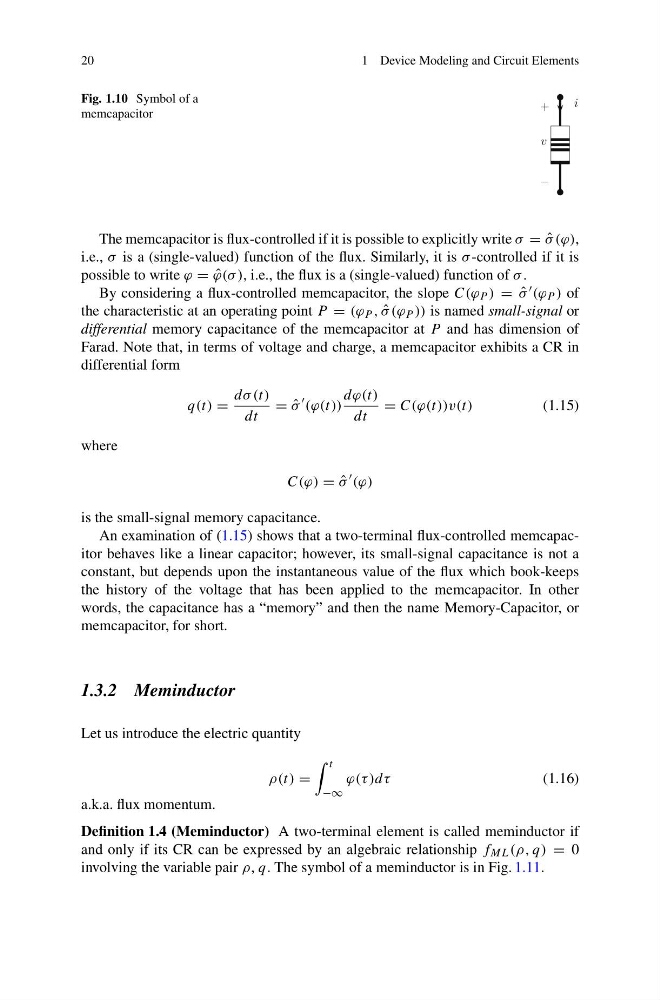
Fig. 1.10 Symbol of a
memcapacitor
−
+
v
i
The memcapacitor is flux-controlled if it is possible to explicitly write σ = ˆ
σ (ϕ),
i.e., σ is a (single-valued) function of the flux. Similarly, it is σ -controlled if it is
possible to write ϕ = ˆ
ϕ(σ ), i.e., the flux is a (single-valued) function of σ .
By considering a flux-controlled memcapacitor, the slope C(ϕ P ) = ˆ
σ (ϕ P ) of
the characteristic at an operating point P = (ϕ P , ˆ
σ (ϕ P )) is named small-signal or
differential memory capacitance of the memcapacitor at P and has dimension of
Farad. Note that, in terms of voltage and charge, a memcapacitor exhibits a CR in
differential form
q(t) =
dσ (t)
dt
= ˆ
σ
(ϕ(t))
dϕ(t)
dt
= C(ϕ(t))v(t)
(1.15)
where
C(ϕ) = ˆ
σ
(ϕ)
is the small-signal memory capacitance.
An examination of (1.15) shows that a two-terminal flux-controlled memcapacitor behaves like a linear capacitor; however, its small-signal capacitance is not a
constant, but depends upon the instantaneous value of the flux which book-keeps
the history of the voltage that has been applied to the memcapacitor. In other
words, the capacitance has a “memory” and then the name Memory-Capacitor, or
memcapacitor, for short.
1.3.2 Meminductor
Let us introduce the electric quantity
ρ(t) =
t
−∞
ϕ(τ )dτ
(1.16)
a.k.a. flux momentum.
Definition 1.4 (Meminductor) A two-terminal element is called meminductor if
and only if its CR can be expressed by an algebraic relationship f ML (ρ, q) = 0
involving the variable pair ρ, q. The symbol of a meminductor is in Fig. 1.11.
1 Device Modeling and Circuit Elements
Fig. 1.10 Symbol of a
memcapacitor
−
+
v
i
The memcapacitor is flux-controlled if it is possible to explicitly write σ = ˆ
σ (ϕ),
i.e., σ is a (single-valued) function of the flux. Similarly, it is σ -controlled if it is
possible to write ϕ = ˆ
ϕ(σ ), i.e., the flux is a (single-valued) function of σ .
By considering a flux-controlled memcapacitor, the slope C(ϕ P ) = ˆ
σ (ϕ P ) of
the characteristic at an operating point P = (ϕ P , ˆ
σ (ϕ P )) is named small-signal or
differential memory capacitance of the memcapacitor at P and has dimension of
Farad. Note that, in terms of voltage and charge, a memcapacitor exhibits a CR in
differential form
q(t) =
dσ (t)
dt
= ˆ
σ
(ϕ(t))
dϕ(t)
dt
= C(ϕ(t))v(t)
(1.15)
where
C(ϕ) = ˆ
σ
(ϕ)
is the small-signal memory capacitance.
An examination of (1.15) shows that a two-terminal flux-controlled memcapacitor behaves like a linear capacitor; however, its small-signal capacitance is not a
constant, but depends upon the instantaneous value of the flux which book-keeps
the history of the voltage that has been applied to the memcapacitor. In other
words, the capacitance has a “memory” and then the name Memory-Capacitor, or
memcapacitor, for short.
1.3.2 Meminductor
Let us introduce the electric quantity
ρ(t) =
t
−∞
ϕ(τ )dτ
(1.16)
a.k.a. flux momentum.
Definition 1.4 (Meminductor) A two-terminal element is called meminductor if
and only if its CR can be expressed by an algebraic relationship f ML (ρ, q) = 0
involving the variable pair ρ, q. The symbol of a meminductor is in Fig. 1.11.