

1.3 Higher-Order Circuit Elements
19
α
β
−
+
v
(α)
i
(β)
v
(α) = ˆ
v(i
(β) )
i
(β)
v
(α)
)
b
(
)
a
(
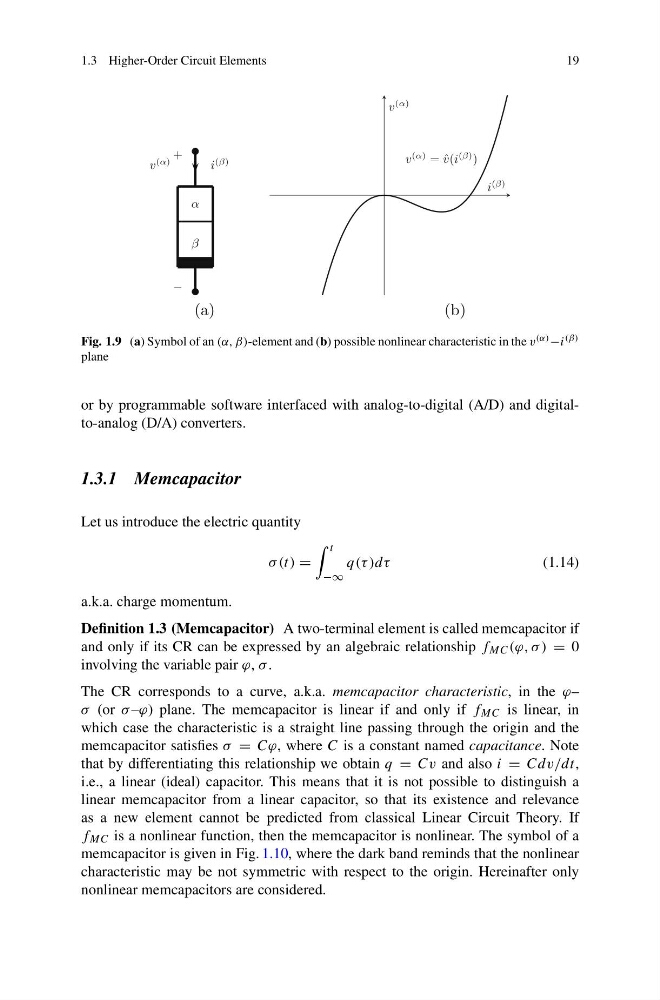
Fig. 1.9 (a) Symbol of an (α, β)-element and (b) possible nonlinear characteristic in the v (α) −i (β)
plane
or by programmable software interfaced with analog-to-digital (A/D) and digitalto-analog (D/A) converters.
1.3.1 Memcapacitor
Let us introduce the electric quantity
σ (t) =
t
−∞
q(τ )dτ
(1.14)
a.k.a. charge momentum.
Definition 1.3 (Memcapacitor) A two-terminal element is called memcapacitor if
and only if its CR can be expressed by an algebraic relationship f MC (ϕ, σ ) = 0
involving the variable pair ϕ, σ .
The CR corresponds to a curve, a.k.a. memcapacitor characteristic, in the ϕ–
σ (or σ –ϕ) plane. The memcapacitor is linear if and only if f MC is linear, in
which case the characteristic is a straight line passing through the origin and the
memcapacitor satisfies σ = Cϕ, where C is a constant named capacitance. Note
that by differentiating this relationship we obtain q = Cv and also i = Cdv/dt,
i.e., a linear (ideal) capacitor. This means that it is not possible to distinguish a
linear memcapacitor from a linear capacitor, so that its existence and relevance
as a new element cannot be predicted from classical Linear Circuit Theory. If
f MC is a nonlinear function, then the memcapacitor is nonlinear. The symbol of a
memcapacitor is given in Fig. 1.10, where the dark band reminds that the nonlinear
characteristic may be not symmetric with respect to the origin. Hereinafter only
nonlinear memcapacitors are considered.
19
α
β
−
+
v
(α)
i
(β)
v
(α) = ˆ
v(i
(β) )
i
(β)
v
(α)
)
b
(
)
a
(
Fig. 1.9 (a) Symbol of an (α, β)-element and (b) possible nonlinear characteristic in the v (α) −i (β)
plane
or by programmable software interfaced with analog-to-digital (A/D) and digitalto-analog (D/A) converters.
1.3.1 Memcapacitor
Let us introduce the electric quantity
σ (t) =
t
−∞
q(τ )dτ
(1.14)
a.k.a. charge momentum.
Definition 1.3 (Memcapacitor) A two-terminal element is called memcapacitor if
and only if its CR can be expressed by an algebraic relationship f MC (ϕ, σ ) = 0
involving the variable pair ϕ, σ .
The CR corresponds to a curve, a.k.a. memcapacitor characteristic, in the ϕ–
σ (or σ –ϕ) plane. The memcapacitor is linear if and only if f MC is linear, in
which case the characteristic is a straight line passing through the origin and the
memcapacitor satisfies σ = Cϕ, where C is a constant named capacitance. Note
that by differentiating this relationship we obtain q = Cv and also i = Cdv/dt,
i.e., a linear (ideal) capacitor. This means that it is not possible to distinguish a
linear memcapacitor from a linear capacitor, so that its existence and relevance
as a new element cannot be predicted from classical Linear Circuit Theory. If
f MC is a nonlinear function, then the memcapacitor is nonlinear. The symbol of a
memcapacitor is given in Fig. 1.10, where the dark band reminds that the nonlinear
characteristic may be not symmetric with respect to the origin. Hereinafter only
nonlinear memcapacitors are considered.