

1.3 Higher-Order Circuit Elements
21
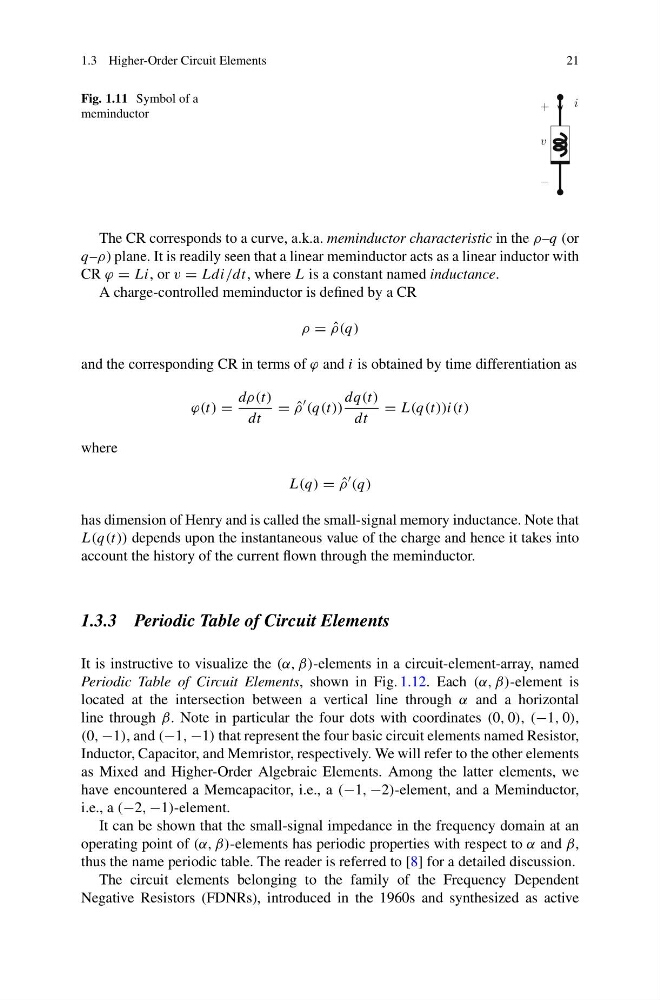
Fig. 1.11 Symbol of a
meminductor
−
+
v
i
The CR corresponds to a curve, a.k.a. meminductor characteristic in the ρ–q (or
q–ρ) plane. It is readily seen that a linear meminductor acts as a linear inductor with
CR ϕ = Li, or v = Ldi/dt, where L is a constant named inductance.
A charge-controlled meminductor is defined by a CR
ρ = ˆ
ρ(q)
and the corresponding CR in terms of ϕ and i is obtained by time differentiation as
ϕ(t) =
dρ(t)
dt
= ˆ
ρ
(q(t))
dq(t)
dt
= L(q(t))i(t)
where
L(q) = ˆ
ρ
(q)
has dimension of Henry and is called the small-signal memory inductance. Note that
L(q(t)) depends upon the instantaneous value of the charge and hence it takes into
account the history of the current flown through the meminductor.
1.3.3 Periodic Table of Circuit Elements
It is instructive to visualize the (α, β)-elements in a circuit-element-array, named
Periodic Table of Circuit Elements, shown in Fig. 1.12. Each (α, β)-element is
located at the intersection between a vertical line through α and a horizontal
line through β. Note in particular the four dots with coordinates (0, 0), (−1, 0),
(0, −1), and (−1, −1) that represent the four basic circuit elements named Resistor,
Inductor, Capacitor, and Memristor, respectively. We will refer to the other elements
as Mixed and Higher-Order Algebraic Elements. Among the latter elements, we
have encountered a Memcapacitor, i.e., a (−1, −2)-element, and a Meminductor,
i.e., a (−2, −1)-element.
It can be shown that the small-signal impedance in the frequency domain at an
operating point of (α, β)-elements has periodic properties with respect to α and β,
thus the name periodic table. The reader is referred to [8] for a detailed discussion.
The circuit elements belonging to the family of the Frequency Dependent
Negative Resistors (FDNRs), introduced in the 1960s and synthesized as active
21
Fig. 1.11 Symbol of a
meminductor
−
+
v
i
The CR corresponds to a curve, a.k.a. meminductor characteristic in the ρ–q (or
q–ρ) plane. It is readily seen that a linear meminductor acts as a linear inductor with
CR ϕ = Li, or v = Ldi/dt, where L is a constant named inductance.
A charge-controlled meminductor is defined by a CR
ρ = ˆ
ρ(q)
and the corresponding CR in terms of ϕ and i is obtained by time differentiation as
ϕ(t) =
dρ(t)
dt
= ˆ
ρ
(q(t))
dq(t)
dt
= L(q(t))i(t)
where
L(q) = ˆ
ρ
(q)
has dimension of Henry and is called the small-signal memory inductance. Note that
L(q(t)) depends upon the instantaneous value of the charge and hence it takes into
account the history of the current flown through the meminductor.
1.3.3 Periodic Table of Circuit Elements
It is instructive to visualize the (α, β)-elements in a circuit-element-array, named
Periodic Table of Circuit Elements, shown in Fig. 1.12. Each (α, β)-element is
located at the intersection between a vertical line through α and a horizontal
line through β. Note in particular the four dots with coordinates (0, 0), (−1, 0),
(0, −1), and (−1, −1) that represent the four basic circuit elements named Resistor,
Inductor, Capacitor, and Memristor, respectively. We will refer to the other elements
as Mixed and Higher-Order Algebraic Elements. Among the latter elements, we
have encountered a Memcapacitor, i.e., a (−1, −2)-element, and a Meminductor,
i.e., a (−2, −1)-element.
It can be shown that the small-signal impedance in the frequency domain at an
operating point of (α, β)-elements has periodic properties with respect to α and β,
thus the name periodic table. The reader is referred to [8] for a detailed discussion.
The circuit elements belonging to the family of the Frequency Dependent
Negative Resistors (FDNRs), introduced in the 1960s and synthesized as active