

408
11 Nonlinear Dynamics of Circuits with Mem-Elements
F
b (·) =
f γ μ (·)
f λμ (·)
: R
n γ μ +n λμ → R
n γ μ +n λμ .
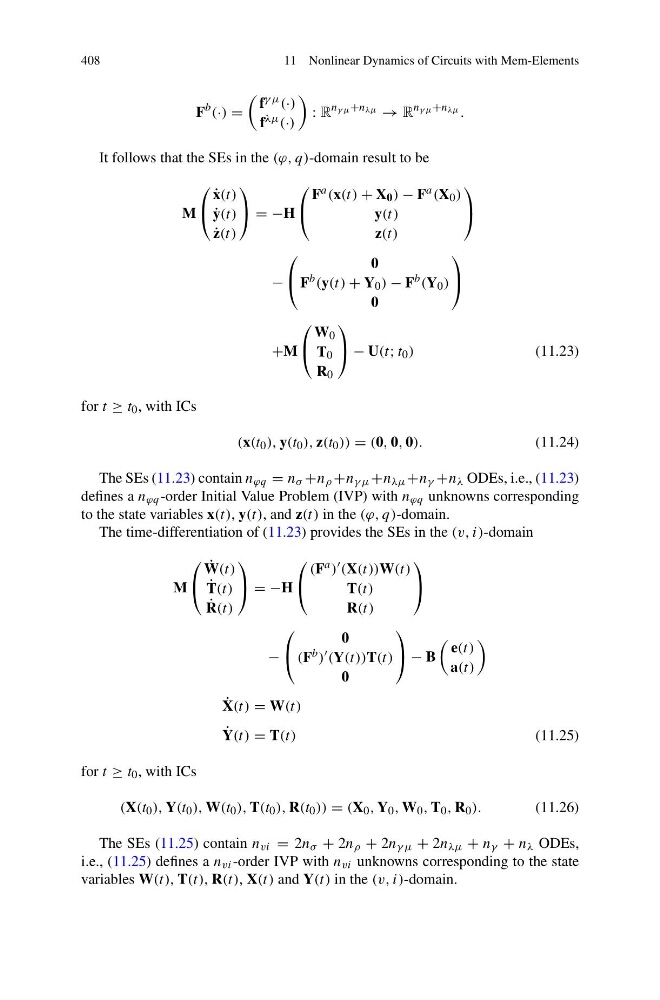
It follows that the SEs in the (ϕ, q)-domain result to be
M
⎛
⎝
˙
x(t)
˙
y(t)
˙
z(t)
⎞
⎠ = −H
⎛
⎝
F a (x(t) + X 0 ) − F a (X 0 )
y(t)
z(t)
⎞
⎠
−
⎛
⎝
0
F b (y(t) + Y 0 ) − F b (Y 0 )
0
⎞
⎠
+M
⎛
⎝
W 0
T 0
R 0
⎞
⎠ − U(t; t 0 )
(11.23)
for t ≥ t 0 , with ICs
(x(t 0 ), y(t 0 ), z(t 0 )) = (0, 0, 0).
(11.24)
The SEs (11.23) contain n ϕq = n σ +n ρ +n γ μ +n λμ +n γ +n λ ODEs, i.e., (11.23)
defines a n ϕq -order Initial Value Problem (IVP) with n ϕq unknowns corresponding
to the state variables x(t), y(t), and z(t) in the (ϕ, q)-domain.
The time-differentiation of (11.23) provides the SEs in the (v, i)-domain
M
⎛
⎝
˙
W(t)
˙
T(t)
˙
R(t)
⎞
⎠ = −H
⎛
⎝
(F a ) (X(t))W(t)
T(t)
R(t)
⎞
⎠
−
⎛
⎝
0
(F b ) (Y(t))T(t)
0
⎞
⎠ − B
e(t)
a(t)
˙
X(t) = W(t)
˙
Y(t) = T(t)
(11.25)
for t ≥ t 0 , with ICs
(X(t 0 ), Y(t 0 ), W(t 0 ), T(t 0 ), R(t 0 )) = (X 0 , Y 0 , W 0 , T 0 , R 0 ).
(11.26)
The SEs (11.25) contain n vi = 2n σ + 2n ρ + 2n γ μ + 2n λμ + n γ + n λ ODEs,
i.e., (11.25) defines a n vi -order IVP with n vi unknowns corresponding to the state
variables W(t), T(t), R(t), X(t) and Y(t) in the (v, i)-domain.
11 Nonlinear Dynamics of Circuits with Mem-Elements
F
b (·) =
f γ μ (·)
f λμ (·)
: R
n γ μ +n λμ → R
n γ μ +n λμ .
It follows that the SEs in the (ϕ, q)-domain result to be
M
⎛
⎝
˙
x(t)
˙
y(t)
˙
z(t)
⎞
⎠ = −H
⎛
⎝
F a (x(t) + X 0 ) − F a (X 0 )
y(t)
z(t)
⎞
⎠
−
⎛
⎝
0
F b (y(t) + Y 0 ) − F b (Y 0 )
0
⎞
⎠
+M
⎛
⎝
W 0
T 0
R 0
⎞
⎠ − U(t; t 0 )
(11.23)
for t ≥ t 0 , with ICs
(x(t 0 ), y(t 0 ), z(t 0 )) = (0, 0, 0).
(11.24)
The SEs (11.23) contain n ϕq = n σ +n ρ +n γ μ +n λμ +n γ +n λ ODEs, i.e., (11.23)
defines a n ϕq -order Initial Value Problem (IVP) with n ϕq unknowns corresponding
to the state variables x(t), y(t), and z(t) in the (ϕ, q)-domain.
The time-differentiation of (11.23) provides the SEs in the (v, i)-domain
M
⎛
⎝
˙
W(t)
˙
T(t)
˙
R(t)
⎞
⎠ = −H
⎛
⎝
(F a ) (X(t))W(t)
T(t)
R(t)
⎞
⎠
−
⎛
⎝
0
(F b ) (Y(t))T(t)
0
⎞
⎠ − B
e(t)
a(t)
˙
X(t) = W(t)
˙
Y(t) = T(t)
(11.25)
for t ≥ t 0 , with ICs
(X(t 0 ), Y(t 0 ), W(t 0 ), T(t 0 ), R(t 0 )) = (X 0 , Y 0 , W 0 , T 0 , R 0 ).
(11.26)
The SEs (11.25) contain n vi = 2n σ + 2n ρ + 2n γ μ + 2n λμ + n γ + n λ ODEs,
i.e., (11.25) defines a n vi -order IVP with n vi unknowns corresponding to the state
variables W(t), T(t), R(t), X(t) and Y(t) in the (v, i)-domain.