

11.4 Constitutive Relations of Two-Terminal Elements in LME
403
qML 0
ϕML 0
ρ ML 0
L
fMC(ˆ qL(t) +
ρ ML 0
L
) −
ρ ML 0
L
ϕML(t)
L
B a
B b
B c
qML(t; t0)
qML(t)
+
−
ϕML(t)
+
−
ϕML(t; t0)
ˆ
qL(t)
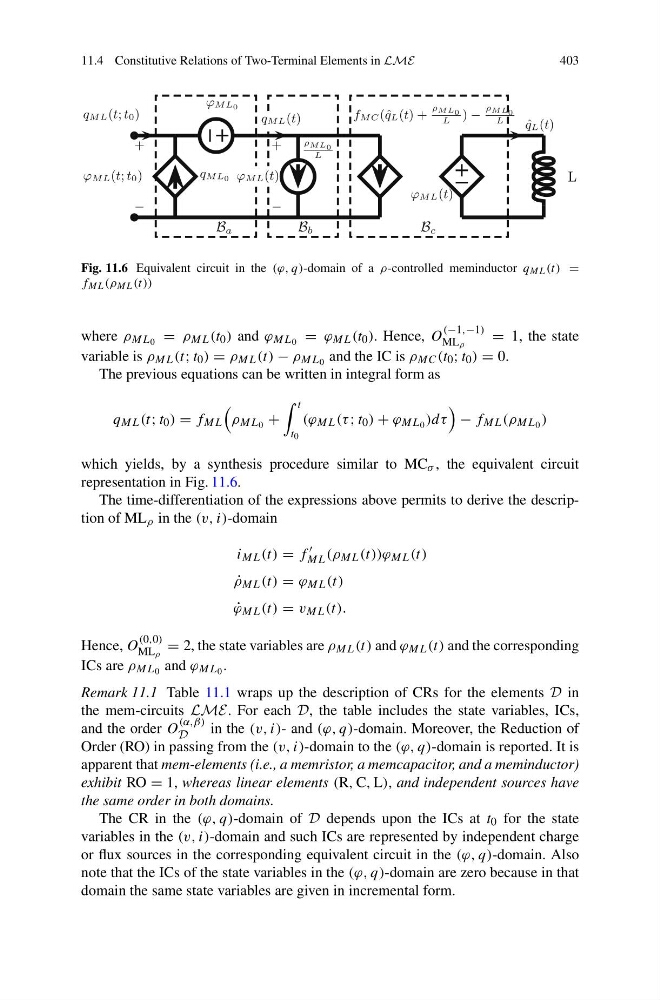
Fig. 11.6 Equivalent circuit in the (ϕ, q)-domain of a ρ-controlled meminductor q ML (t) =
f ML (ρ ML (t))
where ρ ML 0 = ρ ML (t 0 ) and ϕ ML 0 = ϕ ML (t 0 ). Hence, O
(−1,−1)
ML ρ
= 1, the state
variable is ρ ML (t; t 0 ) = ρ ML (t) − ρ ML 0 and the IC is ρ MC (t 0 ; t 0 ) = 0.
The previous equations can be written in integral form as
q ML (t; t 0 ) = f ML
ρ ML 0 +
t
t 0
(ϕ ML (τ ; t 0 ) + ϕ ML 0 )dτ
− f ML (ρ ML 0 )
which yields, by a synthesis procedure similar to MC σ , the equivalent circuit
representation in Fig. 11.6.
The time-differentiation of the expressions above permits to derive the description of ML ρ in the (v, i)-domain
i ML (t) = f
ML (ρ ML (t))ϕ ML (t)
˙
ρ ML (t) = ϕ ML (t)
˙
ϕ ML (t) = v ML (t).
Hence, O
(0,0)
ML ρ
= 2, the state variables are ρ ML (t) and ϕ ML (t) and the corresponding
ICs are ρ ML 0 and ϕ ML 0 .
Remark 11.1 Table 11.1 wraps up the description of CRs for the elements D in
the mem-circuits LME. For each D, the table includes the state variables, ICs,
and the order O
(α,β)
D
in the (v, i)- and (ϕ, q)-domain. Moreover, the Reduction of
Order (RO) in passing from the (v, i)-domain to the (ϕ, q)-domain is reported. It is
apparent that mem-elements (i.e., a memristor, a memcapacitor, and a meminductor)
exhibit RO = 1, whereas linear elements (R, C, L), and independent sources have
the same order in both domains.
The CR in the (ϕ, q)-domain of D depends upon the ICs at t 0 for the state
variables in the (v, i)-domain and such ICs are represented by independent charge
or flux sources in the corresponding equivalent circuit in the (ϕ, q)-domain. Also
note that the ICs of the state variables in the (ϕ, q)-domain are zero because in that
domain the same state variables are given in incremental form.
403
qML 0
ϕML 0
ρ ML 0
L
fMC(ˆ qL(t) +
ρ ML 0
L
) −
ρ ML 0
L
ϕML(t)
L
B a
B b
B c
qML(t; t0)
qML(t)
+
−
ϕML(t)
+
−
ϕML(t; t0)
ˆ
qL(t)
Fig. 11.6 Equivalent circuit in the (ϕ, q)-domain of a ρ-controlled meminductor q ML (t) =
f ML (ρ ML (t))
where ρ ML 0 = ρ ML (t 0 ) and ϕ ML 0 = ϕ ML (t 0 ). Hence, O
(−1,−1)
ML ρ
= 1, the state
variable is ρ ML (t; t 0 ) = ρ ML (t) − ρ ML 0 and the IC is ρ MC (t 0 ; t 0 ) = 0.
The previous equations can be written in integral form as
q ML (t; t 0 ) = f ML
ρ ML 0 +
t
t 0
(ϕ ML (τ ; t 0 ) + ϕ ML 0 )dτ
− f ML (ρ ML 0 )
which yields, by a synthesis procedure similar to MC σ , the equivalent circuit
representation in Fig. 11.6.
The time-differentiation of the expressions above permits to derive the description of ML ρ in the (v, i)-domain
i ML (t) = f
ML (ρ ML (t))ϕ ML (t)
˙
ρ ML (t) = ϕ ML (t)
˙
ϕ ML (t) = v ML (t).
Hence, O
(0,0)
ML ρ
= 2, the state variables are ρ ML (t) and ϕ ML (t) and the corresponding
ICs are ρ ML 0 and ϕ ML 0 .
Remark 11.1 Table 11.1 wraps up the description of CRs for the elements D in
the mem-circuits LME. For each D, the table includes the state variables, ICs,
and the order O
(α,β)
D
in the (v, i)- and (ϕ, q)-domain. Moreover, the Reduction of
Order (RO) in passing from the (v, i)-domain to the (ϕ, q)-domain is reported. It is
apparent that mem-elements (i.e., a memristor, a memcapacitor, and a meminductor)
exhibit RO = 1, whereas linear elements (R, C, L), and independent sources have
the same order in both domains.
The CR in the (ϕ, q)-domain of D depends upon the ICs at t 0 for the state
variables in the (v, i)-domain and such ICs are represented by independent charge
or flux sources in the corresponding equivalent circuit in the (ϕ, q)-domain. Also
note that the ICs of the state variables in the (ϕ, q)-domain are zero because in that
domain the same state variables are given in incremental form.