

396
11 Nonlinear Dynamics of Circuits with Mem-Elements
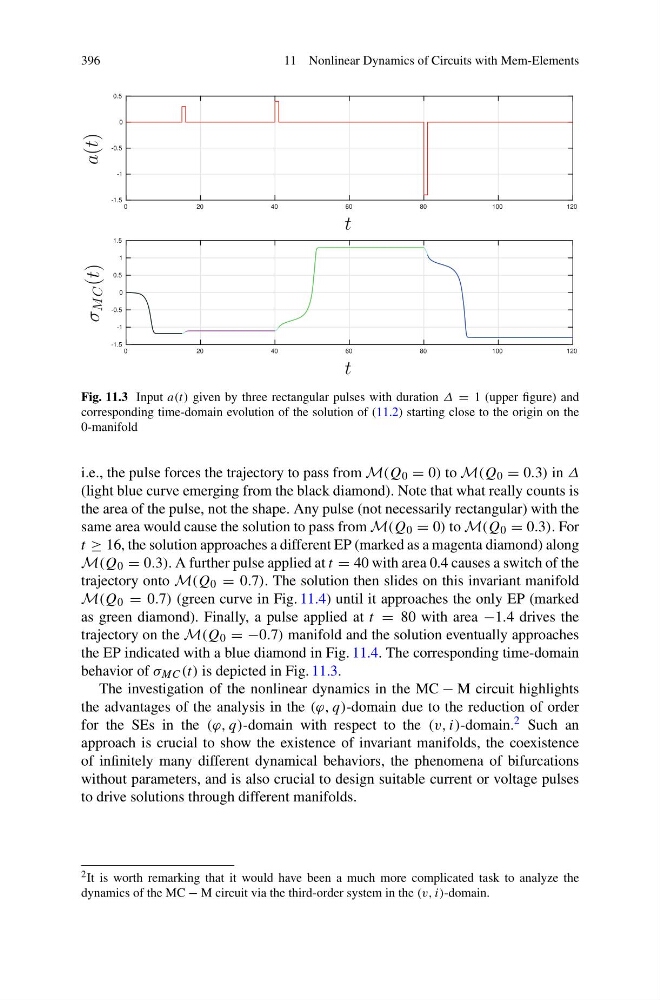
Fig. 11.3 Input a(t) given by three rectangular pulses with duration Δ = 1 (upper figure) and
corresponding time-domain evolution of the solution of (11.2) starting close to the origin on the
0-manifold
i.e., the pulse forces the trajectory to pass from M(Q 0 = 0) to M(Q 0 = 0.3) in Δ
(light blue curve emerging from the black diamond). Note that what really counts is
the area of the pulse, not the shape. Any pulse (not necessarily rectangular) with the
same area would cause the solution to pass from M(Q 0 = 0) to M(Q 0 = 0.3). For
t ≥ 16, the solution approaches a different EP (marked as a magenta diamond) along
M(Q 0 = 0.3). A further pulse applied at t = 40 with area 0.4 causes a switch of the
trajectory onto M(Q 0 = 0.7). The solution then slides on this invariant manifold
M(Q 0 = 0.7) (green curve in Fig. 11.4) until it approaches the only EP (marked
as green diamond). Finally, a pulse applied at t = 80 with area −1.4 drives the
trajectory on the M(Q 0 = −0.7) manifold and the solution eventually approaches
the EP indicated with a blue diamond in Fig. 11.4. The corresponding time-domain
behavior of σ MC (t) is depicted in Fig. 11.3.
The investigation of the nonlinear dynamics in the MC − M circuit highlights
the advantages of the analysis in the (ϕ, q)-domain due to the reduction of order
for the SEs in the (ϕ, q)-domain with respect to the (v, i)-domain. 2 Such an
approach is crucial to show the existence of invariant manifolds, the coexistence
of infinitely many different dynamical behaviors, the phenomena of bifurcations
without parameters, and is also crucial to design suitable current or voltage pulses
to drive solutions through different manifolds.
2 It is worth remarking that it would have been a much more complicated task to analyze the
dynamics of the MC − M circuit via the third-order system in the (v, i)-domain.
11 Nonlinear Dynamics of Circuits with Mem-Elements
Fig. 11.3 Input a(t) given by three rectangular pulses with duration Δ = 1 (upper figure) and
corresponding time-domain evolution of the solution of (11.2) starting close to the origin on the
0-manifold
i.e., the pulse forces the trajectory to pass from M(Q 0 = 0) to M(Q 0 = 0.3) in Δ
(light blue curve emerging from the black diamond). Note that what really counts is
the area of the pulse, not the shape. Any pulse (not necessarily rectangular) with the
same area would cause the solution to pass from M(Q 0 = 0) to M(Q 0 = 0.3). For
t ≥ 16, the solution approaches a different EP (marked as a magenta diamond) along
M(Q 0 = 0.3). A further pulse applied at t = 40 with area 0.4 causes a switch of the
trajectory onto M(Q 0 = 0.7). The solution then slides on this invariant manifold
M(Q 0 = 0.7) (green curve in Fig. 11.4) until it approaches the only EP (marked
as green diamond). Finally, a pulse applied at t = 80 with area −1.4 drives the
trajectory on the M(Q 0 = −0.7) manifold and the solution eventually approaches
the EP indicated with a blue diamond in Fig. 11.4. The corresponding time-domain
behavior of σ MC (t) is depicted in Fig. 11.3.
The investigation of the nonlinear dynamics in the MC − M circuit highlights
the advantages of the analysis in the (ϕ, q)-domain due to the reduction of order
for the SEs in the (ϕ, q)-domain with respect to the (v, i)-domain. 2 Such an
approach is crucial to show the existence of invariant manifolds, the coexistence
of infinitely many different dynamical behaviors, the phenomena of bifurcations
without parameters, and is also crucial to design suitable current or voltage pulses
to drive solutions through different manifolds.
2 It is worth remarking that it would have been a much more complicated task to analyze the
dynamics of the MC − M circuit via the third-order system in the (v, i)-domain.