

346
9 Memristor Cellular Neural Networks Computing in the Flux-charge Domain
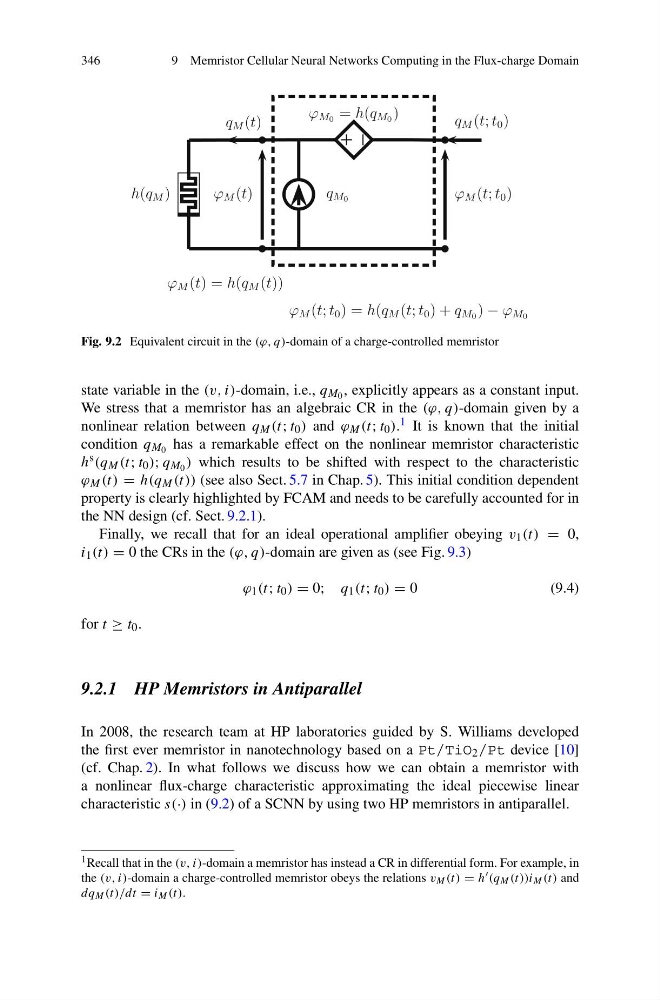
Fig. 9.2 Equivalent circuit in the (ϕ, q)-domain of a charge-controlled memristor
state variable in the (v, i)-domain, i.e., q M 0 , explicitly appears as a constant input.
We stress that a memristor has an algebraic CR in the (ϕ, q)-domain given by a
nonlinear relation between q M (t; t 0 ) and ϕ M (t; t 0 ). 1 It is known that the initial
condition q M 0 has a remarkable effect on the nonlinear memristor characteristic
h s (q M (t; t 0 ); q M 0 ) which results to be shifted with respect to the characteristic
ϕ M (t) = h(q M (t)) (see also Sect. 5.7 in Chap. 5). This initial condition dependent
property is clearly highlighted by FCAM and needs to be carefully accounted for in
the NN design (cf. Sect. 9.2.1).
Finally, we recall that for an ideal operational amplifier obeying v 1 (t) = 0,
i 1 (t) = 0 the CRs in the (ϕ, q)-domain are given as (see Fig. 9.3)
ϕ 1 (t; t 0 ) = 0; q 1 (t; t 0 ) = 0
(9.4)
for t ≥ t 0 .
9.2.1 HP Memristors in Antiparallel
In 2008, the research team at HP laboratories guided by S. Williams developed
the first ever memristor in nanotechnology based on a Pt/TiO 2 /Pt device [10]
(cf. Chap. 2). In what follows we discuss how we can obtain a memristor with
a nonlinear flux-charge characteristic approximating the ideal piecewise linear
characteristic s(·) in (9.2) of a SCNN by using two HP memristors in antiparallel.
1 Recall that in the (v, i)-domain a memristor has instead a CR in differential form. For example, in
the (v, i)-domain a charge-controlled memristor obeys the relations v M (t) = h (q M (t))i M (t) and
dq M (t)/dt = i M (t).
9 Memristor Cellular Neural Networks Computing in the Flux-charge Domain
Fig. 9.2 Equivalent circuit in the (ϕ, q)-domain of a charge-controlled memristor
state variable in the (v, i)-domain, i.e., q M 0 , explicitly appears as a constant input.
We stress that a memristor has an algebraic CR in the (ϕ, q)-domain given by a
nonlinear relation between q M (t; t 0 ) and ϕ M (t; t 0 ). 1 It is known that the initial
condition q M 0 has a remarkable effect on the nonlinear memristor characteristic
h s (q M (t; t 0 ); q M 0 ) which results to be shifted with respect to the characteristic
ϕ M (t) = h(q M (t)) (see also Sect. 5.7 in Chap. 5). This initial condition dependent
property is clearly highlighted by FCAM and needs to be carefully accounted for in
the NN design (cf. Sect. 9.2.1).
Finally, we recall that for an ideal operational amplifier obeying v 1 (t) = 0,
i 1 (t) = 0 the CRs in the (ϕ, q)-domain are given as (see Fig. 9.3)
ϕ 1 (t; t 0 ) = 0; q 1 (t; t 0 ) = 0
(9.4)
for t ≥ t 0 .
9.2.1 HP Memristors in Antiparallel
In 2008, the research team at HP laboratories guided by S. Williams developed
the first ever memristor in nanotechnology based on a Pt/TiO 2 /Pt device [10]
(cf. Chap. 2). In what follows we discuss how we can obtain a memristor with
a nonlinear flux-charge characteristic approximating the ideal piecewise linear
characteristic s(·) in (9.2) of a SCNN by using two HP memristors in antiparallel.
1 Recall that in the (v, i)-domain a memristor has instead a CR in differential form. For example, in
the (v, i)-domain a charge-controlled memristor obeys the relations v M (t) = h (q M (t))i M (t) and
dq M (t)/dt = i M (t).