

8.3 One-Dimensional Arrays of MCCs
327
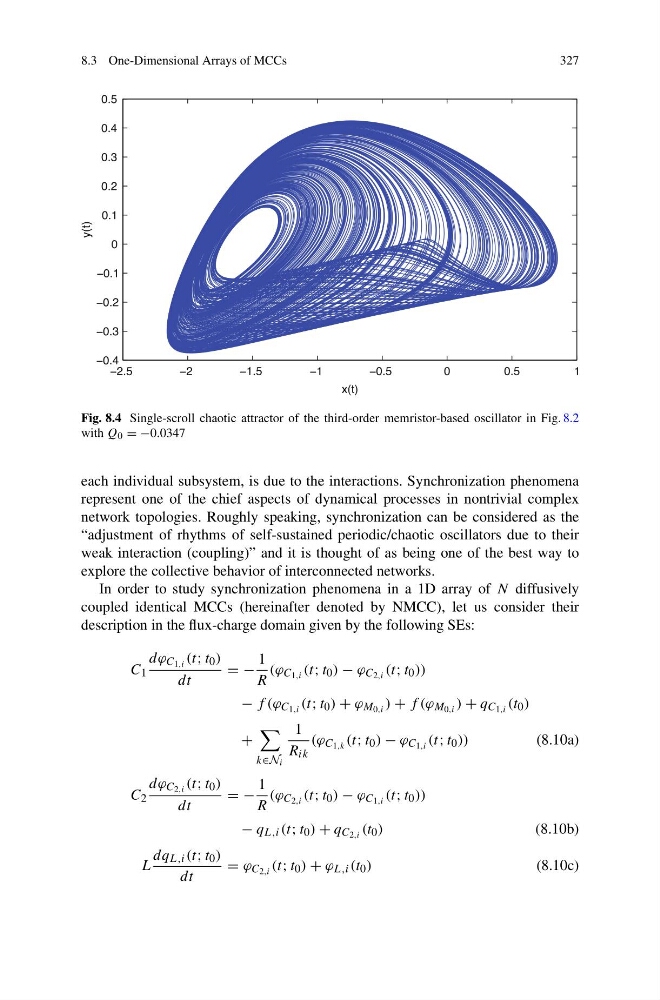
Fig. 8.4 Single-scroll chaotic attractor of the third-order memristor-based oscillator in Fig. 8.2
with Q 0 = −0.0347
each individual subsystem, is due to the interactions. Synchronization phenomena
represent one of the chief aspects of dynamical processes in nontrivial complex
network topologies. Roughly speaking, synchronization can be considered as the
“adjustment of rhythms of self-sustained periodic/chaotic oscillators due to their
weak interaction (coupling)” and it is thought of as being one of the best way to
explore the collective behavior of interconnected networks.
In order to study synchronization phenomena in a 1D array of N diffusively
coupled identical MCCs (hereinafter denoted by NMCC), let us consider their
description in the flux-charge domain given by the following SEs:
C 1
dϕ C 1,i (t; t 0 )
dt
= −
1
R
(ϕ C 1,i (t; t 0 ) − ϕ C 2,i (t; t 0 ))
− f (ϕ C 1,i (t; t 0 ) + ϕ M 0,i ) + f (ϕ M 0,i ) + q C 1,i (t 0 )
+
k∈N i
1
R ik
(ϕ C 1,k (t; t 0 ) − ϕ C 1,i (t; t 0 ))
(8.10a)
C 2
dϕ C 2,i (t; t 0 )
dt
= −
1
R
(ϕ C 2,i (t; t 0 ) − ϕ C 1,i (t; t 0 ))
− q L,i (t; t 0 ) + q C 2,i (t 0 )
(8.10b)
L
dq L,i (t; t 0 )
dt
= ϕ C 2,i (t; t 0 ) + ϕ L,i (t 0 )
(8.10c)
327
Fig. 8.4 Single-scroll chaotic attractor of the third-order memristor-based oscillator in Fig. 8.2
with Q 0 = −0.0347
each individual subsystem, is due to the interactions. Synchronization phenomena
represent one of the chief aspects of dynamical processes in nontrivial complex
network topologies. Roughly speaking, synchronization can be considered as the
“adjustment of rhythms of self-sustained periodic/chaotic oscillators due to their
weak interaction (coupling)” and it is thought of as being one of the best way to
explore the collective behavior of interconnected networks.
In order to study synchronization phenomena in a 1D array of N diffusively
coupled identical MCCs (hereinafter denoted by NMCC), let us consider their
description in the flux-charge domain given by the following SEs:
C 1
dϕ C 1,i (t; t 0 )
dt
= −
1
R
(ϕ C 1,i (t; t 0 ) − ϕ C 2,i (t; t 0 ))
− f (ϕ C 1,i (t; t 0 ) + ϕ M 0,i ) + f (ϕ M 0,i ) + q C 1,i (t 0 )
+
k∈N i
1
R ik
(ϕ C 1,k (t; t 0 ) − ϕ C 1,i (t; t 0 ))
(8.10a)
C 2
dϕ C 2,i (t; t 0 )
dt
= −
1
R
(ϕ C 2,i (t; t 0 ) − ϕ C 1,i (t; t 0 ))
− q L,i (t; t 0 ) + q C 2,i (t 0 )
(8.10b)
L
dq L,i (t; t 0 )
dt
= ϕ C 2,i (t; t 0 ) + ϕ L,i (t 0 )
(8.10c)