

326
8 Complex Dynamics and Synchronization Phenomena in Arrays of Memristor. . .
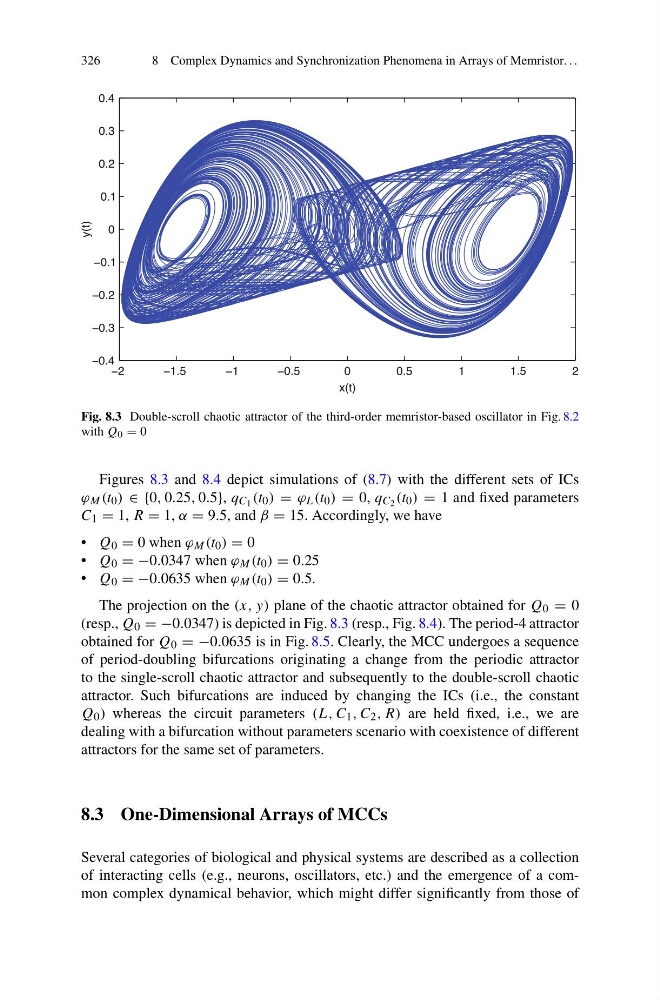
Fig. 8.3 Double-scroll chaotic attractor of the third-order memristor-based oscillator in Fig. 8.2
with Q 0 = 0
Figures 8.3 and 8.4 depict simulations of (8.7) with the different sets of ICs
ϕ M (t 0 ) ∈ {0, 0.25, 0.5}, q C 1 (t 0 ) = ϕ L (t 0 ) = 0, q C 2 (t 0 ) = 1 and fixed parameters
C 1 = 1, R = 1, α = 9.5, and β = 15. Accordingly, we have
• Q 0 = 0 when ϕ M (t 0 ) = 0
• Q 0 = −0.0347 when ϕ M (t 0 ) = 0.25
• Q 0 = −0.0635 when ϕ M (t 0 ) = 0.5.
The projection on the (x, y) plane of the chaotic attractor obtained for Q 0 = 0
(resp., Q 0 = −0.0347) is depicted in Fig. 8.3 (resp., Fig. 8.4). The period-4 attractor
obtained for Q 0 = −0.0635 is in Fig. 8.5. Clearly, the MCC undergoes a sequence
of period-doubling bifurcations originating a change from the periodic attractor
to the single-scroll chaotic attractor and subsequently to the double-scroll chaotic
attractor. Such bifurcations are induced by changing the ICs (i.e., the constant
Q 0 ) whereas the circuit parameters (L, C 1 , C 2 , R) are held fixed, i.e., we are
dealing with a bifurcation without parameters scenario with coexistence of different
attractors for the same set of parameters.
8.3 One-Dimensional Arrays of MCCs
Several categories of biological and physical systems are described as a collection
of interacting cells (e.g., neurons, oscillators, etc.) and the emergence of a common complex dynamical behavior, which might differ significantly from those of
8 Complex Dynamics and Synchronization Phenomena in Arrays of Memristor. . .
Fig. 8.3 Double-scroll chaotic attractor of the third-order memristor-based oscillator in Fig. 8.2
with Q 0 = 0
Figures 8.3 and 8.4 depict simulations of (8.7) with the different sets of ICs
ϕ M (t 0 ) ∈ {0, 0.25, 0.5}, q C 1 (t 0 ) = ϕ L (t 0 ) = 0, q C 2 (t 0 ) = 1 and fixed parameters
C 1 = 1, R = 1, α = 9.5, and β = 15. Accordingly, we have
• Q 0 = 0 when ϕ M (t 0 ) = 0
• Q 0 = −0.0347 when ϕ M (t 0 ) = 0.25
• Q 0 = −0.0635 when ϕ M (t 0 ) = 0.5.
The projection on the (x, y) plane of the chaotic attractor obtained for Q 0 = 0
(resp., Q 0 = −0.0347) is depicted in Fig. 8.3 (resp., Fig. 8.4). The period-4 attractor
obtained for Q 0 = −0.0635 is in Fig. 8.5. Clearly, the MCC undergoes a sequence
of period-doubling bifurcations originating a change from the periodic attractor
to the single-scroll chaotic attractor and subsequently to the double-scroll chaotic
attractor. Such bifurcations are induced by changing the ICs (i.e., the constant
Q 0 ) whereas the circuit parameters (L, C 1 , C 2 , R) are held fixed, i.e., we are
dealing with a bifurcation without parameters scenario with coexistence of different
attractors for the same set of parameters.
8.3 One-Dimensional Arrays of MCCs
Several categories of biological and physical systems are described as a collection
of interacting cells (e.g., neurons, oscillators, etc.) and the emergence of a common complex dynamical behavior, which might differ significantly from those of