

328
8 Complex Dynamics and Synchronization Phenomena in Arrays of Memristor. . .
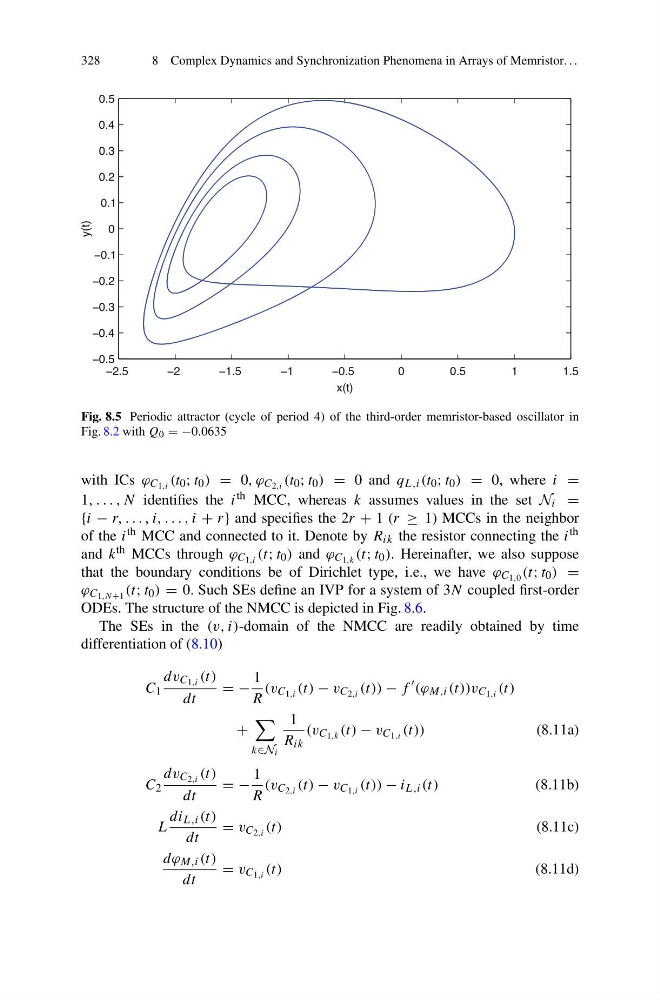
Fig. 8.5 Periodic attractor (cycle of period 4) of the third-order memristor-based oscillator in
Fig. 8.2 with Q 0 = −0.0635
with ICs ϕ C 1,i (t 0 ; t 0 ) = 0, ϕ C 2,i (t 0 ; t 0 ) = 0 and q L,i (t 0 ; t 0 ) = 0, where i =
1, . . . , N identifies the i th MCC, whereas k assumes values in the set N i =
{i − r, . . . , i, . . . , i + r} and specifies the 2r + 1 (r ≥ 1) MCCs in the neighbor
of the i th MCC and connected to it. Denote by R ik the resistor connecting the i th
and k th MCCs through ϕ C 1,i (t; t 0 ) and ϕ C 1,k (t; t 0 ). Hereinafter, we also suppose
that the boundary conditions be of Dirichlet type, i.e., we have ϕ C 1,0 (t; t 0 ) =
ϕ C 1,N+1 (t; t 0 ) = 0. Such SEs define an IVP for a system of 3N coupled first-order
ODEs. The structure of the NMCC is depicted in Fig. 8.6.
The SEs in the (v, i)-domain of the NMCC are readily obtained by time
differentiation of (8.10)
C 1
dv C 1,i (t)
dt
= −
1
R
(v C 1,i (t) − v C 2,i (t)) − f
(ϕ M,i (t))v C 1,i (t)
+
k∈N i
1
R ik
(v C 1,k (t) − v C 1,i (t))
(8.11a)
C 2
dv C 2,i (t)
dt
= −
1
R
(v C 2,i (t) − v C 1,i (t)) − i L,i (t)
(8.11b)
L
di L,i (t)
dt
= v C 2,i (t)
(8.11c)
dϕ M,i (t)
dt
= v C 1,i (t)
(8.11d)
8 Complex Dynamics and Synchronization Phenomena in Arrays of Memristor. . .
Fig. 8.5 Periodic attractor (cycle of period 4) of the third-order memristor-based oscillator in
Fig. 8.2 with Q 0 = −0.0635
with ICs ϕ C 1,i (t 0 ; t 0 ) = 0, ϕ C 2,i (t 0 ; t 0 ) = 0 and q L,i (t 0 ; t 0 ) = 0, where i =
1, . . . , N identifies the i th MCC, whereas k assumes values in the set N i =
{i − r, . . . , i, . . . , i + r} and specifies the 2r + 1 (r ≥ 1) MCCs in the neighbor
of the i th MCC and connected to it. Denote by R ik the resistor connecting the i th
and k th MCCs through ϕ C 1,i (t; t 0 ) and ϕ C 1,k (t; t 0 ). Hereinafter, we also suppose
that the boundary conditions be of Dirichlet type, i.e., we have ϕ C 1,0 (t; t 0 ) =
ϕ C 1,N+1 (t; t 0 ) = 0. Such SEs define an IVP for a system of 3N coupled first-order
ODEs. The structure of the NMCC is depicted in Fig. 8.6.
The SEs in the (v, i)-domain of the NMCC are readily obtained by time
differentiation of (8.10)
C 1
dv C 1,i (t)
dt
= −
1
R
(v C 1,i (t) − v C 2,i (t)) − f
(ϕ M,i (t))v C 1,i (t)
+
k∈N i
1
R ik
(v C 1,k (t) − v C 1,i (t))
(8.11a)
C 2
dv C 2,i (t)
dt
= −
1
R
(v C 2,i (t) − v C 1,i (t)) − i L,i (t)
(8.11b)
L
di L,i (t)
dt
= v C 2,i (t)
(8.11c)
dϕ M,i (t)
dt
= v C 1,i (t)
(8.11d)